
01 August 25

The official told a local TV reporter at the scene what was about to happen. “He can either give us a license,” he said, “or we’ll smash the fucking window out and drag him out.” Then, as the driver refused to exit the car, officers broke the glass.
It was one of nearly 50 documented instances of immigration agents breaking vehicle windows that ProPublica has identified from social media, local news accounts, lawsuits and interviews since President Donald Trump took office six months ago. Using the same methods, we found just eight in the previous decade. Neither number is comprehensive. The government releases no relevant statistics.
Use-of-force experts and former Immigration and Customs Enforcement insiders say the tactic was rarely used during previous administrations. They say there is no known policy change greenlighting agents’ smashing of windows. Rather, it’s a part of a broader shattering of norms.
There are arrest quotas, and they are increasingly aggressive. “There’s been an emphasis placed on speed and numbers that did not exist before,” says Deborah Fleischaker, who served as ICE chief of staff under President Joe Biden.
Officers who break glass aren’t being disciplined — they’re being promoted. The official from Maryland, Matthew Elliston, now occupies a senior position at headquarters and oversees field operations on the East Coast. On the other side of the country, a Border Patrol chief who also embraced the tactic, Gregory Bovino, was put in charge of sweeps in Los Angeles. (Neither answered ProPublica’s questions.)
ICE says its officers use a “minimum amount of force” when making arrests. You can judge for yourself.
Agents break car windows even when sobbing children or pregnant women are inside.
“She is pregnant!” a man yelled as his wife, a U.S. citizen, filmed from inside their Chevy. “Is pregnant! Is pregnant!”
Officers smashed through three windows to arrest Jeison Ruiz Rodriguez and his younger brother César in early March. The video was not the first under Trump — at least nine broken-windows arrests preceded it this year, some documented by Facebook posts or local reporters or Spanish-language TV.
On Mother’s Day in the Boston suburbs, ICE and FBI officers stopped a family on their way to church, threatening Daniel Flores-Martinez with what the family and a bystander believe was a gun. His three children and U.S. citizen wife sobbed in the car. Agents broke the window, forced Martinez to his knees, then slammed him roughly to the ground.
One of the children is a toddler. Another is a 12-year old with severe disabilities.
The incident was captured by then-high school student Kenneth Santizo, who was nearby waiting for his bus. “All I could hear was kids crying,” Santizo said.
People reported bloodied faces, bleeding arms and other injuries after agents smashed through the glass.
Last month, a bystander filmed several masked agents using a baton to break a rear window of a white pickup truck, taking the driver to the ground and pressing his head forcefully into the asphalt. The man, last seen in the video bleeding from the head, has not been identified.
On a residential street in May, agents smashed through two windows of a Ford Focus to arrest the two men inside. A neighbor filmed from inside their home as one man, later identified by WBUR as Guatemalan immigrant Kiender Lopez-Lopez, struggled with masked agents. (He had previously been charged with domestic violence but was not convicted.) Several of them tackled him on the sidewalk while he screamed for help. The government released no information about the arrest, despite repeated requests from WBUR and ProPublica.
At least 10 people have said they were injured this year during broken-windows arrests. César Ruiz Rodriguez had an open wound at the back of his head when he arrived at detention from Spokane, Washington, his lawyer said, and X-rays showed glass in the knees of his brother Jeison. ICE claimed that the Nicaraguan-born brothers were members of the Venezuelan gang Tren de Aragua. Both men have denied any gang affiliation. We found that the brothers had been accused of threatening a family member, but prosecutors dropped the charges.
In Kentucky, agents stopped Martin Rivera and his girlfriend, Jennifer Gribben, a U.S. citizen, while the agents searched for a fugitive. “You said you’re looking for Garcia,” Rivera said in a scene the couple broadcast on Facebook Live and have since deleted. One of the agents replied, “And I found you instead.”
Then they smashed through the car’s window. Gribben later wrote on Facebook that she was beaten “brutally in my head” and that officers broke Rivera’s arm. She pleaded not guilty to charges of resisting arrest and third-degree assault stemming from the incident.
Near Detroit, masked ICE officers dragged 49-year-old Veronica Ramirez Verduzco, an aide at an assisted-living center, out of her car through a window they broke. Ramirez Verduzco still had bloody, jagged scratches up and down her forearms five days later, her lawyer said.
ICE told ProPublica that agents are allowed to use force when civilians don’t follow their commands. But Ramirez Verduzco and others said they were given little time to respond before officers broke their windows.
“They didn’t give me a chance to understand what was going on,” she said in an interview shortly before she was ordered deported to Mexico.
Officials claim they target the “worst of the worst.” But they’re breaking windows to arrest people who don’t have criminal records.
In one case, ICE said a 51-year-old mom was connected to the MS-13 gang.
This spring, ICE arrested Elsy Noemi Berrios after breaking her car window, scattering glass over her patterned dress. Her teenage daughter screamed and cried as she filmed with her cellphone. An officer helped Berrios shake off the glass and step out of the car. “Gracias,” she said. Then he put her in handcuffs.
After the video went viral and outrage spread, the agency put out a statement asserting that Berrios, a Salvadoran national, was a “known affiliate of the violent transnational street gang, MS-13.” Our review of judicial records — both federal and local — found no criminal history for Berrios and no other evidence to support this claim.
This July, in another widely circulated case, officers stopped an Iranian chiropractor and green-card applicant near Portland, Oregon. He was on his way to his toddler’s preschool. “There is a baby in the car,” the man said. They allowed him to continue to the school, then broke a window once the toddler was out. We found no criminal history for him.
Your car is a constitutional gray zone. It doesn’t have the same Fourth Amendment protections as homes. You can refuse to open the door of your home if officers don’t have a judicial warrant; you can’t refuse to step out of your car.
The Constitution still limits when officers can use force and how much they can use. But there are no firm rules. Should they shatter windows just minutes or seconds after making a vehicle stop? Should they drag someone through broken glass when they could wait to make the arrest another day?
“Use of force has to be objectively reasonable,” says Bruce-Alan Barnard, a retired Fourth Amendment instructor at the Federal Law Enforcement Training Center in Georgia, where ICE officers train. The problem with “objectively reasonable,” Barnard says, is that “it’s an oxymoron. What’s reasonable to you might not be reasonable to me.”
Immigration officers are given little guidance on whether or how they should breach car windows, former federal law enforcement officials told ProPublica. The tactic was never prohibited. It was just rare.
It isn’t mentioned in the government’s use-of-force guidelines for immigration agents. And past instructors and students at the Georgia training center say it was never part of the curriculum.
Often, civilians whose windows are smashed aren’t agents’ intended targets. Some are American citizens.
In Massachusetts this spring, a tall ICE officer in a trucker’s cap swung a sledgehammer to arrest Juan Francisco Méndez, the Guatemalan asylum-seeker inside. Officers had stopped the car looking for an “Antonio,” his wife told the New Bedford Light. Méndez has no known criminal record.
He and his wife told officers they were waiting to exit the car until their lawyer could arrive. Before the sledgehammer swung, one of the officers threatened them in broken Spanish: “We can do it two ways. Hard or easy?”
An ICE spokesperson told ProPublica that the agency “concurs with the actions deemed appropriate by the officers on the scene.”
In June, a 15-year-old girl and her mother watched as ICE agents stopped a work truck and roughly arrested several men.
“For the last time, are you opening this, or no?” an officer warned before he broke the glass. “I’m fucking blasting it right now.”
While the teenager yelled and asked the officers if they had a warrant, the driver turned toward her camera and said he was a U.S. citizen.
Early this year, border czar Tom Homan made one of his now-familiar threats to a sanctuary jurisdiction, promising to bring “hell” to the Boston area. To do that, his immigration officers needed help.
An ICE press release soon touted its collaboration with a half-dozen other federal agencies, including the Coast Guard and State Department, on a monthlong crackdown in the region, dubbed Operation Patriot. (The Coast Guard confirmed that it helped transport people arrested on Martha’s Vineyard and Nantucket. The State Department also confirmed its role. Neither commented further.)
In May, bystanders filmed in nearby Waltham, Massachusetts, as masked agents from the Drug Enforcement Administration and Homeland Security Investigations, along with agents from unidentified agencies, questioned two men parked in a work van. “Show me you’re here legally and I’ll leave you alone,” said one officer, identified on his vest only as “federal agent.”
In the months since, federal officers from other agencies have continued to participate in immigration operations around the country.
We don’t know who these masked officers are or, often, even which agency they’re from, or who can be held accountable.
What happens if officers cross the line? Usually very little.
Paths to suing federal officers are even more limited than for police officers, making it particularly hard for immigrants to hold officers accountable for any misconduct.
“The deck is stacked against them,” says Fleischaker, the former top ICE official.
Even if a judge decides to award damages, that usually won’t change what happens — or already happened — in the separate system of immigration court. Evidence of a violent arrest rarely stops a deportation, and if people have already been deported, it won’t bring them back.
In the instance of the family detained on Mother’s Day, they filed a complaint over “unlawful and excessive” actions — but the father has already been deported to Mexico. (The government has not responded to the complaint or to ProPublica’s questions about it.) A precursor to a full civil lawsuit, the complaint says their 3-year-old now tells people, “Police broke the window and threw daddy on the floor.”
Settlements in similar cases have been small. A California woman detained by Border Patrol in 2016 after agents broke her car window while her children screamed settled two years later for $25,000.
When we asked the White House detailed questions about the tactic and specific incidents, it stood by officers’ conduct. “ProPublica is a left-wing rag that is shamelessly doing the bidding of criminal illegal aliens,” deputy press secretary Abigail Jackson said in a statement. “ICE Officers are heroically getting these violent illegal aliens off of American streets with the utmost professionalism.”
Department of Homeland Security Assistant Secretary Tricia McLaughlin also defended the tactic in response to questions about Border Patrol. Officers “may break vehicle windows” if occupants don’t follow their commands, she said. In June, an ICE spokesperson told ProPublica, “Our officers follow their training to use the minimum amount of force necessary to resolve situations in a manner that ensures the success of the operation and prioritizes safety.”
Other agencies whose officers were involved in incidents we documented — FBI; DEA; and the Bureau of Alcohol, Tobacco, Firearms and Explosives — did not respond or declined to comment on specific cases.
Officers are arresting bystanders, too. But they’re still filming.
Bystanders who film these videos do so at no small risk to themselves.
Job Garcia, a 37-year-old Ph.D. student and U.S. citizen, was filming an immigration raid in June near a Home Depot in Los Angeles when Border Patrol agents broke the window of a truck to detain the man inside. Then, agents turned on Garcia.
The Mexican American Legal Defense and Educational Fund filed a complaint against the federal government on Garcia’s behalf in July, alleging agents detained him in retaliation for recording and because he was Latino.
In response to our questions, DHS’ McLaughlin claimed Garcia “assaulted and verbally harassed” Border Patrol. (No assault is shown in the video.) McLaughlin added, “He was subdued and arrested for assault on a federal agent.”
Kayden Goode, the 15-year-old girl who filmed the arrest of the U.S. citizen in Rochester, New York, said she felt compelled to record despite the risk.
"I don’t think it was right,” Goode said. “Just because something is legal doesn’t mean that it’s right.”
Sometimes just the threat of window smashing is enough. One Afghan asylum-seeker who stepped out of a car after ICE threatened his window said in an affidavit, “It reminded me of the Taliban.”
But this all may be only the beginning. Shortly before Trump’s flagship domestic policy bill passed in early July, border czar Tom Homan told a conservative Christian conference that immigration agencies were just getting started. The law will triple the size of ICE and add thousands more immigration agents.
“You think we’re arresting people now?” Homan said. “You wait.”
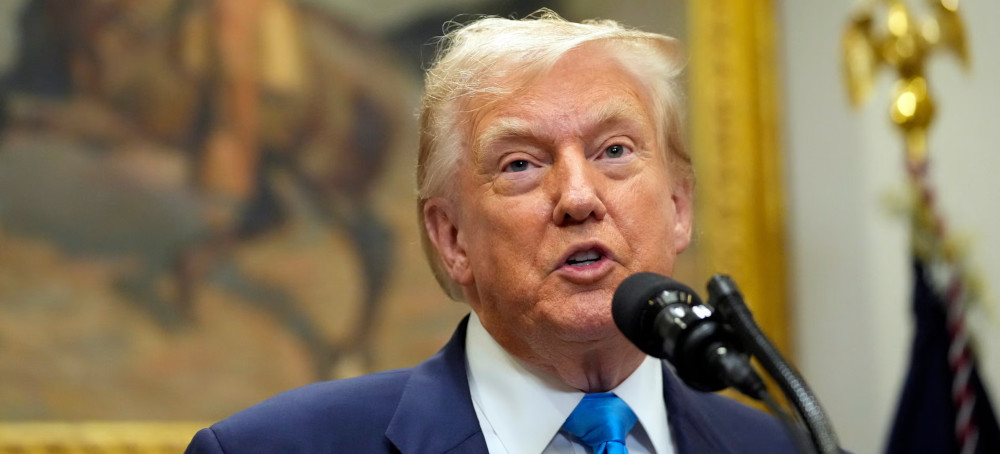 Donald Trump in the White House Roosevelt Room earlier this week. (photo: AP)
Six out of 10 Americans fault president for financial struggles and eight out of 10 worry about tariffs’ impact
Six out of 10 Americans place blame on the Trump administration for driving up their cost of living, according to a poll conducted by Morning Consult for the Century Foundation, which asked 2,007 Americans how they are managing the high cost of living in the US economy, who they think is to blame and what are the solutions.
Sixty three per cent said Trump had had a negative impact on grocery prices, and 61% said he had had a negative impact on the cost of living. Nearly half, 49%, said the Trump administration had had a negative impact on their finances. Nearly eight out of 10 Americans, including 70% of Republicans, fear that Trump’s tariffs will increase the price of everyday goods.
“Donald Trump has simultaneously raised prices on everyday goods through a reckless approach to tariffs, a decimation of programs that help Americans afford healthcare, education, food and childcare, and then kneecapping federal regulators who keep banks and other big businesses from swindling consumers,” said Julie Margetta Morgan, president of the Century Foundation.
“This has created an alarming set of market conditions. Americans are left on their own to face high prices and low earnings, are building their own safety nets from a web of financial products, credit cards, buy now, pay later loans, payday loans and student debt, and companies have been given the green light to manipulate these products to boost their own profits without having to worry about following the law.”
According to the poll, more than six out of 10 Americans said it had become more difficult to find a good paying job, buy a home and afford childcare.
More than four out of five Americans, 83%, said they were concerned about the cost of groceries, with 46% saying they were very concerned. Some 47% said they were worried about being able to pay their rent or mortgage, 64% said they were worried about affording an unexpected medical expense.
About 48% said they believed they would have trouble affording an unexpected $500 bill without borrowing. One in four said it would be “very difficult”.
A quarter of those surveyed said they spent at least three hours a day worrying about their finances and ability to afford basic necessities. Another 25% of respondents said they or someone in their household had skipped meals in the past year in order to make ends meet, and 26% said they had fallen behind on their monthly bills over the past year.
Americans also fear things are getting worse economically, with 76% of those polled saying they fear a looming economic recession.
Corporations and billionaires were seen as a big factor behind this financial anxiety, with 51% saying they believe corporations have had an active role in making life more difficult for average people over the past 25 years, and 52% saying billionaires have made life tougher.
Half of those polled also believe congressional Republicans have made life more difficult, with 41% believing Democrats have made life more difficult.
“Millions of Americans, across parties, across backgrounds, are deeply anxious, and they’re struggling to afford basics like housing and health care. Donald Trump is making these struggles worse,” said Rachel West, senior fellow at the Century Foundation.
“Americans believe the outsized influence of corporations and the wealthy has made their lives harder, and the risks they’re taking to cope with high costs like taking on debt and tapping into their savings should sound an alarm for policymakers.”
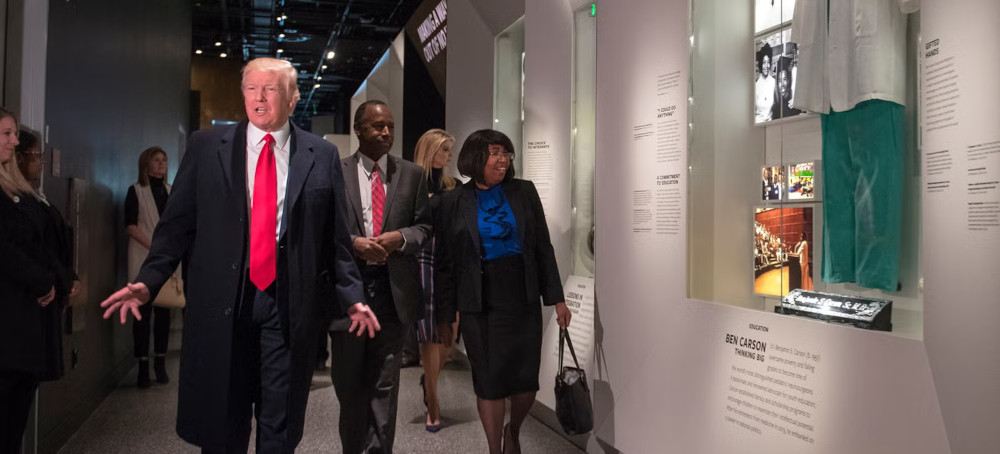 President Trump pictured touring the Smithsonian National Museum of African American History & Culture in DC in 2017. (photo: Getty)
The arts institution has, for months, faced mounting pressure from the president to conform to the removal of ‘improper, divisive or anti-American ideology’
Orders to remove an impeachment reference to the commander-in-chief in the exhibit, “A Glorious Burden”, came as part of a recent content review, triggered by mounting pressure from the White House to make changes to the arts institution, according to a source familiar withThe Washington Post.
The president was impeached twice during his first term in office, the first due to being accused of breaking the law by pressuring Ukraine's leader to dig up damaging information on the Biden family.
The second impeachment came after he was charged with "incitement of insurrection" regarding the deadly storming of Congress on January 6, 2021.
In each case, he was acquitted on all counts by the Senate. In both votes, the Republican party held the majority.
The Smithsonian Institution is the world’s largest museum complex, consisting of 21 museums, the National Portrait Gallery, and the National Zoo in Washington, D.C.
In May, Trump called for the firing of Kim Sajet, the director of the National Portrait Gallery in Washington, D.C., labelling her a supporter of persity, equity, and inclusion policies, and claiming she was unsuitable for the role.
She resigned from her post just two weeks later, following the president’s criticism on Truth Social.
“Her replacement will be named shortly. Thank you for your attention to this matter!” Trump wrote.
Sajet had led the gallery “with passion and creativity” for 12 years, according to the secretary of the Smithsonian Institution, Lonnie Bunch, who wrote the resignation memo.
Trump’s crackdown on the arts came in tandem with his March executive order that called for the removal of “improper, pisive or anti-American ideology” from the network of Smithsonian museums, The Wall Street Journal reported.
However, even prior to the order, the Smithsonian canceled its persity, equity, and inclusion programs to comply with Trump’s anti-DEI vision in January.
The latest change sees the removal of a temporary label that described Trump’s impeachment, notices that had been on display since September 2021.
The museum has now placed a 2008 label on the exhibit, stating that “only three presidents have seriously faced removal,” referring to Andrew Johnson, Bill Clinton, and Richard Nixon, according to The Post. Nixon would have faced impeachment had he not resigned.
The Smithsonian released a statement after the report that said, “a future and updated exhibit will include all impeachments.”
“In reviewing our legacy content recently, it became clear that the ’Limits of Presidential Power’ section in The American Presidency: A Glorious Burden exhibition needed to be addressed,” the spokesperson told The Post.
They explained that the section of the exhibition covered Congress, the Supreme Court, Impeachment, and Public Opinion, noting that the change was necessary because “other topics in this section had not been updated since 2008.”
The institution said it was appropriate to restore the impeachment case to its 2008 appearance.
Trump’s intervention in the arts space follows a string of incidents where he has sought to alter cultural institutions to align with MAGA values.
In February, he usurped the position of chair of the John F. Kennedy Center for the Performing Arts in Washington, D.C. – a hub lauded for its bipartisan approach.
“NO MORE DRAG SHOWS, OR OTHER ANTI-AMERICAN PROPAGANDA”, he wrote on Truth Social at the time.
MAGA has long been particularly critical of the center, and Republicans have now proposed a bill to rename the center after Trump.
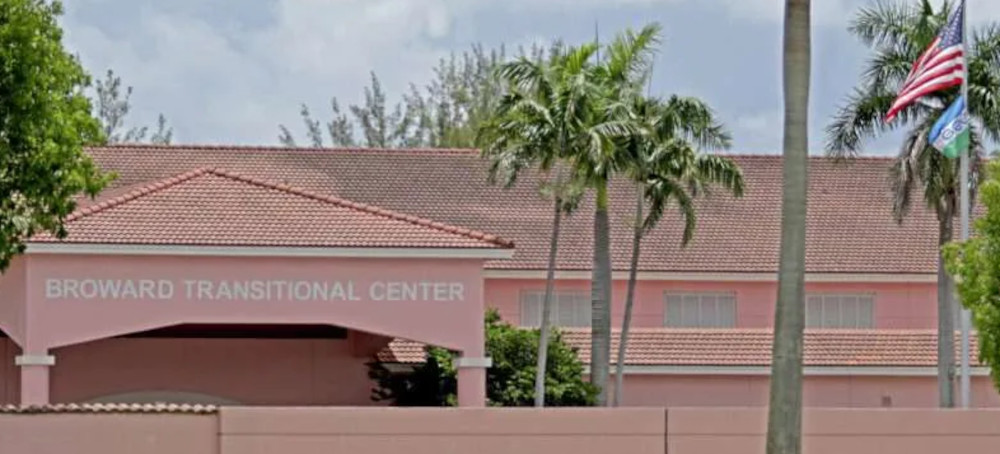 Questions about the death of Marie Blaise at a South Florida ICE detention center have lingered since she collapsed in April. (photo: Newscom)
Marie Ange Blaise, a 44-year-old Haitian national, died on April 25 at the Broward Transitional Center (BTC)—a privately run facility in Pompano Beach, Florida, that contracts with Immigration and Customs Enforcement (ICE). A medical examiner's report obtained by Reason through a public records request concluded that she died of natural causes from cardiovascular disease.
An investigator for the Broward County Medical Examiner's Office interviewed Blaise's son, Kervens Blaise, who said his mother reported being denied medical care.
"I asked Kervens when he last spoke with his mother and said on Friday, 4/25/25 at 2:54 pm (California time)," the investigator wrote in the report. "At that time, did his mother complained of any health issues and he states she complained of having chest pains and abdominal cramps, and when she asked the detention staff to see a physician, they refused her. Kervens states his mother has been experiencing the chest pains for about a month now."
Blaise also reportedly told several other detainees that she wasn't feeling well that day.
Blaise was first detained by ICE on February 14 and was transferred to several different ICE detention centers before being sent to BTC in early April.
An official ICE narrative of Blaise's medical history during her detention states that she had a history of high blood pressure and kidney disease, and that she repeatedly refused to take prescribed medication. According to the ICE report, Blaise saw medical providers three times between her arrival at BTC on April 5 and her death on April 25.
However, BTC detainees who witnessed Blaise collapse said there was also a slow staff response.
In a report on inhumane conditions at South Florida ICE detention centers recently published by several human rights and legal aid groups, a former BTC detainee identified only as "Rosa" told researchers that she heard a scream from a nearby cell and saw Blaise kneeling on the ground.
"We started yelling for help, but the guards ignored us," Rosa told the report authors. "Finally, one officer approached slowly, looked at her without intervening, and then walked away. After that, it took eight minutes for the medical provider to arrive, and then another 15 or 20 before the rescue team came. By then, she was not moving."
Lawyers and detainees have repeatedly alleged medical neglect by staff at ICE facilities in South Florida, including BTC, the Krome Detention Center, and the Federal Detention Center Miami.
Harpinder Chauhan, a British entrepreneur who was detained by ICE this spring and eventually deported, told the report's researchers that BTC staff regularly refused to give him his insulin.
Chauhan eventually collapsed while standing in the dinner line at BTC, leading to him being hospitalized for three days. Chauhan's son said that hospital and ICE staff would not give him any information on his father's condition, and he eventually learned his father had been registered under a false name.
A former detainee, whose lawyer requested that he only be identified as "A.S.," tells Reason he spent four days in an overcrowded holding cell with 50 to 60 other people at the Krome Detention Center.
"There was a dude, he passed out. He was crying for his medicine for like two or three days," A.S. says. "They didn't give him his medicine until he finally passed out, right before they were gonna put him on the plane."
Another man detained at Krome told the report's authors that the only way he could get guards to believe he was suffering from an excruciating hernia was to throw himself on the floor. Prison staff eventually wheeled him to the medical team, where the doctor on duty told him he "likely just had gas" and offered him "a Pepto-Bismol and two Tylenols." The detainee refused to leave until the doctor eventually agreed to send him to a hospital, where he received a CAT scan that found he had a strangulated abdominal wall hernia. "The doctor [at the hospital] told me that if I had not come in then, my intestines would have likely ruptured," the man said.
Blaise's death led to condemnations and calls for investigations from Florida Democrats, such as Rep. Frederica Wilson (D–Miami Gardens).
"Marie is just an example of what is going to continue to happen," Wilson said after touring BTC in May. "This is something we're going to continue to see. It's going to get more crowded. It's going to continue to have more deaths. It's going to continue to have more children without their parents."
The post Woman Who Died of Heart Disease in ICE Custody Reportedly Told Son She Wasn't Allowed to See Doctor for Chest Pains appeared first on Reason.com.
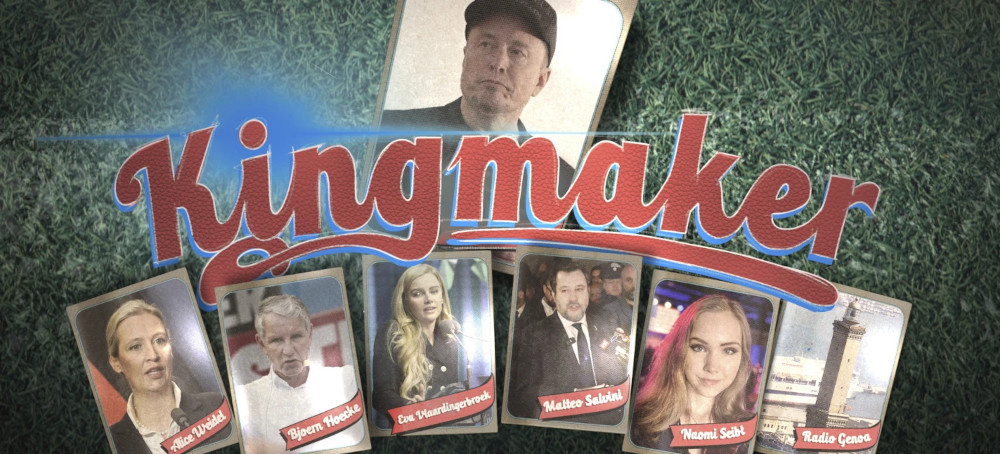 Musk’s influence on the platform he bought for $44 billion has made him a kingmaker at home and abroad. (photo: Marshall Ritzel/AP)
01 August 25
Take the German politician from a party whose own domestic intelligence agency has designated as extremist. Her daily audience on X surged from 230,000 to 2.2 million on days Musk interacted with her posts. She went on to lead her party to its best-ever electoral showing.
Or the anti-immigration activist in Britain, who was banned from Twitter and sentenced to 18 months in prison for contempt of court. Since Musk let him back on the platform in late 2023, he’s mentioned, reposted or replied to the billionaire more than 120 times on X — and gained nearly a million followers.
Even a little-known social-media influencer turned politician from Cyprus has benefited from the Musk effect. Before winning a surprise seat in the European Parliament, where he’s advocated for Musk, the influencer seemed to have one ambition: to hug the world’s richest man. He got his hug — and political endorsements. On days Musk has interacted with his account on X, the man’s audience exploded from just over 300,000 to nearly 10 million views.
Elon Musk may have tumbled from political grace in Washington -- he stepped down as an adviser to President Donald Trump in May and has since traded insults with the president -- but as he works to build his own political party, his power on X remains unchecked.
Musk’s influence on the platform he bought for $44 billion has made him a kingmaker at home and abroad. Among those he has chosen to cultivate are hard-right politicians and insurgent influencers across Europe, according to an Associated Press analysis of public data. His dominance, which has real-world financial and political impacts, is fueling concerns in Europe about foreign meddling -- not from Russia or China this time, but from the United States.
“Every alarm bell needs to ring,” said Christel Schaldemose, a vice president of the European Parliament who works on electoral interference and digital regulation. “We need to make sure that power is not unbalanced.”
In seeking to quantify Musk’s effect on European politics, The Associated Press analyzed more than 20,000 posts over a three-year period from 11 far-right European figures across six countries who frequently promote a hard-right political or social agenda and had significant interactions with Elon Musk since he purchased Twitter. Tens of thousands of posts by Musk on Twitter, now known as X, were also collected.
The AP used the records, obtained from data provider Bright Data, to analyze how Musk’s account interacted with the European influencers, and vice versa, and the extent to which Musk’s engagement boosted their reach.
These case studies are not meant to be representative of a broad universe; rather, they showcase the ways in which Musk’s engagement can have an impact on local influencers who share his views.
Due to limitations on data collection, the dataset is not a complete record of all posts made by these accounts. Even so, it captured at least 920 instances in which one of the European accounts tagged, replied or otherwise attempted to interact with Musk’s account, and at nearly 190 instances where Musk’s own posts interacted with the Europeans.
The AP also analyzed records of daily follower counts, using data from Social Blade, to measure any growth in the European accounts’ audience that occurred in the wake of Musk’s online interactions. This kind of analysis is no longer possible. In March, Social Blade removed X from its analytics, saying that X had increased its data access fees to prohibitive levels, making the platform harder to research.
Among those included in AP’s analysis are several people who have run into legal trouble in their own countries. An anti-immigrant agitator in the U.K., for example, was sentenced in October to 18 months in prison for violating a court order blocking him from making libelous allegations against a Syrian refugee. A German politician was convicted last year of knowingly using a Nazi slogan in a speech. An Italian vice premier was acquitted in December of illegally detaining 100 migrants aboard a humanitarian rescue ship.
Others examined by AP were an influencer known as the “shieldmaiden of the far-right;” a German activist dubbed the “anti-Greta Thunberg” now living in what amounts to political exile in Washington, D.C.; and two politicians who have advocated for the interests of Musk’s companies as those firms seek to expand in Europe.
AP’s analysis shows how Musk is helping unite nationalists across borders in common cause to halt migration, overturn progressive policies and promote an absolutist vision of free speech. While his efforts have sparked backlash in some countries, Musk’s promotion of a growing alliance of hard-right parties and individuals has helped rattle the foundation of a transatlantic bond that has guided U.S. and European relations for over eight decades.
Engagement from Musk does not guarantee a surge in followers or page views. But AP found it can have a huge impact, especially on up-and-coming influencers. One account that began with around 120,000 followers when Musk took over Twitter in October 2022 topped 1.2 million by January of this year. Seven other European accounts saw six-figure increases in their follower counts over the same period.
Most of the 11 accounts examined saw triple-digit percentage increases in their followers. Even some that grew more steadily on their own before Musk interacted with them saw their follower counts rise sharply after he began engaging with their posts. Similarly, on days Musk interacted with a post, its account saw its views soar — in most cases, accruing two to four times as many views, with a few seeing boosts 30 or 40 times their normal daily viewership.
Musk is not the only factor influencing the growth of these accounts, of course, but their rising fortunes are a measure of how the platform has evolved under his leadership. When Musk acquired X, he pledged to turn it into a haven for free speech, declaring himself a “free speech absolutist.” AP’s analysis adds to growing evidence that instead of serving as a neutral forum for free speech, X amplifies Musk’s speech.
This shift has given him sweeping power to direct people’s attention.
“There’s an extreme asymmetry in the way Musk is able to leverage and shape the platform,” said Timothy Graham, an associate professor in digital media at the Queensland University of Technology in Brisbane, Australia, who has studied data anomalies on X. “There’s an unequivocal sense when you go onto the site that you’re entering Musk’s kingdom.”
Musk’s megaphone: Bigger than Trump and Taylor Swift
Since he acquired Twitter in 2022, Musk has come to dominate the platform. His followers have more than doubled, to more than 220 million — growth so tremendous that it easily outpaced the other Top 10 accounts. Not even Taylor Swift has been able to keep up.
Indian Prime Minister Narendra Modi, whose followers grew by 21 million — or 25% — from October 2022 through January, clocked a distant second. Donald Trump’s followers grew by 14%, or around 12 million, while Taylor Swift mustered a mere 3% growth, or 3 million new followers.
None of the other Top 10 accounts have shown such consistent follower growth, month after month, AP found. The result is a further concentration of power for the world’s richest man, who now commands the most popular account on a social media platform used by hundreds of millions of people around the world.
Musk leads in X follower growth
Since buying Twitter, Elon Musk's follower growth on the social media platform he rebranded as X has soared. Not even Taylor Swift or Donald Trump can keep up.
Given the opacity of the algorithms that power X, it’s hard to determine with certainty what array of factors might be driving such unusual — and unusually consistent — growth in Musk’s account. But researchers who have analyzed data patterns on X argue that the platform’s algorithm has, at times, been altered to amplify Musk’s voice.
How X promotes content is a growing point of contention in Europe. In January, the European Union expanded its investigation of X to assess how the platform pushes content to users and why some material goes viral. In February, French prosecutors opened a separate investigation into X over allegations that Musk changed the platform’s algorithms to promote biased content.
Musk’s public attacks on left-leaning politicians, support for hard-right policies and loose handling of facts have prompted rebukes from British Prime Minister Keir Starmer, former German Chancellor Olaf Scholz, French President Emmanuel Macron, Spanish Prime Minister Pedro Sanchez, Italian President Sergio Mattarella, and Norwegian Prime Minister Jonas Gahr Støre.
X did not respond to requests for comment.
Musk is X’s kingmaker
Musk’s dominance creates a strong incentive for people seeking to increase their clout — or their revenues, through the platform’s monetization options — to exploit these network effects and try to get Musk to engage with their content.
“People know that he’s gearing everything towards him,” said Graham, the digital media scholar in Australia. “They’re doing everything they can to get close to this person because he is the moneymaker.”
Germany’s Alternative for Germany (AfD) party, for example, has benefited from the Musk effect. AfD coleader Alice Weidel helped lead the party, which advocates for nationalist and anti-immigrant policies, to second place in German parliamentary elections in February.
When Musk interacted with her account in the run-up to those elections, the average number of daily views she got rose from about 230,000 to 2.2 million.
Germany’s domestic intelligence agency in May classified Weidel’s party as a right-wing extremist organization, which would subject the AfD to greater surveillance. The party, which maintains that it’s a victim of politically motivated defamation, promptly filed a lawsuit against the move, which Musk, along with top U.S. officials blasted as an attack on free speech. The designation has been suspended pending judicial review.
The AfD denies any association with Germany’s Nazi past — though, in a chat with Musk livestreamed on X in January, Weidel falsely described Hitler as a “communist, socialist guy.”
The chat has gotten 16 million views. Musk also appeared at AfD rallies and endorsed the party in a German newspaper.
AfD officials did not respond to requests for comment.
Naomi Seibt, a German climate skeptic, pinged Musk nearly 600 times between October 2022 and Jan. 2025. Musk finally engaged in June 2024, when he asked her to explain why the AfD is so controversial in Germany.
Since then, Musk has replied to, quoted or tagged Seibt more than 50 times, and her followers have grown by more than 320,000 since Musk took over the platform. On days Musk interacted with Seibt, her posts, on average, got 2.6 times as many views.
“I didn’t intentionally ’invade’ Elon’s algorithm,” Seibt told AP. “Obviously Elon has a lot of influence and can help share a message even with those who are usually glued to the legacy media, particularly in Germany.”
Seibt said she’s now living in the United States because she fears political persecution in Europe. “Washington DC is the political heart of America and thus also the safest place for me to be,” she said. “I fear the German state wants me locked up.”
Musk has also boosted the influence of political insurgents in the U.K. Days before British national elections last July, Musk took to X to ask Nigel Farage, the leader of the populist Reform U.K. party: “Why does the media keep calling you far-right? What are your policies?”
Farage replied eagerly: “Because we believe in family, country and strong borders. Call me!”
Such interactions from Musk helped Farage more than triple his daily audience. Farage did not reply to requests for comment.
In Spain, Rubén Pulido, a columnist for a newspaper published by the populist Vox party’s think tank, hit the jackpot in August, when Musk responded to two posts in which he argued that rescue boats operated by nongovernmental organizations effectively help smugglers move migrants to Europe. Pulido’s visibility soared. On days Musk engaged with him, his account got nearly 300,000 views — roughly three times more than usual.
When Musk didn’t interact with Pulido’s account, the results were just as clear. In January, he again inveighed against migrant rescues and sought to get Musk’s attention.
“Hi @elonmusk! Speak up,” he urged.
Three weeks later, he tweeted: “Perhaps @elonmusk might find this interesting.”
That post garnered just 5,128 views.
Pulido did not respond to requests for comment.
While Musk helped boost the accounts of such fringe parties and rising influencers, his interactions did not provide as stark a benefit to more established politicians, AP found. That was true for both Italian Prime Minister Giorgia Meloni, whose ruling Brothers of Italy party has neo-fascist roots, and Dutch politician Geert Wilders, an anti-Islamic firebrand who has been called the Dutch Donald Trump.
What happens on X doesn’t always stay on X
Musk’s interactions online have spilled into political endorsements, policy advocacy -- and money.
X helps users monetize their accounts, through ad revenue sharing and paid subscription programs as well as direct fundraising links. That means a surge in attention on X can bring a surge in revenue.
Tommy Robinson, a British anti-immigration agitator who was released from prison in May, after serving a reduced sentence of seven months for contempt of court, has a link to his fundraising page on his X profile. Interactions from Musk more than doubled Robinson’s daily views, from around 380,000 to nearly 850,000. Robinson — whose real name is Stephen Yaxley-Lennon — could not be reached for comment
Radio Genoa, an account reportedly investigated by Italian authorities last year for allegedly spreading hate speech about migrants, used X to publicize a call for a GoFundMe campaign to raise money for legal defense. Radio Genoa has pinged Musk dozens of times over the last three years, and for good reason: On days Musk engaged with him, the views on his account doubled. Radio Genoa’s followers surged from less than 200,000 before Musk’s engagement to over 1.2 million. Radio Genoa could not be reached for comment.
Eva Vlaardingerbroek -- a conservative Dutch political commentator dubbed the “shieldmaiden of the far-right” whose account Musk has engaged with three dozen times -- uses X to solicit tips and has creator status, which allows her to charge subscription fees. So does Seibt, the German activist -- though she told AP her earnings from X aren’t enough to sustain herself. Vlaardingerbroek did not respond to requests for comment.
Musk has also advocated for Matteo Salvini, vice premier of Italy and the leader of the hard-right, anti-migrant League party. On X, Musk’s interactions boosted Salvini’s daily visibility more than fourfold. Offline, Salvini has urged Italy to move ahead with controversial contracts for Starlink and pushed back against EU efforts to regulate content on X.
Before Fidias Panayiotou — a 25-year-old social media influencer from Cyprus with no political experience — won a surprise seat as an independent in the European Parliament last year, he spent weeks camped outside Twitter and Space X headquarters in a highly publicized quest to hug the world’s richest man. In January 2023, his wish came true. Their embrace went viral.
Soon, Musk was interacting with Panayiotou’s posts on a variety of subjects, expanding his typical audience on X by more than 3,000%.
Since taking his seat, Panayiotou -- whose positions often also reflect the views of Cyprus’ traditional leftist establishment -- has praised X on the floor of the European Parliament, pushed back against regulations that impact the platform, and credited Musk with sparking his call to fire 80% of EU bureaucrats.
Musk, evidently, was pleased. “Vote for Fidias,” he posted on X, an endorsement that was viewed more than 11.5 million times. “He is smart, super high energy and genuinely cares about you!”
In July, after AP asked for comment, Panayiotou posted a video to dispel any impression that he was Musk’s puppet. “I don’t have any relationship with Elon Musk,” he said. “We haven’t spoken at all since we hugged, neither through messages, nor by phone, and I’ve never invited him anywhere.”
He said that Musk, unprompted, began reposting his content after he was elected to the European Parliament.
“I don’t think it’s a danger to democracy honestly that Elon Musk supports me,” Panayiotou explained in another video. “I think this is the beauty of democracy.”
 A sedated rhino is being prepared before a hole is drilled into its horn and isotopes carefully inserted, at a rhino orphanage in Mokopane, South Africa, Thursday, July 31, 2025. (photo: AP)
Under the collaborative project involving the University of the Witwatersrand, nuclear energy officials and conservationists, five rhinos were injected in what the university hopes will be the start of a mass injection of the declining rhino population.
They're calling it the Rhisotope Project.
Last year, about 20 rhinos at a sanctuary were injected with isotopes in trials that paved the way for Thursday's launch. The radioactive isotopes even at low levels can be recognized by radiation detectors at airports and borders, leading to the arrest of poachers and traffickers.
Researchers at Witwatersrand's Radiation and Health Physics Unit say that tests conducted in the pilot study confirmed that the radioactive material was not harmful to the rhinos.
"We have demonstrated, beyond scientific doubt, that the process is completely safe for the animal and effective in making the horn detectable through international customs nuclear security systems," said James Larkin, chief scientific officer at the Rhisotope Project.
"Even a single horn with significantly lower levels of radioactivity than what will be used in practice successfully triggered alarms in radiation detectors," said Larkin.
The tests also found that horns could be detected inside full 40-foot shipping containers, he said.
The International Union for Conservation of Nature estimates that the global rhino population stood at around 500,000 at the beginning of the 20th century but has now declined to around 27,000 due to continued demand for rhino horns on the black market.
South Africa has the largest population of rhinos with an estimated 16,000 but the country experiences high levels of poaching with about 500 rhinos killed for their horns every year.
The university has urged private wildlife park owners and national conservation authorities to have their rhinos injected.


No comments:
Post a Comment
Note: Only a member of this blog may post a comment.