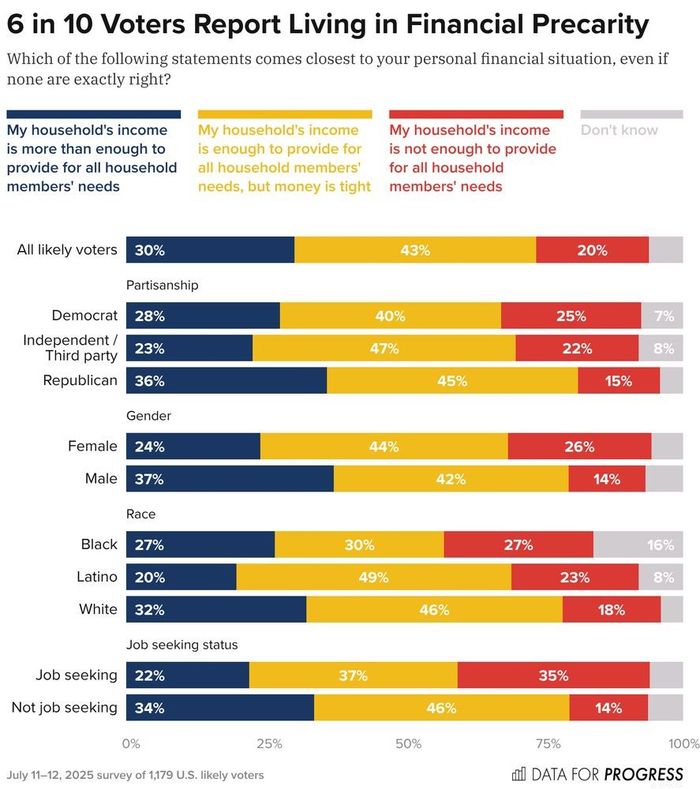
Amid intensifying tariffs, just 30% of Americans say they can afford the cost of living, according to a poll from Data for Progress.
By Stephen Prager
The White House says the U.S. is in the midst of an "economic boom" under President Donald Trump. But voters aren't feeling it in their wallets.
Polling released by Gallup Thursday found the president's approval rating at just 37%, the lowest point of his second term so far, with an all-time low approval rating of 29% among independents.
This precipitous decline has been helped along by sagging approval on the economy, which has historically been the issue where he gets the most support. After a high of 42% in February, approval for his handling of the economy is likewise down to just 37%.
An uptick in inflation seen over the past month has exacerbated the cost of living crisis Trump promised to abate on the campaign trail.
A poll released Friday by Data for Progress found that, "Only 30% of likely voters report having enough income to be able to comfortably provide for their household's needs, while a plurality of voters (43%) say they have enough income but money is tight, and 20% say they do not make enough to provide for all household members' needs."
(Graphic: Data for Progress)
"As his approval tanks, President Trump has finally lost voters on the one issue where they've historically trusted him: the economy," said Lindsay Owens, the executive director of the Groundwork Collaborative. "Not only has Trump shirked his promise to lower prices, he's made the situation substantially worse as his tax and tariff policies have landed a double blow to household budgets."
According to data from Indeed, cited by Forbes, 43% of Americans have seen their wages lagging behind the cost of living over the past year. The jobs feeling the worst crunch are those "at the low-to-middle end of the pay spectrum."
Trump has imposed the highest tariffs on imported goods since the Great Depression. After months of relative quiet, they began to make their impact felt this past month, with consumer prices up 2.7% from the previous year, compared with just 2.4% in May.
While rising rent costs were the top driver of inflation in June, prices for clothing, toys, and consumer appliances all rose, as did food and energy.
The president was elected on promises to tackle the cost of living. But now 70% say that he is not focused enough on lowering prices, according to polling released Sunday by CBS News. Meanwhile, 61% say Trump is focusing too much on his tariff policy, which remains broadly unpopular.
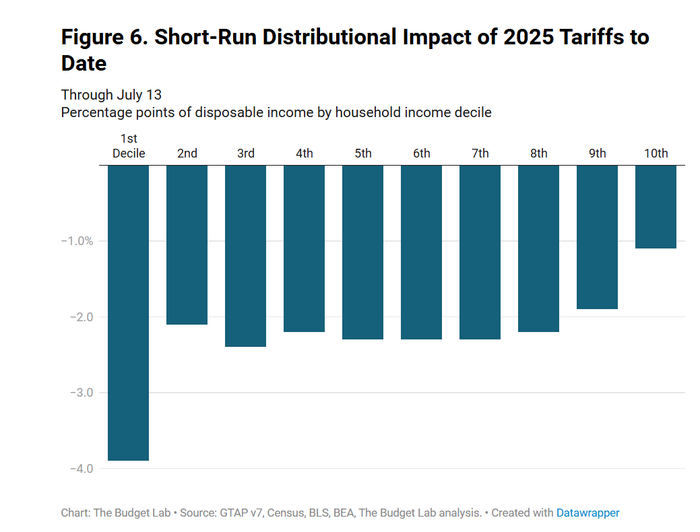
Yale's Budget Lab estimates that it would cost the average household $2,770 worth of disposable income per year if tariffs stayed at their current rate indefinitely, with the worst impact—especially in the short term—on the poorest Americans.
(Graphic: Yale Budget Lab)
But they are set to grow more intense beginning on August 1, when Trump has said he'll roll out new levies on imports from some of America's top trading partners, including Canada, the European Union, Mexico, Brazil, and South Korea.
According to economists who spoke with Vox, the worst effects are likely yet to come. Preston Caldwell, chief U.S. economist for Morningstar, said inflation would likely peak in 2026 rather than 2025.
"Companies have started paying tariffs on their imported goods, but as far as the goods that are being sold in stores right now, those are primarily being drawn from the inventory of goods that were brought in before the tariffs," Caldwell said. "So most companies are still not really having to recognize the loss of tariffs yet to a great degree."
"The more that it becomes clear that tariffs are here for at least the foreseeable future," he continued, "the more that they are going to have to eventually adjust to this new reality, which will entail increasing their prices."
Owens said that will likely translate to even fiercer backlash against Trump.
"Working families," she said, "know exactly who to blame as they pay higher prices on everything from groceries and electricity bills to school supplies and appliances."
"These state-sanctioned fear tactics are opening the door for vulnerable communities to be abused and must not become the norm," said Rep. Summer Lee.
By Julia Conley
Pressing the Trump administration to explain its rationale for allowing federal agents to don masks and drive unmarked vehicles when carrying out immigration raids and arrests, two Democratic members of Congress on Friday pointed to numerous times in recent months when authorities working under President Donald Trump have eroded "public trust and fundamental constitutional rights" by concealing their identities.
"In Los Angeles, agents were photographed in June 2025 wearing face covers during residential raids," wrote Reps. Robert Garcia (D-Calif.) and Summer Lee (D-Pa.) in a letter to Homeland Security Secretary Kristi Noem. "In Chicago, witnesses reported masked agents detaining individuals without identification. Similarly, in New York City, then-mayoral candidate Brad Lander was arrested by masked federal agents."
The two progressive lawmakers sit on the House Committee on Oversight and Government Reform, with Garcia serving as ranking member and Lee serving as ranking member of the Federal Law Enforcement Subcommittee. They reminded Noem that the panel has "broad authority to investigate 'any matter' at 'any time' under House Rule X" as they requested documents regarding Department of Homeland Security (DHS) and Immigration and Customs Enforcement (ICE) protocols "governing agent identification and accountability during operations in civilian settings."
DHS, said Garcia and Lee, has been "in direct violation" of the Fourth and Fifth Amendments of the U.S. Constitution as it has allowed ICE and other federal agents to conceal their identities and the agencies they work for while raiding workplaces and residential neighborhoods, and waiting outside courtrooms and daycare centers to arrest immigrants.
"This causes a dangerous erosion of public trust, due process, and transparency in law enforcement. It also makes it nearly impossible for individuals to determine whether they are being detained by legitimate law enforcement agents or unlawfully abducted," wrote Garcia and Lee. "These tactics contradict long-standing democratic principles such as the public's right to accountability from those who enforce the law and pave the way for increased crime, making our communities less safe."
The lawmakers noted that federal agents' use of masks and unmarked cars has allowed some people to leverage "the opacity and fear surrounding immigration operations to commit serious crimes," such as an armed man who entered an auto repair shop in Philadelphia wearing a tactical vest labeled "Security Enforcement Agent" and restrained a female employee before stealing $1,000. Another man in Houston recently claimed to be an ICE agent as he used his vehicle to block another driver's car and stole $1,800 and a Guatemalan ID from the victim.
"These cases starkly illustrate how the use of masks, unmarked vehicles, and minimal identification by actual ICE agents does not just erode trust—it effectively hands bad actors a roadmap to exploit vulnerable communities," said Lee and Garcia.
In a statement, Lee accused federal agents, with the Trump administration's approval, of "cowardly concealing their identities behind masks."
"Federal agents under the Trump administration are operating like a secret police force on U.S. soil. These agents must identify themselves," said Lee. "Every person—regardless of immigration status—has a constitutional right to due process and protection from unlawful searches and seizures. These state-sanctioned fear tactics are opening the door for vulnerable communities to be abused and must not become the norm."
Lee and Garcia also noted that lawyers representing ICE and the Trump administration have begun concealing their identities by refusing to give their names when appearing in court to argue immigration cases.
The lawmakers quoted one immigration law expert who toldThe Intercept last week, "Not identifying an attorney for the government means if there are unethical or professional concerns regarding [DHS], the individual cannot be held accountable."
However, one critic lamented that corporate media "continues to act like starvation is the unfortunate byproduct of 'war.'"
By Brett Wilkins
As more and more Palestinians, mostly children, starve to death due to Israel's 657-day obliteration and siege of Gaza, reliably pro-Israel U.S. corporate media outlets in recent days have centered the starvation crisis—which began in October 2023—while critics have decried passive language and anti-Palestinian tropes used in some reporting.
The Washington Post published at least two articles on the subject in as many days, including an Associated Press story by Wafaa Shurafa, Sarah El Deeb, and Lee Keath titled "Dozens of Kids and Adults in Gaza Have Starved to Death in July as Hunger Surges" and an internal piece by Louisa Loveluck, Heba Farouk Mahfouz, Siham Shamalakh, Miriam Berger, and Abbie Cheeseman with the headline "Mass Starvation Stalks Gaza as Deaths Rise From Hunger." The authors of the latter article noted that "Israel has severely limited the amount of food entering Gaza, where society is on the brink of collapse."
The New York Times on Friday published a morning newsletter article by Lauren Jackson titled "The Starvation Spreading in Gaza," which stressed that "hunger in Gaza is not new" amid an Israeli blockade that has choked the strip "for nearly two decades." Jackson's piece followed a Thursday front-page story by Rawan Sheikh Ahmad, Isabel Kershner, and Abu Bakr Bashir, with images by Palestinian photographer Saher Alghorra, headlined "Gazans Are Dying of Starvation."
Palestinian peace activist Ihab Hassan, who heads the Agora Initiative's Human Rights for Gaza project, said on the social media site X, "Starvation in Gaza made it to the front page of The New York Times—a horror so vast, it could no longer be ignored."
Carnegie Middle East Center senior editor Michael Young wrote on X, "Don't underestimate that a mainstream media outlet in the U.S. is finally stating the obvious, that Gazans are dying of starvation."
"But it's not as if they're just dying, for no reason; they are being denied adequate amounts of food by Israel, therefore are being killed," Young added. "Nonetheless, that the NYT presents the story in so blunt a way, under a heartbreaking photograph, must qualify as a turning point of sorts given how reluctant U.S. media outlets are to say anything bad about Israel."
Assal Rad, a fellow at the Arab Center Washington D.C. and frequent media critic, offered a more accurate headline for the Times story—"ISRAEL IS STARVING PALESTINIANS TO DEATH."
Fairness & Accuracy in Reporting's Counterspin blog took aim at the Post's "Mass Starvation Stalks Gaza" headline, noting that "it's actual human beings stalking Gaza, who could right now choose to act differently."
Still, there have recently been remarkable discussions about Gaza in U.S. corporate media outlets that would have been all but unimaginable during past Israeli attacks on Palestine.
CNN's "NewsNight" with Abby Phillip on Thursday aired a panel discussion titled, "Why Is the U.S. Silent About the Starvation in Gaza?" The segment featured journalist Peter Beinart, who highighted the International Criminal Court's issuance of arrest warrants for Israeli Prime Minister Benjamin Netanyahu for alleged crimes against humanity and war crimes including forced starvation, U.S. support for Israel's ethnic cleansing of Gaza, and the Israeli government's ban on foreign journalists entering the strip.
"To say the United States is silent, it's much worse than that," Beinart said. "We are profoundly complicit and deeply responsible. It is our weapons that enforce this starvation. It is our diplomatic efforts that prevent international justice from being done."
"The blood is on our hands!" he stressed.
The CNN segment also featured a video clip of United Nations World Food Program Director Cindy McCain, whose warnings of a looming starvation emergency in Gaza began in October 2023.
Asked by Phillip if the images of starving Gazans making headlines around the world marked "an inflection point," Beinart replied, "Why did it take this long?"
Meanwhile, Israel's oldest newspaper, Haaretz, ran an editorial Thursday titled "Israel Is Starving Gaza."
"Gaza is starving, and Israel is responsible," the Haaretz editors wrote. "According to the Gaza Health Ministry, 111 people have died from malnutrition since the war began, most of them children. Alarmingly, 43 of those deaths occurred just in the past week."
"The famine that has been created is another facet of Israel's cruel inhumanity towards the people of Gaza," the editors added. "It constitutes a war crime and a crime against humanity and is a clear violation of the orders issued a year and a half ago by the International Court of Justice in The Hague."
***CHINA IS PROMOTING CHEAP CLEAN ENERGY & THEIR ECONOMY IS
PROSPERING! TRUMP & MAGA ARE WALLOWING IN BIG OIL SUBSIDIES
TO THE DETRIMENT OF OUR ENVIRONMENT & ECONOMY ! THE US IS AN
ENERGY GUZZLER - EXCEEDING PER CAPITA CONSUMPTION OF OTHER
NATIONS...REDUCE OUR CONSUMPTION, POCKET THE SAVINGS &
"We are done letting fossil fuel executives write the rules while our communities pay the price," said Rep. Ilhan Omar.
By Brad Reed
Two progressive lawmakers are teaming up to take down the subsidies for fossil fuel companies contained in the recently passed Republican budget law.
U.S. Sen. Bernie Sanders (I-Vt.) and Rep. Ilhan Omar (D-Minn.) on Friday introduced a bill that is an update of a 2012 Sanders bill to repeal the nearly $200 billion worth of federal subsidies and tax loopholes that they describe as "welfare" for oil and gas companies.
While the United States has long provided such subsidies to fossil fuel companies, Sanders and Omar noted that the GOP budget law recently signed by President Donald Trump adds roughly "$20 billion in new subsidies for coal, oil drilling, methane emissions, pipelines, and other false climate solutions."
Among the budget law's expenses singled out by the lawmakers are $1.48 billion for the production of metallurgical coal, up to $3 billion for power plant owners to transport carbon, a $447 million initiative aimed at helping fossil fuel companies avoid having to pay the corporate minimum tax, and $1.5 billion in tax breaks for methane-emitting polluters.
"Donald Trump has sold out the young people of America and future generations," said Sanders. "Big Oil spent $450 million to elect Donald Trump and Republicans during the last election cycle. In return, the president has directed the full regulatory, legal, and financial weight of the federal government toward helping his fossil fuel executive friends get rich at the expense of a healthy and habitable planet for our kids and grandkids."
Omar said that "we are done letting fossil fuel executives write the rules while our communities pay the price."
"For decades, Big Oil has raked in billions in taxpayer handouts while destabilizing our climate," she added. "The End Polluter Welfare Act will finally hold polluters accountable and eliminate these harmful subsidies once and for all. I'm proud to reintroduce this legislation with Sen. Sanders because our planet can't wait, and neither can we."
In addition to Omar and Sanders, Sens. Elizabeth Warren (D-Mass.), Jeff Merkley (D-Ore.), Peter Welch (D-Vt.), Chris Van Hollen (D-Md.), Ed Markey (D-Mass.) and Cory Booker (D-N.J.) have signed on as co-sponsors of the bill, as have more than 20 lawmakers in the House of Representatives. Hundreds of nonprofit advocacy organizations, including the Sierra Club, Public Citizen, and Friends of the Earth U.S., have also endorsed the bill.
The GOP's budget package tore up most of the renewable energy subsidies and initiatives that were passed by Democrats in 2022 as part of the Inflation Reduction Act.
"There will be an additional 6 million newly infected persons in the world," said the United Nations' top AIDS prevention official recently. "That has started already."
By Julia Conley
The U.S. program credited with saving an estimated 26 million lives and preventing millions of new HIV infections has not sufficiently provided a direct benefit to the United States, suggests Trump State Department planning documents for the George W. Bush-era initiative.
Congress rejected cuts to the President's Emergency Plan for AIDS Relief (PEPFAR) last week, even as Republicans pushed through nearly $8 billion in foreign aid cuts; the program has long had robust bipartisan support as it has enabled 5.5 million babies to be born without HIV to HIV-positive mothers, provided support to 7 million orphans, and driven a decline in new HIV infections in young women in every geographic area that implements its prevention program.
But as The New York Timesreported Thursday, a draft plan at the State Department details proposals for "transitioning" low-income countries away from PEPFAR, with the Trump administration imposing what it calls "bilateral relationships" with the aim of ostensibly prioritizing public health in the United States.
Countries in the Global South would be asked to focus efforts on "the detection of outbreaks that could threaten the United States and the creation of new markets for American drugs and technologies," reported the Times.
The administration appears to be approaching PEPFAR with the logic, said journalist Ben Krauss, that the program "needs to be remade to exclusively serve American interests."
"Saving 25 million lives over the past two decades and pulling off one of the greatest humanitarian feats of the century was already serving American interests," said Krauss. "This is just evil."
The State Department documents also say the Trump administration believes "that the transition of PEPFAR can become the premier example of the U.S. commitment to prioritizing trade over aid, opportunity over dependency, and investment over assistance."
PEPFAR-funded programs in low-income countries have already struggled to stay afloat this year following President Donald Trump's foreign aid funding freeze soon after he took office in January. A stop-work order forced some programs to halt services like the provision of antiretroviral therapy and to lay off thousands of staffers.
A waiver issued in February allowed PEPFAR to continue certain programs, but the administration's cuts to and elimination of the U.S. Agency for International Development, which has implemented PEPFAR since its inception in 2003, has also impacted the initiative.
Under the plan outlined in the documents—which a spokesperson denied were "reflective of the State Department's policy on PEPFAR"—countries would be required to spend far more of their own funds on fighting the spread of HIV/AIDS. Countries that are close to controlling the epidemic, such as Vietnam and Botswana, would see an end to PEPFAR within two years, while countries that still have high rates of infection and receive significant amounts of U.S. funding, including Kenya and Zimbabwe, would have up to four years.
"There will be some countries that can manage where the PEPFAR investment is not as heavy or as large a proportion of their total effort," Robert Black, a professor at Johns Hopkins Bloomberg School of Public Health, told the Times. "But some of the African countries with enormous HIV problems and national financial problems, debt, and other development issues—I cannot see that they are going to be able to pick up all or even a large proportion of the costs in that kind of time frame."
Winnie Byanyima, the executive director of UNAIDS, the United Nations AIDS prevention agency, said earlier this month that the threats Trump has already made to AIDS relief programs across the globe have begun a "deadly funding crisis."
"Personally I am devastated," she said of the U.S. funding cuts at a U.N. summit in Seville, Spain. "Appalled. Shaken and disgusted. I don't have the English words to use."
Byanyima emphasized that HIV/AIDS prevention funding through PEPFAR and similar programs represents "a drop of money that is nothing in one of these rich G7 countries."
PEPFAR is funded through discretionary spending in the federal budget and accounts for less than .08% of U.S. spending.
"To create such crisis, such pain, and such anger on the ground," said Byanyima. "This cut, that's dedicated people losing jobs, loyal support gone, research ended, vulnerable people abandoned. And it is deaths. What went away immediately was prevention services, so we are very worried about the new infections and about deaths... There will be an additional 6 million newly infected persons in the world. That has started already."
"The stench of this transaction will linger over the commission for years," said a pair of Democratic senators.
By Jake Johnson
The Republican-controlled Federal Communications Commission on Thursday gave formal approval to the $8 billion merger of CBS owner Paramount and the media firm Skydance, which won over the agency's Trump-appointed chairman with pledges to review CBS' content and appoint an ombudsman to evaluate claims of bias.
The FCC's two Republicans, Chairman Brendan Carr and Commissioner Olivia Trusty, supported approval of the merger, a decision that comes weeks after Paramount agreed to pay $16 million to settle President Donald Trump's lawsuit over the organization's handling of a pre-election "60 Minutes" interview with Kamala Harris.
Anna Gomez, the FCC's lone Democratic-appointed commissioner, said Thursday that "after months of cowardly capitulation to this administration, Paramount finally got what it wanted."
"Despite this regrettable outcome, this administration is not done with its assault on the First Amendment," said Gomez, who opposed the merger. "In fact, it may only be beginning. The Paramount payout and this reckless approval have emboldened those who believe the government can—and should—abuse its power to extract financial and ideological concessions, demand favored treatment, and secure positive media coverage. It is a dark chapter in a long and growing record of abuse that threatens press freedom in this country."
"The partisan vote is a dark day for independent journalism and a stain on the storied history of the Federal Communications Commission."
Democratic lawmakers responded with similar disgust and alarm. In a joint statement, Sens. Ed Markey (D-Mass.) and Ben Ray Luján (D-N.M.) said the merger approval "reeks of the worst form of corruption."
"While we're glad that the commission took a vote on the deal, as we have repeatedly called for, the partisan vote is a dark day for independent journalism and a stain on the storied history of the Federal Communications Commission," the senators added. "The stench of this transaction will linger over the commission for years."
Sen. Elizabeth Warren (D-Mass.) said that "this merger must be investigated for any criminal behavior."
"It's an open question whether the Trump administration’s approval of this merger was the result of a bribe," said Warren.
Under the publicly available terms of the Paramount settlement, the company agreed to put $16 million toward Trump's future presidential library. But Trump has claimed that the deal is actually worth more than twice the publicly reported figure, asserting that Skydance agreed to spend $20 million on "advertising, PSAs, or similar programming."
Earlier this week, Warren and two other senators demanded answers from Skydance CEO David Ellison about the purported side deal, which the lawmakers described as a "potential secret Trump payoff."
Conor Gaffney and Janine Lopez, attorneys at the nonprofit group Protect Democracy, wrote Thursday that "no doubt the boards of Paramount and Skydance are hoping this saga ends today—now that they've appeased the FCC and cleared merger review."
"But as we've seen time and again, businesses that capitulate to the Trump administration find themselves captured rather than in the clear—with the president quick to change his mind and come back for more," they wrote. "The costs of capitulation are higher than they might initially seem, and the business calculation that Paramount and many others have made may be wrong. The price of protection only goes up, and the mob keeps coming around."
JOIN THE MOVEMENT
As a people-powered nonprofit news outlet, we cover the issues the corporate media never will.
Your contribution supports this bold media model—free, independent, and dedicated to reporting the facts every day. Stand with us in the fight for economic equality, social justice, human rights, and a more sustainable future.
Free speech advocates are raising concerns that a new bipartisan bill would force social media companies to censor criticism of Israel on their platforms.
The bill would mandate that social media companies work with the federal government to implement moderation policies that curb the speech of groups the government designates as "terrorists." They'd be required to provide regular reports to the U.S. attorney general. Those that don't comply would be fined $5 million each day they refuse.
The lawmakers justified the measure by citing some recent examples of overt antisemitism and calls for violence on social media.
"We've seen an explosion of disinformation and antisemitic hate online in America and around the world," Gottheimer said. "After the shooting outside the Capital Jewish Museum, anti-Zionist extremists used social media to call for further violence, posting messages like 'may all Zionists burn.' Even AI platforms like Grok have posted deeply disturbing content, praising Adolf Hitler and Nazism."
Bacon said, "We want to be in a country that makes clear that antisemitism or any kind of racism is repugnant, unacceptable, not allowed in an online space, and that we have zero tolerance for it."
However, other statements from the lawmakers make clear that their definition of "antisemitism" goes far beyond expressions of hatred or calls for violence against Jewish people.
As Matthew Petti wrote for the libertarian magazine Reason: "The specific idea that Bacon had in mind was antisemitism, and he made clear that it includes criticism of the State of Israel in his book."
At the press conference, Bacon explicitly referenced recent protests against Israel's policy of starvation in Gaza.
"I saw protests out here the last two days, they were vile, right?," he said. "They were...you can see the antisemitism in their comments and how they were treating some of our members of Congress who are Jewish. I saw that firsthand."
Bacon did not specify what specific comments he was referring to. However, Petti noted:
Protesters stormed the congressional cafeteria on July 1 to call for food aid to Gaza, and interrupted Rep. Randy Fine (R–Fla.)—who has called for Palestinians to "starve away"—during a hearing on campus antisemitism last week.
Bacon also suggested that merely stating opposition to pro-Israel congresspeople, including himself, constitutes antisemitism.
"I even saw an article today. It was about me, but talking about we have to oppose congressmen who are pro-Zionists, right?" said Bacon, who is notably not Jewish. "It's all over our social media and it's unacceptable."
Gottheimer, meanwhile, said the policy was not just about combating terrorism, but about halting a "massive disinformation campaign influencing us every day."
Independent journalist Glenn Greenwald—a critic of government efforts to regulate "misinformation"—suggested that the bill flies in the face of the right's supposed commitments to free speech.
"There was [a] full consensus on the Right for the last decade that Big Tech censorship was a great evil, especially if pressured and demanded by the U.S. government," he said on X. "All that changed [when] it came time to censor for Israel."
In a statement released Friday, the American‑Arab Anti‑Discrimination Committee (ADC) likewise described the STOP HATE Act as part of "the continuous efforts by lawmakers to silence, censor, and chill freedom of speech and expression in this country at the behest of Israel."
They warned that the bill gives the government, in tandem with pro-Israel groups like the ADL, "unfettered powers to police private social media companies, attack lawful expression, and levy fines of up to five million dollars each day if companies fail to silence and censor users."
This is not the first time Gottheimer and Bacon have introduced the STOP HATE Act. A similar version, introduced in 2023, died in committee.
When introducing that version of the bill, they were more explicit in their calls for government regulation of media—calling on the Department of Justice to require the news outlets Al Jazeera and its subsidiary AJ+, which are sponsored by the Qatari government,to register as foreign agents.
The two congressmen were also at the forefront of calls for the U.S. government to ban TikTok, which Gottheimer said was being used by the Chinese Communist Party to "boost anti-Israel and pro-Hamas videos in the United States." They have also introduced legislation that would criminalize efforts to boycott Israeli products.
Greenblatt, who spoke alongside the two legislators on Wednesday, has explicitly said that "Anti-Zionism is antisemitism." Though he's faced criticism for this stance, including from members of the ADL itself, he has only continued to double down.
In one infamous exchange during the outbreak of pro-Palestine protests on college campuses in 2024, Greenblatt suggested that students wearing keffiyehs—a kind of scarf commonly worn by Palestinians—were doing the equivalent of wearing a swastika armband.
More recently, he endorsed Immigration and Customs Enforcement's warrantless abduction of pro-Palestine organizer Mahmoud Khalil, who he accused—along with other pro-Palestine demonstrators—of being an asset of foreign governments and likened to Middle Eastern terrorist groups.
Wednesday's press release from the legislators on the STOP HATE Act cites the ADL's 2024 "Social Media Scorecard," as evidence that "the five major social media platforms—Facebook, Instagram, TikTok, YouTube, and X—routinely failed to act on antisemitic hate reported to them."
That Scorecard page features a quote from Greenblatt, who said, "Social media platforms are still falling far too short when it comes to moderating antisemitic and anti-Israel content."
After the October 7, 2023 attacks led by Hamas, the ADL changed its methodology to categorize antisemitic incidents to not only include hate speech or threats directed at Jewish people, but also language expressing "opposition to Zionism."
The proposed STOP HATE Act comes at a time when American public opinion has dramatically shifted against Israel's genocidal actions in Gaza. According to a CNN poll conducted by SSRS, released last Friday:
Only 23% of Americans say Israel’s actions have been fully justified, a 27-point drop from a[n] October 2023 poll taken shortly after Hamas’ October 7 attacks. Another 27% now say those actions have been partially justified and 22% say that they have not been justified at all. In October 2023, just 8% said Israel’s actions were not justified at all.
In recent weeks, Israeli leaders have openly called for the mass displacement of two million Palestinians to make room for Jewish settlers. Meanwhile, at least 115 Palestinians—including more than 80 children—have reportedly starved due to Israel's restrictions on aid entering the Gaza Strip. Over 1,000 aid seekers have been killed, often by Israel Defense Forces soldiers, at aid sites jointly administered by the U.S. and Israel.
"The First Amendment is supposed to be the cornerstone of American democracy—our shield against censorship and government overreach," said Abed Ayoub, ADC's national executive director. "When members of Congress and state lawmakers start compromising our freedoms to satisfy the demands of a foreign government, we lose what makes this country free. We must reject any legislation that threatens our speech, our conscience, and our right to dissent."
Trump's new executive order on homelessness is not a departure from policy failure. It is the logical continuation of a governance model that confuses erasure with resolution.
By Matt Watkins
There are words that live quietly in the margins of law, waiting for the right conditions to become instruments of control. Vagrancy is one of them. It does not name a crime so much as a condition—a presence deemed out of place, a body detached from property, purpose, or permission. It has always been a word that grants the state an elastic mandate: to sweep, to detain, to erase.
Its history is older than this country. In 14th-century England, following the Black Death, the ruling class faced a labor shortage that briefly shifted the balance of power toward the working poor. Rather than negotiate, they legislated. A series of statutes criminalized idleness and movement, branding those who wandered without employer or land as enemies of order. The offense was not what they did—it was that they could not be accounted for. Vagrancy became a pretext for containment, a tool to bind the body to power, and a signal that survival outside sanctioned structures would not be tolerated.
The word arrived in the Americas with that logic intact and found new utility in a country built on hierarchy and extraction. Across centuries, it was used to arrest freed Black men for walking without proof of employment, to justify the confinement of Indigenous people who had refused removal, to expel Chinese workers labeled as moral contagions, to target queer youth and disabled residents whose lives defied social norms. It appeared on signs and statutes alike, a vague but potent summons of disorder, always defined from above. It did not require action. It required only that someone be seen.
Now, the word has returned—not as metaphor or memory, but as mandate. On July 24, 2025, President Trump signed an executive order titled “Ending Crime and Disorder on America's Streets”—a sweeping directive that promises to fight “vagrancy” and reframes homelessness, addiction, and mental illness not as public health crises or systemic failures, but as threats to civic peace.
The order offers no new housing, no expanded care infrastructure, no commitment to addressing the material conditions that produce displacement. Instead, it offers a rubric for removal. Under its provisions, federal grants from Housing and Urban Development, Health and Human Service, the Department of Justice, and the Department of Transportation will prioritize jurisdictions that criminalize public presence—cities that ban urban camping, prohibit loitering, penalize “urban squatting,” and track individuals deemed out of bounds. Programs that offer harm reduction, low-barrier shelters, or evidence-based treatment models face new restrictions or disqualification. Legal safeguards against involuntary psychiatric commitment are to be rolled back, consent decrees reversed, and behavioral nonconformity redefined as detainable.
Vagrancy persists because it works—not in reducing harm, but in reallocating blame. It shifts public anxiety about inequality, addiction, and disorder away from the systems that produce them and toward the individuals who cannot hide them.
This is not a departure from policy failure. It is the logical continuation of a governance model that confuses erasure with resolution. The language remains soft—beautification, humane treatment, restoration—but the infrastructure it supports is hard: surveillance in place of service, confinement in place of care, disappearance in place of dignity. It teaches agencies to measure success not by outcomes but by optics: How many tents are gone? How few bodies remain visible? How fully have we restored the image of control?
Vagrancy persists because it works—not in reducing harm, but in reallocating blame. It shifts public anxiety about inequality, addiction, and disorder away from the systems that produce them and toward the individuals who cannot hide them. It casts the existence of suffering as a provocation and conditions civic belonging on legibility, order, and stillness. In doing so, it grants governments a new kind of authority: the power not simply to punish what people do, but to penalize who they are when no performance is possible.
This order does not restore order. It reinstates a hierarchy of visibility. It tells those without shelter, treatment, or family that the problem is not what they lack—but that they can still be seen. And in doing so, it signals to the rest of us that our security lies in distance, that the absence of suffering from view is proof that it has been addressed. It invites the public to mistake silence for peace, stillness for stability, emptiness for care.
But the history of vagrancy tells a different story. It is a word that rises not in response to crisis, but in response to fear: the fear that the margins might speak, might move, might disrupt the fictions we tell about what this country is and who it serves. When the powerful feel that their order is slipping, they do not ask what has failed. They ask who can be removed.
If there is any hope in this moment, it lies in refusing the comfort of euphemism. This is not about restoration. It is about removal. Not about care, but control. Not about safety, but sightlines.
We do not have to accept the return of vagrancy into our political vocabulary. We can name it for what it is: a centuries-old code for managing the inconvenient poor, repackaged as policy. We can refuse to let language do the work of violence. And we can insist—still, again—that visibility is not disorder, and that survival, even unkempt, even unsanctioned, is not a threat to be eliminated.
It is a truth to be answered. With housing. With care. With courage. And with clarity
We must explicitly name the culprits that are creating an environment rife with both climate catastrophe and conditions hostile to children and families—corporate power and concentrated wealth.




No comments:
Post a Comment
Note: Only a member of this blog may post a comment.