Tuesday, October 21, 2025
■ Today's Top News
"The ethical conflict is just so basic and fundamental, you don't need a law professor to explain it," said Pace University's Bennett Gershman. "It's bizarre and almost too outlandish to believe."
By Jessica Corbett
President Donald Trump is facing fresh allegations of attempting to corruptly profit from his office after The New York Times reported Tuesday that the Republican is demanding that the US Department of Justice pay him about $230 million in taxpayer dollars for previous federal investigations into him, and his allies at the DOJ are expected to make the final decision.
Trump filed the administrative claims—which are submitted to the department for potential settlements to prevent lawsuits in federal court—before he returned to the White House earlier this year, people familiar with the matter told the newspaper. However, the president nodded to the legal battle in public comments at the White House last week.
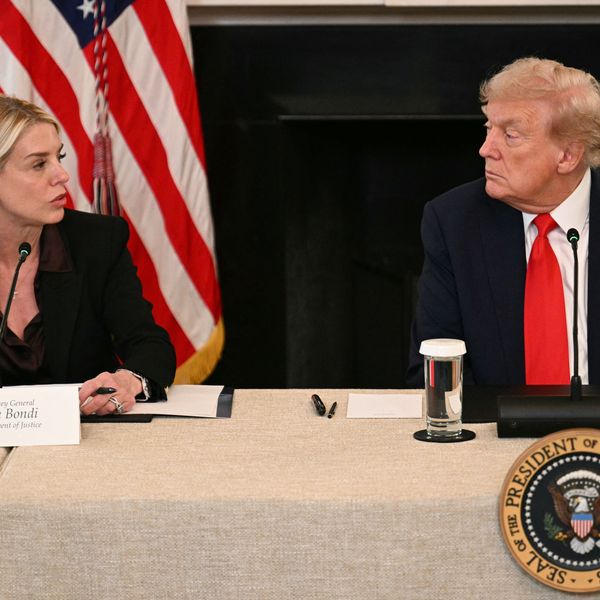
“They raided my house in Florida. It was an illegal raid,” the president said beside Federal Bureau of Investigation (FBI) Director Kash Patel, US Attorney General Pam Bondi, and her deputy, Todd Blanche—Trump’s former lead criminal defense lawyer and one of two people who can green-light such settlements.
“I have a lawsuit that was doing very well, and when I became president, I said, I’m sort of suing myself. I don’t know,” Trump continued. “How do you settle the lawsuit? I’ll say, Give me X dollars, right? And I don’t know what to do with the lawsuit. It’s a great lawsuit. And now I won—it sort of looks bad. I’m suing myself, right?”
“Trump is now openly shaking down HIS OWN JUSTICE DEPARTMENT for hundreds of millions of dollars to line his pockets… while claiming there’s not enough money for Americans’ healthcare.”
As the Times detailed Tuesday:
The first claim, lodged in late 2023, seeks damages for a number of purported violations of his rights, including the FBI and special counsel investigation into Russian election tampering and possible connections to the 2016 Trump campaign, according to people familiar with the matter. They spoke on the condition of anonymity because the claim has not been made public.
The second complaint, filed in the summer of 2024, accuses the FBI of violating Mr. Trump's privacy by searching Mar-a-Lago, his club and residence in Florida, in 2022 for classified documents. It also accuses the Justice Department of malicious prosecution in charging him with mishandling sensitive records after he left office.
In addition to the deputy attorney general, the head of the DOJ’s Civil Division can sign off on such settlements. That post is currently held by Stanley Woodward Jr. As the newspaper noted, Woodward previously represented not only Walt Nauta, the president’s co-defendant in the classified documents case, but also “a number of other Trump aides, including Mr. Patel, in investigations related to Mr. Trump or the Capitol riot on January 6, 2021.”
A White House representative referred questions to the DOJ, where spokesperson Chad Gilmartin said, “In any circumstance, all officials at the Department of Justice follow the guidance of career ethics officials.”
Meanwhile, Pace University professor Bennett Gershman told the Times: “What a travesty... The ethical conflict is just so basic and fundamental, you don’t need a law professor to explain it.”
“And then to have people in the Justice Department decide whether his claim should be successful or not, and these are the people who serve him deciding whether he wins or loses,” he added. “It’s bizarre and almost too outlandish to believe.”
Congressional Democrats, lawyers, journalists, and other critics also weighed in on Trump’s reported conduct on social media, condemning it “corrupt and impeachable,” “straight grift,” and “straight up extorting the Justice Department and looting taxpayers.”
“It’s hard to think of an action more purely corrupt than a president ordering the executive branch to pay him hundreds of millions of dollars,” said David French, a Times columnist and visiting professor of public policy at Lipscomb University. “I cannot wait to read the MAGA defenses of this (and there will be many). They’ll display Soviet levels of sycophancy.”
People’s Policy Project president Matt Bruenig said that “suing the government in your personal capacity and then having the government, which you run, settle the lawsuit with you for money is the true infinite money trick.”
Matthew Miller, the US State Department spokesperson during the Biden administration, suggested that “this would be the most corrupt act in presidential history. No complicated schemes, no outside actors, just a straight-up looting of the taxpayers to put $230 million in Trump’s pocket.”
Lisa Gilbert, co-president of the watchdog group Public Citizen, said in a statement:
It's difficult for a president who spent the past 10 months behaving like a wannabe dictator and demonstrating his contempt for the law to surprise us, but Donald Trump has managed to do it today. Instead of being content with getting away with his lawless behavior, Trump is now brazenly demanding compensation from taxpayers for having the audacity to treat him like a public servant who can be held accountable for wrongdoing.
There is no other way to put it: The authoritarian demagogue we call our president is drunk on power, and there is no amount of money that can satiate this grifter's appetite for hoarding wealth instead of using his presidency to serve the good of the country. This disgusting behavior must be called out and stopped.
The reporting came on day 21 of a federal government shutdown over congressional Republicans‘ refusal to reverse healthcare cuts expected to negatively impact tens of millions of Americans.
“Trump is now openly shaking down HIS OWN JUSTICE DEPARTMENT for hundreds of millions of dollars to line his pockets… while claiming there’s not enough money for Americans’ healthcare,” declared US Sen. Mark Warner (D-Va.). “He has no shame. He is openly and boldly corrupt.”
Sen. Andy Kim (D-NJ) said: “What does Donald Trump need more of OUR money for? I guess it’s good to be president when you can bully, intimidate, and shake down every institution in this country, including now the Department of Justice. This is what a mob boss looks like.”
Democrats on the US House Judiciary Committee were similarly critical, calling it “the ultimate Shutdown Shakedown.”
“Donald Trump, who’s put more than $3 billion in his pocket since returning to the White House, now wants to have ’his’ lawyers at the DOJ to pay him $230 million in the middle of the GOP government shutdown,” the panel members said. “While tens of millions of Americans desperately try to pay for groceries, healthcare, and childcare, Trump is robbing America blind. This is exactly why the Constitution forbids the president from taking any money from the government outside of his official salary. This is Donald Trump First, America Last—the Gangster State at work, billionaires shaking down the people.”
Rep. Jamie Raskin (D-Md.), the panel’s ranking member—and manager of Trump’s historic second impeachment—is launching an investigation into the potential settlement, citing the US Constitution’s domestic emoluments clause.
Like the committee’s Democrats, critics pointed to the various ways Trump and his family have cashed in on the presidency, from his Qatari jet to their cryptocurrency moves.
Former Labor Secretary Robert Reich concluded Tuesday that “America’s Grifter-in-Chief knows no bounds.”
“It is the federal government’s job to provide a better way of life for its people... right now, it just feels like they’re not trying," said one respondent.
By Brad Reed
As congressional Republicans refuse to budge on Democrats’ demands to extend expanded healthcare tax credits as a precondition for funding the federal government, a new poll shows US voters are deeply concerned about how the expiration of these credits will impact their insurance premiums.
As The Associated Press reported on Tuesday, the AP-NORC poll shows 6 in 10 Americans are “extremely” or “very” worried about their healthcare costs going up over the next year, while 4 in 10 Americans are “extremely” or “very” worried about not being able to afford healthcare and medications they need.
In interviews with the AP, some poll respondents explained why they are feeling so acutely anxious about their access to healthcare in the coming year.
“Even before these healthcare cuts came into play, I was already having a significant issue getting the care that I needed this year,” said Latoya Wilson, a 46-year-old Louisiana resident. “Anything worse than what I already have is pretty scary.”
Caleb Richter, a 30-year-old Wisconsin native, told the AP that he was disappointed that elected officials seemed to be doing so little to help Americans deal with spiraling healthcare costs.
“It is the federal government’s job to provide a better way of life for its people,” he said. “Right now, it just feels like they’re not trying.”
The AP-NORC poll was at least the third survey released this month showing deep anxiety of the affordability of healthcare, as a poll from Data for Progress and Groundwork Collaborative showed 72% of respondents were somewhat or very concerned about premiums rising.
The latest KFF Health Tracking Poll, which was released in early October, found that 78% of Americans want Congress to extend enhanced tax credits for people who buy their health insurance through exchanges established by the Affordable Care Act (ACA), compared to just 22% of Americans who want to let the credits expire.
While Democrats have made it their directive to stop some of the worst Republican attacks on the ACA subsidies in order to forestall dire impacts on Americans families who will face enormous increases in their monthly premiums—hikes of 40% or more—or lose their coverage entirely due to inability to pay, some political observers question whether Democrats shouldn’t just allow the GOP to have its way and let President Donald Trump and his party take the blame when the devastation materializes.
“Haven’t they read Machiavelli?” asked Les Leopold, executive director of the Labor Institute, in a Common Dreams op-ed published Tuesday. “It would damage Republicans if premiums shot up dramatically for millions of voters because of Trump’s so-called ‘big, beautiful bill.’ Why save the Republicans from themselves, when it would soon be obvious to all that the GOP stole the premium subsidies to give more money to billionaires?”
Still, this does not seem to be the calculation of most Democrats or progressive lawmakers like Sen. Bernie Sanders (I-Vt.) who have railed against the damage Republicans are threatening to unleash when it comes to healthcare costs.
The expiring ACA subsidies aren’t the only threat to Americans’ healthcare, as Republicans’ One Big Beautiful Bill Act cut spending on Medicaid by nearly $1 trillion over the next decade, which the Congressional Budget Office estimated would result in more than 10 million people, among the nation’s poorest, losing their coverage.
"Look how CNN shut down his question and moved on," said one viewer.
By Julia Conley
Saikat Chakrabarti, the progressive organizer who is challenging US Rep. Nancy Pelosi for the House seat she has held since 1987, was met with stone-faced stares and laughter on CNN when he spoke during a panel discussion Monday about the Trump administration national security memo that one journalist said amounts to a “declaration of war” on the president’s political opponents.
Chakrabarti was joined by author and historian Max Boot, journalist Bata Ungar-Sargon, commentator and former Clinton White House aide Keith Boykin, and former spokesperson for the George W. Bush administration Pete Seat in a panel discussion hosted by Sara Sidner.
The discussion covered the weekend’s No Kings rallies, racist texts attributed to a nominee of President Donald Trump, and US Immigration and Customs Enforcement’s (ICE) raids in cities across the country before turning to the administration’s recent strikes on boats in the Caribbean Sea, which it says have been aimed at stopping drug trafficking and which have killed dozens of people.
Chakrabarti said the administration’s policy of bombing boats in the Caribbean—vessels that, Vice President JD Vance admitted, could very well be fishing boats—to kill people the White House has claimed without evidence are “narco-terrorists,” raises alarm about the president’s push to unilaterally define who qualifies as a “terrorist.”
Trump’s policy in the Caribbean, Chakrabarti suggested, represents just one way in which the president is attempting to designate groups as terrorists. In the wake of right-wing activist Charlie Kirk’s killing—which he baselessly blamed on left-wing groups—he signed an executive order in September designating “antifa”—an anti-fascist ideology embraced by autonomous groups and individuals—as a “domestic terrorist organization,” despite the fact that there is no such legal designation in the US.
Days later, Trump signed National Security Presidential Memorandum 7 (NSPM-7), which focuses on left-wing and anti-fascist organizations and mandates a “national strategy to investigate and disrupt networks, entities, and organizations that foment political violence so that law enforcement can intervene in criminal conspiracies before they result in violent political acts.”
The memo has recently garnered outrage from Democratic lawmakers, more than 30 of whom signed a letter condemning Trump’s threats against progressive groups and organizers, but it has received little attention in the corporate media, and Chakrabarti’s fellow guests on CNN Monday displayed little recognition of what he was talking about when he raised alarm about NSPM-7.
“Here’s what concerns me—Trump is saying, ‘I can define who’s a terrorist, and that means I can kill him.’ At the same time, we’re seeing executive orders defining whole parts of Democratic Party as domestic terrorists,” said Chakrabarti. “Here we’re seeing NSPM-7, which says any anti-American or anti-capitalist or anti-Christian speech, is extremist speech.”
While claiming to protect the US from drug traffickers, he added, the administration has created “a task force of 4,000 agents who are being taken off of drug trafficking and human trafficking, and the actual crime, and being put on prosecuting those people who are saying anti-capitalist things.”
“Do you think that’s okay?” he asked the other panelists. “Can you put two and two together about what’s going on here?”
None of the other guests responded, and Seat looked blankly at Chakrabarti before Sidner said the show was going to a commercial break.
“We will answer that question, coming up,” Sidner said, laughing. “We’re going to leave it there for that conversation.”
When the show returned, the conversation turned to Ukraine and Russia.
“Look how CNN shut down his question and moved on,” said commentator Guy Christensen.
Ken Klippenstein, who has reported on NSPM-7 and tracked mentions of the memo in the corporate press—some of which have downplayed the threat—expressed alarm that “the moment NSPM-7 comes up, [the] CNN anchor laughs nervously and ends the segment.”
On Tuesday, however, Klippenstein reported that the “NSPM-7 dam” in the corporate media was continuing to break, with CNN airing a second segment that mentioned the memo.
“This would be like if George W. Bush had said CodePink was al-Qaeda,” explained former national security official Miles Taylor, “or people protesting the wars in Iraq and Afghanistan were associated with the Islamic State.”
As Reuters asked agencies about the Interagency Weaponization Working Group targeting "the Deep State," Fox News amplified key government leaders' claims about the initiative.
By Jessica Corbett
As President Donald Trump’s increasingly authoritarian behavior draws millions of Americans to the streets in protest, his administration is pushing a narrative about a newly revealed interagency group formed in response to one of his executive orders.
Trump issued his Ending the Weaponization of the Federal Government order on the first day of his second administration, and US Attorney General Pam Bondi and Director of National Intelligence Tulsi Gabbard swiftly announced related groups at their agencies. Reuters published a report late Monday after speaking with an unnamed source and obtaining federal records about an umbrella organization, the Interagency Weaponization Working Group (IWWG).
“Trump and his allies use the term ‘weaponization’ to refer to their unproven claims that officials from previous administrations abused federal power to target him during his two impeachments, his criminal prosecutions, and the investigation into Russia’s interference in the 2016 election,” Reuters reported. The source said IWWG’s mission is “basically to go after ’the Deep State,‘” which, the outlet noted, is a term “used by Trump and his supporters to refer to the president’s perceived foes from the Obama and Biden administrations and his own first term.”
IWWG involves at least 39 officials from across the government, including the White House, Office of the Director of National Intelligence (ODNI), Central Intelligence Agency, Federal Communications Commission, Internal Revenue Service, and departments of Defense, Homeland Security, and Justice (DOJ), according to Reuters.
“Shortly after Reuters asked the agencies for comment on Monday,” the news outlet highlighted, “Fox News reported the existence of the group, citing Gabbard as saying she ’stood up this working group.‘”
Specifically, Gabbard told Fox that IWWG has been meeting biweekly since April to “share information, coordinate, and execute.”
“The American people made a clear choice when they elected President Trump—to stop the Biden administration’s prolific and dangerous weaponization of government agencies against the American people and the Constitution,” she said. “I stood up this working group to start the important work of interagency coordination under President Trump’s leadership to deliver accountability.”
“True accountability is the first step toward lasting change,” added the former congresswoman.
The Fox article, published just a few hours before Reuters’ reporting, also features comments from Bondi and Federal Bureau of Investigation (FBI) Director Kash Patel, who have been accused of abusing their positions and politicizing their agencies for the president. The pair pointed to DOJ action against Trump, “pro-life” advocates, and parents at school board meetings during the Biden administration.
There are also complaints from unnamed officials that the media has attempted to “negatively spin lawful oversight and accountability” by claiming that IWWG is a way for the Trump administration to weaponize the government against political opponents. One official told Fox, “The irony is, accusing the Interagency Weaponization Working Group of targeting the president’s political opponents is classic projection and could not be further from the truth.”
Such comments appear to be a direct response to Reuters, which reported: “Among those discussed by the interagency group, the source said, were former FBI Director James Comey; Anthony Fauci, Trump’s chief medical adviser on the Covid-19 pandemic; and former top US military commanders who implemented orders to make Covid-19 vaccinations compulsory for servicemembers. Discussions of potential targets have ranged beyond current and former government employees to include former President Joe Biden’s son, Hunter.”
A senior ODNI official claimed that there was “no targeting of any individual person for retribution,” and “IWWG is simply looking at available facts and evidence that may point to actions, reports, agencies, individuals, etc. who illegally weaponized the government in order to carry out political attacks.”
Fauci and lawyers for Hunter Biden and Comey did not respond to requests for comment. Comey is fighting criminal charges that his legal team argues are an example of officials using “courts to punish and imprison their perceived personal and political enemies.”
After Comey was indicted last month, Trump pledged that “there’ll be others.” Since then, Trump adviser-turned-critic John Bolton and New York Attorney General Letitia James—who successfully prosecuted the president for financial crimes—also have been indicted.
According to Reuters:
Another focus for the interagency group was retribution for the prosecution of the January 6 rioters, said the source.
Bondi tasked the DOJ Weaponization Working Group with reviewing the J6 prosecutions. Some of the documents seen by Reuters show that a smaller subset of employees from across the government have been convening on the topic. The Justice Department denied in its statement to Reuters that a separate January 6 group exists.
Among other issues the source recalled being discussed were the Jeffrey Epstein files, the prosecutions of Trump advisers Steve Bannon and Peter Navarro, and the possibility of stripping security clearances from transgender US officials. Reuters could not independently confirm these were the subject of discussions.
Officials from the White House and ODNI denied that the Epstein files were discussed. The ODNI officials said the same about revoking security clearance for transgender officials and the Bannon and Navarro cases.
Despite officials’ claims, readers of the reporting suggested that IWWG appears to be a way for the administration to target Trump’s “enemies list.”
Larry Pfeiffer, who was previously a senior director of the White House Situation Room and chief of staff to former Central Intelligence Agency Director Michael V. Hayden, sarcastically said on social media: “Great! An interagency enemies list committee. And with participants from CIA and the ODNI. Nothing unusual about that!”
Meanwhile, Mother Jones editor-in-chief Clara Jeffery dubbed IWWG the president’s “revenge committee.”
"This administration’s failure to investigate or even acknowledge that these indiscriminate immigration raids are canceling the rights of US citizens is dangerous."
By Julia Conley
Days after new reporting revealed that at least 170 US citizens are among those who have been detained by federal immigration agents under the Trump administration, which Congresswoman Pramila Jayapal called “absolutely shocking,” the Washington Democrat joined Rep. Jamie Raskin in demanding answers from top homeland security officials on the report.
Jayapal and Raskin (D-Md.) noted that they previously wrote to Homeland Security Secretary Kristi Noem and acting Immigration and Customs Enforcement (ICE) Director Todd Lyons in February, just weeks into President Donald Trump’s second term, when the detention of US citizens ensnared in Trump’s mass deportation operation was already raising alarm.
At that point, NBC News had reported on the detentions of US citizens including Native tribe members, which raised concerns about racial profiling—but in their Monday letter to Noem and Lyons, Jayapal and Raskin said the response they got in February was “flippant and unserious,” with the officials simply reiterating existing policies that prohibit ICE from detaining US citizens—“without providing any assurance” that agents were “actually following that policy.”
“This administration cannot hide behind a broad policy statement, as it continues to unlawfully detain US citizens as part of indiscriminate immigration raids,” wrote Jayapal and Raskin.
The lawmakers emphasized that numerous arrests of US citizens by ICE and other immigration agents have been violent.
Raskin and Jayapal drew attention to four specific cases, including those of:
Raskin and Jayapal accused Noem and Lyons of overseeing a “lawless ‘detain first, ask questions later’ approach to immigration
enforcement” that is “terrorizing communities across the country.”
“Masked, armed agents are snatching people on the street and refusing to identify themselves,” said the lawmakers. “US citizens are now afraid to speak Spanish in public and are carrying their passports everywhere they go. This
Raskin and Jayapal drew attention to four specific cases, including those of:
- Rodrick Johnson, a 67-year-old man who was dragged out of his apartment in Chicago by immigration agents who zip-tied him after breaking down his door as part of a raid on his building, and then left tied up outside the building for nearly three hours;
- George Retes, who was pepper-sprayed and detained for three days in a raid on a farm where he worked, with agents refusing to look at his ID and then denying him his right to see an attorney or make a phone call;
- Julio Noriega, a 54-year-old man who was handcuffed by ICE officers and loaded into a van while he was handing out copies of his resume to businesses in Berwyn, Illinois; and
- Leonardo Garcia Venegas, who was arrested twice during worksite raids in Alabama, even after showing agents his REAL ID that proved his US citizenship.
Other cases not mentioned in the letter include those of Job Garcia, a photographer who was tackled and held on the ground by ICE agents during a raid at a Home Depot in Los Angeles and then detained for more than 24 hours, and Debbie Brockman, a news producer in Chicago who was handcuffed by agents who accused her of throwing an object at them, and then hauled into an unmarked vehicle that crashed into another car as it sped away—only to be released later that day with no charges.
Raskin and Jayapal accused Noem and Lyons of overseeing a “lawless ‘detain first, ask questions later’ approach to immigration
enforcement” that is “terrorizing communities across the country.”
“Masked, armed agents are snatching people on the street and refusing to identify themselves,” said the lawmakers. “US citizens are now afraid to speak Spanish in public and are carrying their passports everywhere they go. This administration’s failure to investigate or even acknowledge that these indiscriminate immigration raids are canceling the rights of US citizens is dangerous.”
Jayapal and Raskin demanded that Noem and Lyons provide an accounting of all the US citizens who have been detained with their identities, the length of time they were held, and their criminal records if they had any—which, according to an analysis by the CATO Institute in June, a majority of people arrested by ICE this year have not.
“We once again demand that you immediately provide a full accounting of all cases in which US citizens have been detained since January 20, 2025,” said the Democrats, “and explain any concrete steps your agencies are implementing to prevent such abuses from continuing.”
"Donald Trump and Republicans are selling out America's seniors," said one advocate.
By Jake Johnson
A major pharmaceutical industry handout that Republicans—with the support of one Senate Democrat—included in President Donald Trump’s signature legislative package is expected to cost US taxpayers nearly twice as much as originally expected, the nonpartisan Congressional Budget Office said in an updated analysis released Monday.
The CBO initially projected that the provision, known as the ORPHAN Cures Act, would cost around $5 billion over the next decade. But the office said Monday that its earlier assessment did not take into account several major, high-priced drugs that will be exempted from Medicare price negotiations as a result of the Trump-GOP law.
The budget office said it now expects the provision of Trump’s One Big Beautiful Bill Act to cost $8.8 billion over the next 10 years.
Among the drugs included in the new CBO analysis is Keytruda, a cancer medication sold by Merck that carries a list price of $24,062 every six weeks. The Trump GOP-budget law delays Keytruda’s eligibility for Medicare price negotiations by at least a year, postponing significant potential savings for taxpayers and patients.
Merith Basey, executive director of Patients for Affordable Drugs Now, said in response to the updated CBO analysis that “the ORPHAN Cures Act is a wildly expensive handout to Big Pharma that will harm patients, drain taxpayer dollars, and weaken the government’s ability to rein in high drug prices.”
Basey noted that the “insatiable” pharmaceutical industry is not satisfied with the enactment of the ORPHAN Cures Act, which restricts Medicare price negotiations for drugs that treat more than one rare disease. Big Pharma, Basey said, is “spending record sums this year to advance additional carveouts like the EPIC Act, which would exempt even more blockbuster drugs from negotiation.”
“Any support for these bills goes against the will of the 90% of Americans who want Congress to go further to lower drug prices—not facilitate another handout to Big Pharma,” said Basey.
“This isn’t about helping lower costs—it’s about doing the bidding of big drug companies, and Trump and the GOP are all too happy to oblige.”
The deep-pocketed pharmaceutical industry has waged war on the popular Medicare price negotiation program since its inception during the Biden administration.
While pharmaceutical giants’ efforts to gut the program have been stymied in court, the industry-friendly Trump administration and Republican lawmakers have done pharma’s bidding through legislation and executive action. Earlier this year, as Common Dreams reported, Trump signed an executive order aimed at delaying price negotiations for a broad category of medications despite the president’s repeated promises to bring down costs.
“Trump and Republicans are selling out America’s seniors,” said Brad Woodhouse, president of the advocacy group Protect Our Care. “Instead of letting Medicare negotiate lower prices for more drugs, they carved out a loophole to protect the industry’s most profitable drugs.”
“Not only does the GOP tax bill throw over 15 million Americans off their healthcare and hike costs for millions more, but it also forces older Americans to pay more for life-saving medicines while CEOs and billionaires line their pockets with more money than they know what to do with,” Woodhouse continued. “This isn’t about helping lower costs—it’s about doing the bidding of big drug companies, and Trump and the GOP are all too happy to oblige.”
Steve Knievel, access to medicines advocate at Public Citizen, said Monday that “instead of transferring $10 billion from taxpayers and cancer patients to drug corporations that are already extremely profitable, President Trump and members of Congress must work to strengthen and expand Medicare drug price negotiations.”
“Instead of gutting the law through bills like the ORPHAN Cures Act, EPIC Act, and MINI Act so Big Pharma can block negotiations on blockbuster treatments,” Knievel added, “Congress should pass legislation to empower Medicare to negotiate lower drug prices on all costly medicines and allow all patients to access lower, negotiated prices, even if they don’t have Medicare.”
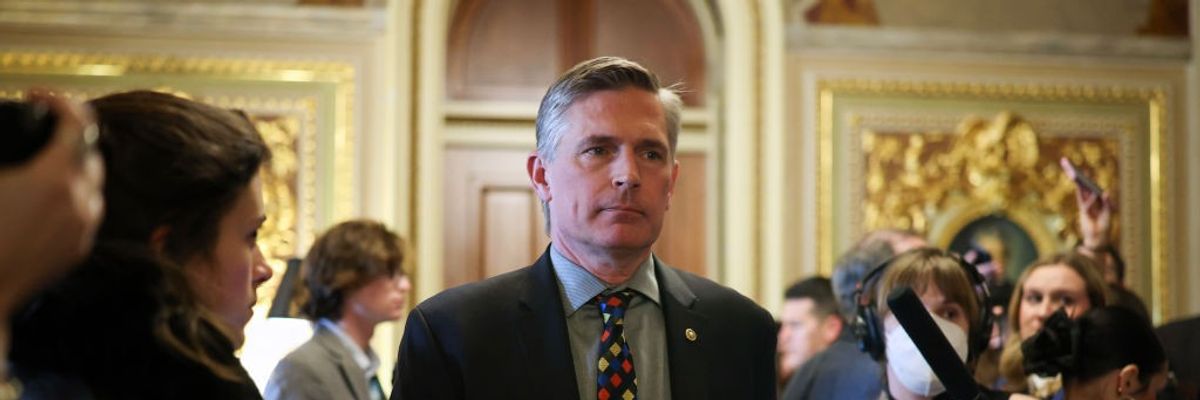
U.S. Sen. Martin Heinrich (D-N.M.) leaves the Democratic caucus lunch at the U.S. Capitol on March 13, 2025 in Washington, D.C.
(Photo: Kayla Bartkowski/Getty Images)
The provision, part of the Senate budget bill, was described as “a blatant giveaway to the pharmaceutical industry that would keep drug prices high for patients while draining $5 billion in taxpayer dollars.”












No comments:
Post a Comment
Note: Only a member of this blog may post a comment.