
05 September 25

The president has built his return to power on projecting American strength abroad, and Venezuela offers a ready stage.
This isn’t the first time a mysterious explosion at sea has been used to shape American public opinion and drum up pro-war sentiments. In 1898, the battleship USS Maine blew up in Havana Harbor, killing more than 260 sailors. The cause was never proven, but American newspapers exploited the ambiguity to blame Spain, stoking outrage that fueled the Spanish-American War. Within months, the United States had radically recast power in the Caribbean, a grip it has maintained ever since, even when such power was challenged during the Cold War.
The strike on what U.S. officials insist was a drug boat carries the same kind of ambiguity. The Trump administration quickly produced a blurry video of the explosion, but the images don’t prove who was aboard, what they were doing or whether drugs were even present. The White House has offered no hard evidence that the dead were members of a gang. “Pentagon officials were still working Wednesday on what legal authority they would tell the public was used to back up the extraordinary strike in international waters,” The New York Times reported.
But for a president who has promised to “pursue our manifest destiny,” this is part of a larger script already in motion. “In the Trump era, a new manifest destiny is here, accelerating protectionism and expansionism at the cost of the powerless,” I wrote at the start of Trump’s second term. This worldview, shaped by a 19th-century ideology that also fueled the war against Spain 127 years ago, treats the Western Hemisphere as territory still to be controlled.
Under Trump, as in recent decades, the so-called war on drugs provides the cover. Never mind that America remains an incredibly lucrative drug market — fighting trafficking has been good for American interventionism. Plan Colombia poured billions into militarization that fueled displacement and bloodshed. The Mérida Initiative coincided with record homicides and human rights abuses in Mexico. In the Caribbean, counternarcotics has long served as the rationale for an expanded U.S. naval presence, including the current deployment of warships off the coast of Venezuela.
The timing of the attack, which experts are calling a violation of international law, is no coincidence. Trump has built his return to power on projecting American strength abroad, and Venezuela offers a ready stage. The United States has deployed more than 4,500 sailors and Marines, along with seven warships, in the Caribbean. Casting the South American country as a narco-state justifies force, rallies his base and signals to the region that Washington still wants to dictate the rules to Latin America.
And the messenger matters. Fully supporting Trump is Marco Rubio, the country’s first secretary of state of Latino descent. Defending the decision to reporters in Mexico City on Wednesday, Rubio said that “instead of interdicting it, on the president’s orders, we blew it up — and it’ll happen again.” He argued that ordinary seizures don’t deter traffickers, adding, “What will stop them is if you blow them up. The president is going to wage war on narco-terrorist organizations.”
Rubio’s words were less a policy blueprint than a posture. They reflected Cuban exile politics that have long pushed Washington toward confrontation in the region and that Rubio, as a longtime senator from Florida, is deeply familiar with. And that posture does have an audience, particularly among U.S. Latinos. Social media analysis from the Digital Democracy Institute of the Americas (DDIA) notes that “online discourse among U.S. Latino communities this week continues to be dominated by escalating U.S.-Venezuela tensions, with prominent social media accounts driving narratives of imminent military action and growing calls for [Venezuelan President Nicolás] Maduro’s Venezuela to be designated a narco-terrorist state.” In fact, Venezuela doesn’t really produce that much cocaine, although The New York Times reports that “U.S. indictments and leaked Colombian records describe Venezuelan security forces as overseeing drug shipments worth billions of dollars.”
As expected, Venezuela has made sure to paint Trump and the United States as Yankee imperialist warmongers. Maduro isn’t popular, but the left-wing authoritarian knows history and how to use it. He said the U.S. buildup “threatens the entire region,” and warned he would declare a “republic in arms” if American troops crossed into Venezuelan territory.
As far-fetched as that may seem, the Trump administration is ramping up the tension, instead of toning it down. History shows how quickly moments like this can escalate. The Maine in 1898, U.S. troops in the Dominican Republic in 1965, Grenada in 1983, Panama in 1989 — each framed as defensive, each ending in military intervention. This week’s strike carries the same risk, wrapped in similar justifications.
The question isn’t whether a corrupt, authoritarian figure leads Venezuela. It’s whether the United States is again using a familiar script to justify actions that will destabilize a hemisphere, with Latino communities in the U.S. now serving as both amplifiers and targets of the narrative.
This week’s strike was an act of war. To pretend otherwise is to ignore history and to blind ourselves to what the United States has done time and again in Latin America and the Caribbean. If we are serious about learning from the past, we should call it what it is.
Trump's Return of the ‘War Department’ Is More Than Nostalgia. It’s a Message.
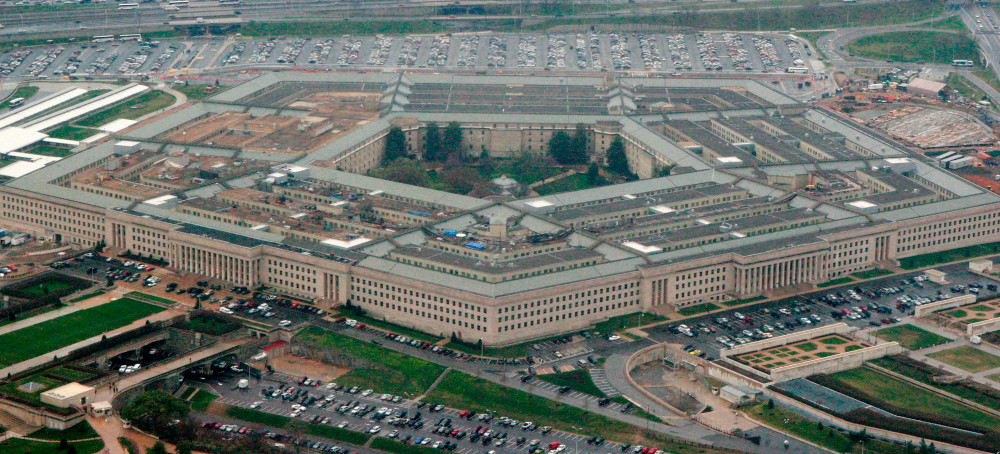 “Everybody likes that we had an unbelievable history of victory when it was Department of War,” (photo: Getty)
President Trump and his defense secretary say they want to return to the era when America won wars. They largely ignore the greatest accomplishment of the past 80 years: avoiding superpower conflict.
It was a terrifying time for Americans, and the new name was intended to reflect an era in which deterrence was critical — because war, if it broke out among the superpowers, could be planet-ending. For decades, the odds of avoiding that nuclear exchange, or direct superpower conflict, seemed slim at best. So to many historians, the greatest accomplishment of the Cold War is that it largely stayed cold, despite wars in Korea and Vietnam, the Cuban Missile Crisis and arms races that followed.
All of which makes President Trump’s planned executive order on Friday seeking to restore the Pentagon to its old name — the War Department — more than just a throwback, a restoration of tough-guy nomenclature. At a moment when deterrence is more critical than ever — in cyberspace, outer space and a world where Russia and China are celebrating an uneasy partnership to challenge American pre-eminence — Mr. Trump argues that the answer is to go back to the good old days.
“Everybody likes that we had an unbelievable history of victory when it was Department of War,” he told reporters two weeks ago. “Then we changed it to Department of Defense.”
To anyone who has watched the revolution sweeping the country’s national security institutions over the past seven months, the president’s order came as no surprise.
“In a way it makes perfect sense: This administration is simply taking us back to that period before the Truman era,” said Douglas Lute, a career Army officer who played key roles in the National Security Council in the Bush and Obama administrations and served as the U.S. ambassador to NATO. “It has disassembled the processes, institutions and the norms that were established after World War II.
“More substantive than the name change is what they have done,” he said, citing the doubts of American allies that the United States would come to their defense and Mr. Trump’s gyrations in dealing with Russia. “Once that trust that serves as the glue of the alliance structure is eroded, we’ll pay a very high price to get it back, if we can recover it at all.”
Certainly in recent months Mr. Trump has shown less interest in building deterrence than he has in investing in new weaponry. He has dismantled broad swaths of the Cybersecurity and Infrastructure Security Agency, part of the Department of Homeland Security, because its mission of defending against foreign and domestic cyberattacks included securing election systems. He even ordered the Justice Department to investigate the agency’s chief during the 2020 elections, for his declaration that it was one of the most secure in history, contradicting his insistence that it was rigged to elect Joseph R. Biden.
Mr. Trump fired the four-star general heading both the National Security Agency and U.S. Cyber Command, part of a broader purge of apolitical military officers who were appointed in the Biden era. Morale among senior officers is suffering, as they wonder whether it is worth pursuing top command positions if a declaration from a MAGA influencer that they are secretly members of the so-called deep state is all it takes to end a three-decade-long career.
Mr. Trump’s one big investment in defense is the Golden Dome, his plan to build a coast-to-coast missile defense. But to America’s adversaries, the system, involving weapons in space, looks as much like offense as defense.
When it comes to renaming the department, no one is more enthusiastic than Defense Secretary Pete Hegseth. If Mr. Trump gets his way, will get the title of secretary of war — the president has already called him that in public — joining a long line that started with Henry Knox, for whom Fort Knox is named.
“We won World War I, and we won World War II, not with the Department of Defense, but with a War Department,” Mr. Hegseth said on Fox News on Wednesday. “As the president has said, we’re not just defense, we’re offense.”
“We think words and names and titles matter,” he concluded. Clearly he does: It is Mr. Hegseth who talks repeatedly about bringing “lethality” and a “warrior ethos” back to the American military. When he arrived at the Pentagon, one of his first moves was to ban the oft-used phrase in the building that “our diversity is our strength.” (“The single dumbest phrase in our military history,” he told the troops.)
But words matter to other nations as well, allies and adversaries alike. And this change in name, assuming Congress is willing to rewrite the Truman-era laws, plays right into the narrative that Russia and China propagate about the United States.
In their telling, all of America’s talk about being a peace-loving, law-abiding international player is thin cover for a country that truly just wants to strike at any target it regards as a threat. To bolster their cases, their state-controlled commentators point to Mr. Trump’s unilateral decisions to strike Iran’s nuclear facilities in June or sink an open skiff of alleged drug runners, killing 11 people off the coast of Venezuela.
“This is a backward-looking decision,” said R. Nicholas Burns, the former U.S. ambassador to China who spent decades as a foreign service officer, including ambassador to NATO. “It plays into China’s narrative in its unrelenting contest for global influence with the U.S. Beijing will brand this unfairly as evidence the U.S. is a threat to the international order and China is a defender of the peace.”
Mr. Trump and Mr. Hegseth may be granting President Vladimir V. Putin of Russia a similar opportunity. Long before he invaded Ukraine in 2022, Mr. Putin insisted the “root causes” of his determination to restore some of the old boundaries of the Russian empire included the American-led drive to expand NATO to Russia’s borders in the 1990s. The West’s response has always been that NATO’s presence is entirely defensive.
But the United States undercuts that case when it insists that it’s tired of playing defense, as the president and the defense secretary have insisted repeatedly in recent weeks. To them, the restoration of a War Department heralds the fact that there is a new sheriff in town, with a new way of looking at the use of force.
At one level, of course, what Mr. Trump and Mr. Hegseth are doing is little more than rebranding — a concept the president knows well, as he renamed real estate projects in hopes that by sounding better, they would sell better. The mission of the Army, Navy, Air Force and Marines does not change. Nor does the combination of defensive and offensive missions at the units sitting on the cutting edge of new technology, such as the United States Cyber Command or Mr. Trump’s beloved Space Command.
But at another level, renaming the world’s most powerful military force — the trillion-dollar defense budget (perhaps better called the war budget) is roughly three times larger than China’s — will be seen as part of the continuum of the Trump revolution.
In that world, American soft power is out, and hard power is celebrated. Shuttering the U.S. Agency for International Development, silencing the Voice of America and Radio Free Asia, and cutting billions of dollars in foreign aid in the State Department budget sent a message: The United States is out of the democracy-promotion business, and out of the benevolent-nation business.
Mr. Trump and his aides have made it abundantly clear they view soft power as no form of power at all. Secretary of State Marco Rubio this week celebrated giving up one of his four government titles — administrator of U.S.A.I.D. — to Russell T. Vought, the director of the Office of Management and Budget. “Russ is now at the helm to oversee the closeout of an agency that long ago went off the rails,” Mr. Rubio wrote. “Congrats, Russ.”
As Mr. Rubio’s comments made clear, those programs — once considered vital to attracting the world to American values — rank somewhere between unaffordable charity and wastefulness, disconnected from American interests.
Trump’s Radical Agenda Will Ultimately Reach a Supreme Court Stacked in Favor of Conservatives
 Donald Trump is expected to ask supreme court to review his use of Alien Enemies Act to deport Venezuelans, ruled as unlawful by a lower court. (photo: Will Oliver/EPA)
Court has already dramatically limited ability of lower courts to issue injunctions to pause administration policies across the US
Trump has already asked the supreme court to overturn the lower court ruling in the tariffs case. Almost certain to follow are Trump’s invocation of the Alien Enemies Act to deport Venezuelans, his hostile conflict with Harvard University and his deployment of the national guard and marines to Los Angeles. All have been deemed unlawful in lower courts.
“It’s simple: the president and his administration continue to do illegal things at an astonishing pace, and so the courts are finding that these things are illegal,” said Donald Sherman, executive director and chief counsel at Citizens for Responsibility and Ethics in Washington.
“The president is committed to pursuing his agenda regardless of whether it’s legal or not, and is seeing what he can get away with.”
The ultimate arbiter of that will be the supreme court, which is stacked 6-3 in favor of conservatives, many of whom Trump has appointed. The court has already dramatically limited the ability of lower courts to issue nationwide injunctions to pause Trump administration policies across the country.
That has not stopped them from issuing more targeted blocks. On Tuesday, a three-judge panel of the fifth US circuit court of appeals ruled in a 2-1 decision that the president had unlawfully invoked the 18th-century Alien Enemies Act to deport Venezuelan men he alleged were members of a criminal gang. Its preliminary injunction blocked the administration from removing a group of Venezuelans.
The seldom-used act gives the government expansive powers to detain and deport citizens of hostile foreign nations, but only in times of war, or during an “invasion or predatory incursion”. Circuit judge Leslie Southwick rejected the Trump administration’s claim that the Venezuelan gang Tren de Aragua had engaged in a “predatory incursion” on US soil.
“This is a critically important decision reining in the administration’s view that it can simply declare an emergency without any oversight by the courts,” said Lee Gelernt, the American Civil Liberties Union attorney who represented the Venezuelans.
The Trump administration, however, could ask the entire fifth circuit to rehear the case – and it is expected to eventually reach the supreme court.
Also on Tuesday, a federal judge found that Trump had illegally deployed thousands of military troops to Los Angeles in June, and barred the Pentagon from using national guard members and marines to perform police functions, such as arrests and crowd control.
About 300 troops are still on the streets of Los Angeles and Trump is threatening to send more to other Democratic-led cities, including Chicago and Baltimore. Last month, he deployed the national guard to Washington DC, where he has direct legal control, supposedly to crack down on violent crime, which is at a 30-year low in the city.
The judge’s order, set to take effect on 12 September, condemns Trump’s apparent goal of “creating a national police force with the president as its chief”. It was a victory for the California governor, Gavin Newsom, who sued the administration in June, arguing Trump had violated the 1878 law – the Posse Comitatus Act – prohibiting the use of US military troops in domestic law enforcement.
Newsom called Trump’s actions an “unmistakable step toward authoritarianism” and an alarming abuse of power. The administration countered that troops were protecting federal officers, not enforcing laws – but the judge disagreed, ruling the deployment illegal.
A day later, a different federal judge ruled that the Trump administration had unlawfully terminated about $2.6bn in grants awarded to Harvard University, and ordered it to reverse funding cuts to the prestigious Ivy League school. It marked a major legal victory for the nation’s oldest university. The judge said the administration’s actions constituted illegal retaliation after Harvard refused the White House’s demands to change its policies and governance.
In a separate case, the judge had already barred the administration from halting Harvard’s ability to enrol international students, who comprise about a quarter of its student body.
Just as Trump used the Alien Enemies Act in the context of a wider move to deport millions of people, and used troops on US soil as part of a wider authoritarian crackdown, Harvard was another test case – this time as part of Trump’s effort to leverage federal funding to force ideological changes at American universities.
Each of the cases, Sherman said, attempt to push the boundaries of what’s allowable by “brazenly violating the law”.
“He’s attempting to do things knowing that it’s illegal, knowing it would have to go to court to be challenged,” he said. “It is monumentally stupid.”
But it also presents a significant challenge for individuals and organizations forced to sue, Sherman adds – and for the courts themselves, which must keep up with the volume of lawsuits.
“They are breaking laws that are clearly written and understood, and it’s creating strain on other institutions who are struggling to keep up.”
Now Trump has asked the supreme court to review the tariff defeat after the ruling that he had overstepped his presidential powers when he enacted punitive financial measures against almost every country. In a 7-4 ruling, the Washington DC court said that, while US law “bestows significant authority on the president to undertake a number of actions in response to a declared national emergency”, none of those actions allow for the imposition of tariffs or taxes.
The ultimate decision on many, if not all, of these cases will probably be made by the supreme court. With its rulings on presidential immunity and other key conservative opinions, Trump has “indications from the supreme court that, despite what the law says, he can do what he wants”, Sherman said.
“That has informed his approach since he’s been back in office,” he added. “He seems to be unencumbered by what the law is and what the law requires.”
***NATIONAL GUARD PLANTING GRASS & PICKING UP TRASH FOR + $ 1 MILLION PER DAY! ****
With No End in Sight, National Guard Troops Deployed to DC Grow Weary
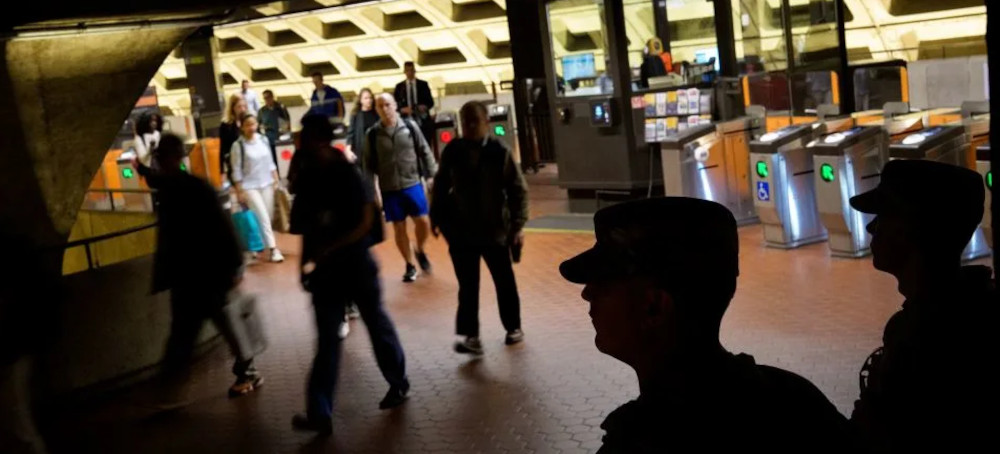 National Guard troops from South Carolina stand guard at Washington, DC's Foggy Bottom Metro Station on August 20. (photo: Andrew Harnik/Getty)
05 September 25
One soldier from Tennessee told his father that from 4 p.m. to 4 a.m. every day, his only task is to walk around Chinatown. Another service member from Mississippi told a loved one that she’d been repeatedly cursed at while on patrol. During a call to his wife, a guardsman from Louisiana said there was confusion about what the military was actually doing there.
“We haven’t gotten critically low on morale, but we’re falling fast,” said one soldier who, like others quoted in this story, spoke to CNN on the condition of anonymity because they’re not authorized to speak to the media and feared reprisal.
Of the more than 2,200 National Guard soldiers President Donald Trump deployed to Washington, DC, last month, in addition to a wave of federal law enforcement, roughly 1,300 are from out of state. Guard members on the DC mission and their relatives who spoke to CNN said they left behind civilian jobs and children to serve – a sacrifice they understood when they enlisted.
And while domestic missions typically have National Guard troops responding to crises like hurricanes or wildfires, in DC, much of their work has involved more mundane tasks – patrolling popular tourist destinations and assisting with “beautification projects” including picking up trash, raking leaves and laying mulch.
Most of that beautification work has been assigned to soldiers from the DC National Guard to avoid angering GOP governors who have sent their troops.
For some, the mundane orders aren’t an issue. One father of a Guardsman joked that this is like a vacation for his son. But the mother of another soldier from Mississippi said her daughter is missing out on “a lot of first events with her child” to serve in Washington.
It’s also unclear how long the deployment will last. A senior official familiar with the planning told CNN military orders for guardsmen on the mission are expected to be extended through the end of December, though the official stressed that was largely to ensure the continuity of their benefits like health care coverage, and not necessarily to indicate the mission will continue through year’s end.
Trump has also threatened to mobilize the National Guard to other cities, including Chicago, Baltimore and New Orleans, as part of his administration’s crackdown on crime. He’s said he could keep National Guard members in Washington “as long as I want” by declaring a national emergency.
‘Yeah, this is crazy’
For a mission that already carries a price tag of about $1 million a day, costs are continuing to mount. Expenses include an estimated $7 million in catered food for the first 10 weeks and $5 million for 18 weeks of laundry services, according to a CNN review of contracts.
An additional $5 million for a tent city has also been approved, the contracts show, along with $600,000 in air conditioning rental and more than $500,000 for land mobile radios.
The troops are assigned to stay in hotels, most of which are located in suburban Virginia. Housing is among the biggest expenditures. Hotel rooms are provided for out of town troops, while housing allowances are given to DC National Guard members.
Though some of the National Guard and their families contacted by CNN expressed support for Trump and his decision to send troops to DC, they acknowledged the personal sacrifices for soldiers on the mission. In many cases, the standard military pay is less than what a soldier or airmen may be earning in their civilian careers. Some have had to make special arrangements for childcare while they’re away.
“I don’t know what he thought he’d be doing, but I really don’t think he thought he’d just be walking around for 12 hours every day,” said the father of a Guardsman from Tennessee.
“When I talked to him, he was just like, ‘Yeah, this is crazy,’” the father added. He said his son, a car salesman, is making less money now while deployed.
Typically, guard members only receive full military benefits like a housing allowance or health care coverage when they’re on active orders for more than 30 days.
A statement on Monday from Joint Task Force-DC, which is overseeing the DC mission, acknowledged there had been “concerns about the pay and benefits” for service members on the mission, but said “the majority of service members are mobilized on orders extending beyond 30 days, ensuring they qualify for full benefits.”
“I mean, we’ve got to get these cities cleaned up,” said the mother of one Guardsman from Tennessee. “We’re very much pro boots on the ground. If that’s what it takes, we back the troops.”
A unique mission
In situations when the National Guard has been deployed for an emergency, such as in the wake of a major hurricane, their presence is typically welcome and applauded. But in Washington, some soldiers have received a chilly reception from locals, family members said. City residents who disagree with Trump’s federal interference have hung posters on street corners calling for the soldiers to leave.
“Go home,” a crowd of people chanted two weeks ago to some troops standing outside the Columbia Heights metro.
“The president is driving a wedge between the people and the military,” Retired Army Maj. Gen. Randy Manner, the former acting vice chief of the National Guard Bureau from 2011-2012, said in an interview with CNN.
“Our military’s duty is to defend our nation overseas and to be there to save lives in times of a natural disaster,” Manner added. “So this idea that the National Guard are there to watch us and to intimidate us, if it is continued over the next months and years, will absolutely drive this feeling that those men and women in uniform are not us, and they are against us.”
The contingent of more than 2,000 National Guard soldiers has been divided into serving the “safe and secure mission” and a “beautification task force.” The troops working on the secure mission are assigned to support federal and local law enforcement efforts, while the beautification project is largely designed to clean up national park properties in the city.
The senior official familiar with the DC mission said that while morale among those deployed is generally good at the moment, that could change if their orders are extended and people are kept from their families and civilian careers. The person added that senior leaders in the DC Guard have made a point in participating in the “beautification projects” – largely trash pickup – to ensure the tasks don’t fall to just junior soldiers or airmen.
An out-of-state Guardsman standing outside a metro station during Labor Day weekend told CNN that the reaction to his presence there is “50-50.” Some people have stopped to take photos with him and have thanked him for serving. Others leveled disapproving looks, he said.
He added that he would be in Washington “until they tell us we can go home.”
‘National gardeners’
Trump officials have said the troops are there to establish a presence at various locations – mostly federal monuments and metro stations – and act as a crime deterrent. The intention is to free up law enforcement agents to address crime elsewhere in the city. The senior official familiar with the mission said the Guard has heard from local law enforcement that their presence has in fact been a deterrent to crime they might usually see in the area.
***CONSPICUOUS LIES!****
As of Tuesday evening, Joint Task Force-DC said there had been a 37% drop in carjackings in DC, a 50% decrease in robberies, and a 23% drop in violent crime since the mission began. Though Trump justified the troop surge to Washington by saying that crime was “out of control” in the city, violent crime declined in 2024 and has declined again so far in 2025. The Justice Department has said it’s investigating whether that data from the DC Metropolitan Police Department was manipulated.
Social media pages for the state National Guard units part of the DC mission have posted photos of smiling soldiers around the city. Family members and friends commented wishing for the troops to stay safe.
***$1 MILLION PER DAY TO PLANT GRASS?****
Some soldiers have also been doing things like replanting grass. Manner said that some are now referring to the troops as “National Gardeners,” which he believes is also “very deflating” for them.
“To date, Guardsmen have cleaned more than 3.2 miles of roadways, collected more than 500 bags of trash, and disposed of three truckloads of plant waste in coordination with the U.S. National Park Service,” the Joint Task Force-DC said in an update on Monday.
Trump’s executive order in March, titled “Making the District of Columbia Safe and Beautiful,” ordered federal agencies to restore federal monuments that have been defaced or damaged, remove graffiti from local areas, and “uplift and beautify public spaces and generate in the citizenry pride and respect for our Nation.”
A South Carolina National Guard officer who knows soldiers deployed to Washington said that all servicemembers must obey lawful orders, but “the problem is, this is not a clear set mission.”
“If you wanted to be smart about it, then you might send a water purification unit to DC to help them with purifying water, or you could’ve sent an agriculture unit to help with farming,” the officer said. “But an infantry unit to rake? That doesn’t make any sense.”
On Labor Day, some National Guard stood beside armored military vehicles at Washington’s Union Station as a small number of protesters holding upside down American flags and signs gathered in front of them. Other soldiers walked around the city’s baseball stadium while the Nationals played that afternoon.
The wife of one Guardsman deployed to Washington said more clarity on the mission’s timeline would help. She and her husband have three children with another on the way. Just like past deployments, she’d avoided asking when he’ll be home.
“It’s a little unusual in terms of what National Guard are usually deployed for, but I mean, I guess I would say I’m open to it,” the wife said. “I feel like maybe they would get a little boost in morale if they could just get a little bit more details.”
***LOVE THE PHOTO!
2 IGNORANT BOOBS SIDE BY SIDE!****
RFK Jr. And the White House Buried a Major Study on Alcohol and Cancer. Here’s What It Shows.
 President Donald Trump and Health Secretary Robert F. Kennedy Jr. will oversee a revision of the US dietary guidelines — including the guidance on drinking alcohol. (photo: Chip Somodevilla/Getty)
For the past three years, the industry, aided by its allies in Congress and later the Trump administration, has sought to discredit and eventually bury a major analysis that offers new evidence of the link between drinking alcohol and getting sick and dying from various causes, including cancer.
It appears their campaign has succeeded. Three co-authors on the Alcohol Intake and Health Study, which was commissioned in early 2022 by the US Department of Health and Human Services under President Joe Biden, told Vox that they were informed last month that the Trump administration did not intend to publish the final draft of the study or its findings.
“The thing that the alcohol industry fears more than increased taxes is increased knowledge about the risks associated with drinking alcohol, particularly around cancer,” Mike Marshall, CEO of a group dedicated to reducing alcohol’s harms called the Alcohol Policy Alliance, who was not involved with the study, told me. “Like the tobacco industry, like the opioid industry, they are working hard to prevent the American people from gaining the knowledge that they need to make the best decisions for themselves.”
Why assert so much pressure? It makes sense if you look at the headwinds the alcohol industry faces. Americans today are drinking less. This year, Gallup recorded a historic low in the percentage of US adults who drink: 54 percent, down from 67 percent in 2022.
Though the vibes around alcohol are shifting, a lot of people still don’t fully understand alcohol’s health consequences. Surveys have found that while the percentage of Americans who know that alcohol is a carcinogen has been rising, it is still below 50 percent.
By the end of the year, the federal government will issue new dietary guidelines — something that happens every five years — which include recommended limits on alcohol consumption. The alcohol study’s results were intended to inform those guidelines.
“I was hopeful. … Look at all this evidence we have,” Priscilla Martinez, deputy scientific director of the Alcohol Research Group at the Public Health Institute and one of the co-authors, told me in an interview. “This is when the change is going to happen.”
But after the authors submitted their final report to Trump’s health department in March and never saw it again, Reuters reported in June, citing anonymous sources, that the new dietary guidelines would eliminate any specific recommended limits on alcohol consumption.
“I think it’s a shame,” said Katherine Keyes, an epidemiologist at Columbia University and another co-author. “Anyone who is a decision-making authority, you want them to have all of the information.”
It is another example of the Trump administration seeming to work against the best interest of public health — despite allying itself closely with Health Secretary Robert F. Kennedy Jr. and his Make America Healthy Again movement.
Kennedy and MAHA are fixated on harmful toxins and the corrupting influence of corporate interests. But neither Kennedy, who has been in addiction recovery himself for decades, nor the broader movement has seemed to make reducing alcohol consumption a priority. Instead, the Trump administration will not release a report that would actually show just how harmful to people’s health drinking alcohol can be, the latest in a series of decisions that could actually leave Americans less healthy.
Vox reached out to the White House and HHS to ask why the administration hasn’t published the study, but a spokesperson for the Substance Use and Mental Health Services Administration, the HHS subagency that oversaw the Alcohol Intake and Health Report, declined to address our questions directly.
“People are going to get sick who might have avoided getting sick, because they might have decreased their drinking,” Martinez said.
The Alcohol Intake and Health Study’s conclusions, explained
For this story, I spoke with three of the six authors of the study: Martinez, Keyes, and co-author Tim Naimi, an alcohol researcher affiliated with the University of Victoria and Boston University. They all emphasized that they had sought to conduct a study that would fairly represent America’s alcohol consumption. They not only reviewed a wide range of observational studies, but they also ran data through a statistical model based on the US population, specifically to estimate the mortality effects of alcohol for Americans.
Martinez said the thinking was: “We’ve got to make this relevant to Americans.”
They broke out their findings by different drinking levels — from one drink per day to three — and focused on health outcomes that have been proven to be associated with alcohol use. Their big-picture conclusion: Among the US population, the negative health effects of drinking alcohol start at low levels of consumption and begin to increase sharply the more a person drinks. A man drinking one drink per day has roughly a one in 1,000 chance of dying from any alcohol-related cause, whether an alcohol-associated cancer or liver disease or a drunk driving accident. Increase that to two drinks per day, and the odds increase to one in 25.
The general finding that the health risks from alcohol start at low levels of drinking and increase significantly for people who drink more is consistent with previous research, as I covered in a story earlier this year. Public health experts broadly agree that heavy drinking is bad for your health; the debate has been over moderate amounts of drinking. There is another issue that continues to complicate the debate: Lay people may have an inflated definition of what “moderate” drinking means compared to their doctor or a scientist, which could lead to people putting their health at risk even if they don’t think of themselves as heavy drinkers.
In that context, the report is a harrowing read: Alcohol use is associated with increased mortality for seven types of cancer — colorectal, breast cancer in women, liver, oral, pharynx, larynx, and esophagus. Risk for these cancers increases with any alcohol use and continues to grow with higher levels of use, the study’s authors concluded. Women experience a higher risk of an alcohol-attributable cancer per drink consumed than men. Men and women who die from an alcohol-attributable cause die 15 years earlier on average.
Amid all of the public discourse about alcohol and its health effects, here was a clear and authoritative summary of the evidence that would be most relevant to Americans. It was, its authors told me, consistent with the scientific consensus at this time.
“Nothing we’re saying is all that surprising or controversial to those of us who know the field,” Keyes said.
So, why has the US government buried the final draft of that report for the past six months? And why does it appear that the Trump administration will instead push the country’s dietary guidelines in the opposite direction?
A tale of two studies
Every five years, the federal government reviews the nation’s dietary guidelines and issues new ones that reflect the current best consensus among scientists about what we should eat, how much of it we should eat, and what we should avoid eating and drinking to lead a healthy life.
US officials always solicit expert opinion as they prepare a fresh set of dietary guidelines. The input is usually compiled into one massive report from a group of experts called the US Dietary Guidelines Advisory Committee and then submitted to the Department of Health and Human Services and the Department of Agriculture, the two agencies that produce the guidelines.
That was how the process went in 2020, and at that time, the subcommittee of researchers dedicated to alcohol (including Naimi) advised the government to reduce the recommended limit down to one drink per day for men, from two. The Trump administration ultimately decided not to follow the recommendation.
Ahead of drafting the new guidance for 2025, the Biden administration began considering in February 2022 whether to take a different approach to more thoroughly review alcohol’s health effects ahead of the 2025 dietary guidelines being developed and released. By April 2022, HHS had decided to launch a new review of the science on alcohol and health, called the Alcohol Intake and Health Study — the research Trump’s administration has yet to release — to be conducted by an outside expert panel. That analysis would be submitted to Congress as part of an annual report on underage drinking, and it would be shared with USDA and HHS to consider for the 2025 dietary guidelines.
It makes sense why the federal government would launch an effort like this. The negative health effects of alcohol have been getting more and more attention, and research continues to link drinking even in moderate amounts to cancer, liver disease, and mental health problems. The World Health Organization declared in 2023 that no amount of drinking could be considered safe. It was time to take a hard look at American drinking.
The dueling government alcohol reports, briefly explained
With their mouthful titles and tangle of acronyms, it’s easy to lose track of which government report is which. To keep them straight, here are the key ways the Biden-commissioned Alcohol Intake and Health Study differs from the more recent National Academies report:
- The Alcohol Intake and Health Study reviewed the effects of different levels of drinking; it reported on mortality directly linked to alcohol use, and included original modeling based on the US population.
- The National Academies report reviewed the differences between moderate drinking and no drinking; it reported on all-cause mortality rather than deaths from specific causes, and it did not include any original modeling.
- The Alcohol Intake and Health Study found the negative health effects of alcohol started at relatively low levels of drinking and increased exponentially with more drinks per day. Drinking was linked to higher overall mortality rates and increased cancer rates.
- The National Academies report, on the other hand, found modestly positive benefits from alcohol at low levels of drinking and a weak association with most kinds of cancer except for breast cancer among women.
But almost immediately, controversy was already brewing around the Alcohol Intake and Health Study.
In December 2022, several months after HHS had decided to launch the Alcohol Intake and Health Study, Congress included a provision in a routine government spending bill: The National Academies of Sciences, Engineering, and Medicine should undertake its own study of alcohol’s health effects and submit that as the basis for the 2025 dietary guidelines. Two of the initial co-authors for that report were removed after objections over their reported connections to the alcohol industry. But at least one of the scholars who replaced them has also had their work supported by the industry.
When the experts who would produce the Alcohol Intake and Health Study were named in 2023, the alcohol industry began to circulate documents to lawmakers and other government officials claiming authors of the study were prejudiced against alcohol (all of the researchers had submitted conflict-of-interest paperwork ahead of joining the project). Naimi, in particular, has been labeled a “new prohibitionist” by Reason, a libertarian publication.
Keyes told me that she believed she had been criticized for, in effect, describing the findings of various alcohol-related studies.
“When I read criticism of my involvement in the committee, and it was described as a conflict of interest, the conflict was that I had accurately described scientific research in the media,” Keyes said.
Lawmakers on Capitol Hill waded into the fight. In March 2024, Congress tucked a provision into another omnibus spending bill that instructed HHS and USDA to consider the National Academies report when writing the alcohol guidelines. Representatives from states including Kentucky and California — where whiskey and wine are important cultural exports, respectively — sent letters to HHS in April 2024 and again that September, criticizing the Alcohol Intake and Health Study for being duplicative of the National Academies report — even though the former was commissioned by the government first. (HHS said at the time that it would not be duplicative but complementary.) The House Oversight Committee even sought to subpoena documents from the agency on the HHS report and the process that was producing it.
Both groups of researchers continued to assemble their reports as the public relations war raged. But when it came time to publish their findings, they had very different experiences.
Why hasn’t the final Alcohol Intake and Health Study been released?
A draft version of the Alcohol Intake and Health Study was posted on January 15, just days before Trump’s second inauguration and around the same time that then-Surgeon General Vivek Murthy recommended that alcohol come with cancer warning labels; you can still find it online here. This is the process for most government reports: The authors put together a draft, the initial findings are released for public comment, stakeholders submit their takes, and then the authors will take those comments into consideration and revise their report for its final publication.
But that didn’t happen with the Alcohol Intake and Health Study. After the public comment period, the authors made minor revisions — not to the findings themselves but to help translate its takeaways for non-experts. They sent that final report to the Trump administration in March.
And after that…nothing. The report never surfaced, and, according to the three co-authors I spoke with, they received no explanation for the radio silence.
Vox contacted HHS with a detailed list of questions about the Alcohol Intake and Health Study and why it hasn’t been released, as well as Kennedy’s general perspective on alcohol and health. The agency sent a brief comment in response:
“This information has been provided to HHS and USDA for consideration during the development of the 2025-2030 Guidelines,” an HHS spokesperson said.
Some of the authors still held out hope that the study would be included in the annual report on underage drinking that is required by federal law to be submitted to Congress and is expected later this year.
But then in August, those hopes were shattered: According to all three co-authors, they were told that the Trump administration did not intend to publish the study in any form and would not include it in the upcoming congressional report on underage drinking. (The authors are currently working, as they always planned to do, on publishing their findings in an independent academic journal.)
Then, at the beginning of September, Congress introduced a new government spending bill that would, among many other things, defund the interagency group responsible for launching the Alcohol Intake and Health Study in the first place during the Biden administration.
The National Academies report, on the other hand, has been released on time. Its findings, however, were controversial: It indicated that moderate levels of drinking could actually be beneficial to people, and even the links to cancer, despite ethanol being widely classified as a carcinogen, were limited. Some unaffiliated alcohol researchers have called their findings and their methodology into question.
Critics said the National Academies report was based on observational studies that can show a correlation between, for example, moderate drinking and cardiovascular health, but don’t prove a cause; the National Academies report’s authors acknowledged that limitation. As Naimi told me earlier this year, many moderate drinkers may have other attributes — such as higher incomes — that could explain their better health without accounting for alcohol. Critics of the National Academies report also said the authors had used overly restrictive criteria for which research to include, excluding many studies that have found harmful effects from alcohol use.
The Alcohol Intake and Health Study, on the other hand, focused on health outcomes for which there is a substantiated link to alcohol, included more studies, and modeled the available data to the US population.
The ball is now in the Trump administration’s court. Will it change the dietary guidelines as rumored and eliminate a specific recommended limit on alcohol consumption? The National Academies report would appear to set the stage for such a change, with its industry-preferred messaging that low levels of drinking could make people healthier.
And all the while, the Alcohol Intake and Health Study and a very different perspective on alcohol’s health effects remains locked in the administration’s proverbial basement.
****DIRTY ENERGY KOCH FUNDED OPPOSITION TO CAPE WIND, THE FIRST PROJECT
OF OFFSHORE WIND TURBINES PLANNED FOR THE COAST OFF CAPE COD. THEY
FOUGHT FOR 16 YEARS BEFORE ABANDONING THE PROJECT!
VINEYARD WIND IS SCHEDULED TO BEGIN FULL PRODUCTION BY THE END OF THE
YEAR & WILL PRODUCE ENOUGH POWER TO PROVIDE THE ENERGY NEEDS OF
400,000 HOMES! NOW ANTI-WIND TRUMP ET AL ARE THREATENING TO PULL
PERMITS!
PROJECTS OFF THE COAST OF RHODE ISLAND & CONNECTICUT ARE THREATENED.
FUNDING FOR SALEM MASSACHUSETTS HAVE BEEN CANCELLED - LAWSUIT
FILED!
THERE WERE OUTLANDISH LIES & PROPAGANDA PROMOTED!
THIS IS DIRTY ENERGY WITH STICKY FINGERS TO PROMOTE DIRTY ENERGY
& CONTINUE TAXPAYER SUBSIDIES, OUTRAGEOUS PROFITS & CONTINUE
THEIR POLLUTION!
SUPPORT CLEAN WIND TURBINES THAT NOT ONLY PRODUCE CLEAN ENERGY
BUT ALSO CREATE JOBS! THIS IS THE FUTURE! ****
Scientist Exposes Anti-wind Groups as Oil-funded. Now They Want to Silence Him.
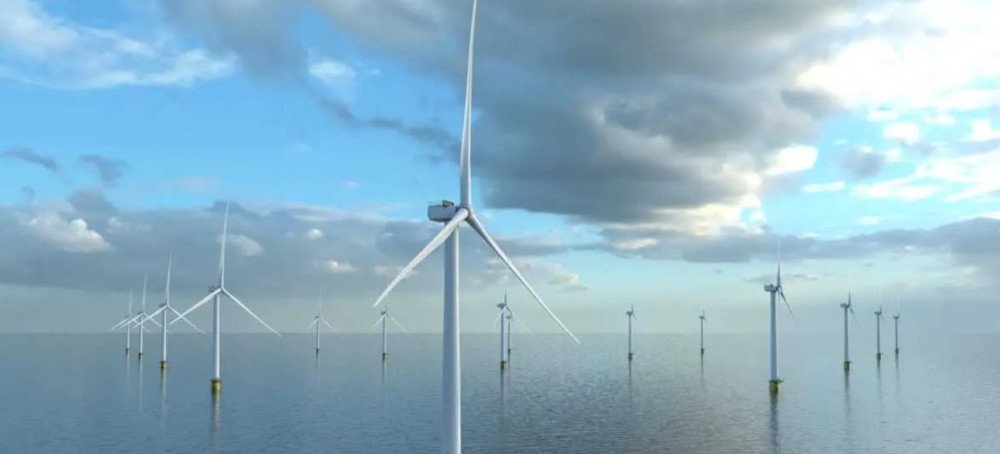 An off-shore wind project. (photo: Empire Wind)
A new report came out last week from the Climate … Development Lab (CDL) at Brown University, titled “Legal Entanglements: Mapping Connections of Anti-Offshore Wind Groups and their Lawyers in the Eastern United States.”
The study focuses on several examples of law firms with connections to anti-wind groups, the fossil fuel industry, and the American political right wing. These fossil-funded groups have spread disinformation to slow the adoption of clean and cheap wind power, in order to keep America addicted to the poison that the fossil fuel industry wants to keep selling us.
The lab is headed by J Timmons Roberts, but the research was done by various students and faculty at at the lab. The new report builds on former research by the CDL cataloguing extensive connections between these groups and the dark money networks that fund the anti-wind movement.
Why the East Coast needs offshore wind
Offshore wind, especially in the North Atlantic, is a cheap and abundant form of energy that is heretofore relatively untapped in the US. It also has very little environmental cost, given that its carbon emissions and land use are both zero, and wind tends to be quite consistent over the ocean, making it more reliable as a power source.
Many other countries have successfully implemented offshore wind projects to bring this cheap and clean power to their populaces, with particular booms in China, the UK, Vietnam, Germany and several other Northern European countries (like Denmark, where many large wind power companies are based).
And wind is important for the global transition to renewable energy and the fight against climate change. As a zero-emission power source, it’s essential for meeting the US East Coast’s climate and renewable energy goals, and could provide a huge chunk of the power needs for the entire US Eastern seaboard, where the country’s population is clustered.
However, offshore wind has recently encountered setbacks due to the spread of disinformation from fossil-funded networks, which has made its way into the popular conception and into right-wing politics. (Nevertheless, Americans of all political stripes still support greater deployment of offshore wind)
How and why fossil fuel companies oppose wind
Fossil fuel companies oppose wind power because it would help to wean America off of fossil fuels, displacing coal and methane generation for electricity and enabling greater electrification of the vehicle fleet to wean us off of oil. All of these would result in air quality improvements, cost reductions, health improvements and avoidance of climate change – which are all anathema to the most deadly industry the world has ever seen.
So, fossil fuel companies have developed and funded a complicated network of fake public interest groups, politicians and lawyers to oppose wind power by spreading disinformation. And the CDL’s report highlights how certain legal firms have received funding from fossil fuel companies and/or given support to these fake public interest groups in attempts to sue wind projects out of existence.
While many of these lawsuits have been unsuccessful, they can still add delays to a project, making it more expensive and slower to deploy (which then makes your electricity more expensive). In some cases, the delays can result in project cancellation, like when oil billionaire William Koch sued Cape Wind out of existence via a fake public interest group called the Alliance to Protect Nantucket Sound.
In the report, five specific legal networks are highlighted in particular, showing how each is related to fossil fuels and science denial. The networks have provided representation, written comments, filed lawsuits and otherwise spread disinformation in an attempt to stop the public good that offshore wind power represents.
The nature of the disinformation
The disinformation largely focuses on the North Atlantic Right Whale, a whale whose population is currently experiencing an “unusual mortality event” due to changing climate and Atlantic shipping and fishing.
Anti-wind groups have invoked laws like the Endangers Species Act and Marine Mammal Protection Act, despite the fact that the products of the industry they are funded by are the deadliest thing for marine life.
Burning oil raises both the temperature and acidity of our oceans, disrupting marine ecosystems in profound ways. For example, North Atlantic krill populations have dropped by 50% due to ocean warming driven by fossil fuel use. Krill are the main food source for the North Atlantic Right Whale, which anti-wind groups claim to be interested in protecting, but are in fact aiding the decline of.
Further, whale populations are directly harmed by vessel strikes, which are the leading direct cause of death for North Atlantic Right Whales in recent years. And 29% of those vessels are carrying oil across the globe – shipments that would be unnecessary if transportation were powered by clean renewable energy instead of deadly oil. Not only that, but some of the exact same groups that oppose wind also opposed draft regulations to reduce vessel strikes, showing that they are actually interested in continuing to harm whales, not protecting them.
Law firm responds to the truth by pressuring university to hide it
One of the law firms highlighted in the report, Marzulla Law, sent a letter threatening its authors. Marzulla Law said it would complain to mommy… I mean, Brown’s funding sources, including the US Department of Energy which a former oil executive is currently squatting as the head of, in an attempt to get the entirety of Brown University’s funding pulled if the CDL doesn’t self-censor its research findings.
The CDL itself is not funded by the Department of Energy, Roberts said to Bloomberg, so the threat isn’t even related to CDL’s funding sources, but to Brown University’s as a whole.
Marzulla Law represented one of the disinformation groups which the CDL has highlighted before, the deceptively-named “Green Oceans.” Green Oceans opposed the Revolution Wind project, which was halted on Friday over fake national security concerns by a convicted felon who is Constitutionally barred from holding office in the US, despite the project already being 80% finished, costing the US billions in waste and increased utility bills.
Mike Herr, a spokesman for Green Oceans said “these oft-repeated lies are designed to discredit the messenger while preventing the public from absorbing the substance of our valid and well-researched concerns,” which is itself an example of the very thing he’s wrongly accusing the researchers of.
Herr’s organization lies about offshore wind, and their attack on science (through their law firm) is designed to discredit the messenger while preventing the public from absorbing the substance of valid and well-researched concerns: the connection between fossil fuels, the republican party, and disinformation that keeps us from embracing superior forms of cheaper, cleaner energy like wind.
Discrediting science and knowledge is increasingly becoming a feature of the American right wing, which is currently on a crusade against universities as it tries to make America stupider.
Roberts called Marzulla’s response “strategic harassment to shut me up and waste my time and make me more cautious,” which is a common reaction faced by truth-tellers in this day and age, particularly when funding from the largest and most deadly industry on the planet, which has repeatedly shown its interest in propaganda, is involved.
For its part, Brown University did not comment on Marzulla’s demands, but did state that “Scholars shape their own research and course of instruction at Brown. One principle that is core to research at Brown is the ability for scholars to discuss contested topics and themes and to have those topics openly debated.”
However, Brown is one of the universities which recently kowtowed to the idiotic demands of an inept moron, making its words about academic independence ring somewhat hollow. We’ll have to see if they step up to defend truth this time around, or bend the knee to one of the dumbest people on the planet once again, if it comes to that.
PO Box 2043 / Citrus Heights, CA 95611


No comments:
Post a Comment
Note: Only a member of this blog may post a comment.