Thursday, July 10, 2025
■ Today's Top News
Republicans plan to utilize a rare process called "rescission" to skirt Congress' power of the purse and illegally allow Trump to withhold hundreds of billions of dollars in federal funding to critical programs.
By Stephen Prager
The U.S. Senate will soon vote on whether President Donald Trump can claw back billions of dollars that have already been appropriated by Congress.
Last month, the House narrowly voted to allow Trump to rescind $9.4 billion in funds that were meant to fund global health initiatives—including AIDS, malaria, and tuberculosis prevention—and public broadcasters like PBS and NPR.
It's far from the first time that this Republican-controlled Congress has voted on massive budget cuts, but progressive groups and some Democratic lawmakers say this vote has another frightening dimension to it.
These funds were among the more than $420 billion appropriated by Congress that Trump illegally impounded, or refused to spend, at the start of his term.
In a letter sent Wednesday to members of Congress, a coalition of more than 100 groups—including Public Citizen, the AFL-CIO, and Greenpeace—warned that by voting to approve these rescissions of federal funds, they would be giving Trump tacit approval to unconstitutionally take away Congress' authority to spend money.
"This rescissions proposal does not ask Congress, as required by the Impoundment Control Act, to approve the entirety of the federal spending that has been illegally frozen by the Trump administration," the letter notes. "The administration is merely trying to establish a veil of legitimacy while it continues unconstitutional actions that it began more than 100 days ago."
The groups went on to warn that allowing the president to unilaterally cut funding that he doesn't approve of "risks irreparable damage to the regular bipartisan appropriations process."
"Despite the political back-and-forth, Congress eventually reaches a bipartisan agreement on government funding every year, one way or another," they said. "The basis for that bipartisan agreement is that both parties must agree to compromises to achieve any of their goals. If a party with a political trifecta can simply rescind funding for the parts of appropriations bills they compromised on, they undermine congressional checks and balances and the basis for future bipartisan dealmaking on an already politically fraught process."
Under the Impoundment Control Act of 1974, presidents are forbidden from unilaterally refusing to spend funds. However, Congress is allowed to pass a "rescission" bill within 45 days of canceling them if the president requests it.
Trump would be the first president since Bill Clinton in 1999 to successfully have funds rescinded by Congress, and it would be the largest rescission in four decades.
But as the Center for Budget and Policy Priorities points out, there is a key difference: "The administration illegally impounded the funds at issue for months before proposing the [rescission] package" and that it is "unlawfully withholding much larger amounts of funding that it has not proposed for rescission."
According to a tracker created by the office of Rep. Rosa DeLauro (D-Conn.) and Sen. Patty Murray (D-Wash.), who sit on the House and Senate appropriations committees, respectively, the Trump administration is blocking congressionally appropriated funds for programs including:
- Research into Alzheimer's disease, women's health, cancer, diabetes, and other illnesses;
- Natural disaster relief;
- School lunch assistance for children;
- Early childhood education through the Head Start Program; and
- Birth control and cancer screenings for over 800,000 patients
Russell Vought, the head of the White House's Office of Management and Budget (OMB) has openly indicated a desire to use rescission to cut all of this spending "without having to get an affirmative vote" from Congress.
According to The New York Times, Vought is planning to use an even more arcane and illegal maneuver known as "pocket rescission" to avoid spending the funds. As Tony Romm reported in June:
Under the emerging plan, the Trump administration would wait until closer to Sept. 30, the end of the fiscal year, to formally ask lawmakers to claw back a set of funds it has targeted for cuts. Even if Congress fails to vote on the request, the president’s timing would trigger a law that freezes the money until it ultimately expires.
Some Senate Democrats have indicated they'd be willing to risk a government shutdown to prevent the rescission bill from passing.
In a letter published Tuesday, Senate Majority Leader Chuck Schumer (D-N.Y.) wrote that the prospect of the rescissions bill passing had "grave implications."
"[I]t is absurd for [Republicans] to expect Democrats to act as business as usual and engage in a bipartisan appropriations process to fund the government, while they concurrently plot to pass a purely partisan rescissions bill to defund those same programs negotiated on a bipartisan basis behind the scenes," Schumer wrote.
Murray called out Vought directly on Wednesday at a markup session on the next round of bills in the Senate Appropriations Committee.
"For us to be able to work in a bipartisan way effectively, that requires us to work with each other. To not just write bipartisan funding bills—but to defend them from partisan cuts sought by the president and the OMB director," she said during her opening remarks. "We cannot allow bipartisan funding bills with partisan rescission packages. It will not work."
"This is a blatant violation of international humanitarian law, and a stark reminder that no one and no place is safe in Gaza," said the head of Project HOPE.
By Brett Wilkins
An Israeli strike on Palestinians waiting in line outside a charity clinic in central Gaza killed at least 17 people including 10 children Thursday, a day that saw scores more Gazans killed throughout the embattled enclave.
The Palestinians were killed even as progress was made toward a cease-fire agreement, with Hamas agreeing to release 10 hostages held since October 2023.
Eyad Amawi, director of al-Aqsa Martyrs Hospital in Deir al-Balah, told The Washington Post that the facility received the bodies of at least 17 victims of the strike on the Altayara Clinic, which is operated by Project HOPE, a Washington, D.C.-based humanitarian aid group. More than 30 others were wounded in the attack.
Drop Site News published the names and ages of 15 people killed in the strike, who include seven preteen children and toddlers.
Warning: The "show more" link in the following social media post shows images of death.
"The scene was so painful, more than you can imagine," local journalist Dua al-Hazarin told the Post.
According to the newspaper:
In footage [al-Hazarin] took and shared on social media, dust rises from the streets as the high-pitched wails and screams of children ring out. Women gather around the body of a child with blood seeping from his head. Elsewhere, bodies lie on the ground with pools of blood around them. One bloodied little girl is motionless in a pink dress. Next to her is a man hunched over, with blood seeping from his head. A woman lies still. Their conditions are unclear. The camera continues to pan over more bodies, many of them children, collapsed across the pavement.
Victims were waiting in line to receive treatment for chronic illnesses, infections, and malnutrition amid an ongoing starvation crisis caused by Israel's "complete siege" of Gaza, which officials say has caused the deaths of hundreds of residents, many of them children and infants, since October 2023. The United Nations Children's Fund (UNICEF) reported last month that more than 5,000 Gazan children under the age of 5 were treated for malnutrition in May alone.
"Project HOPE's health clinics are a place of refuge in Gaza where people bring their small children, women access pregnancy and postpartum care, people receive treatment for malnutrition, and more," Rabih Torbay, the charity's CEO, said in a statement. "Yet, this morning, innocent families were mercilessly attacked as they stood in line waiting for the doors to open."
"This is a blatant violation of international humanitarian law, and a stark reminder that no one and no place is safe in Gaza, even as cease-fire talks continue," Torbay added. "This cannot continue. Project HOPE urgently calls for an immediate cease-fire, unimpeded humanitarian access, and a dramatic scale-up of aid to meet the urgent needs of Gaza's civilian population."
No Project HOPE staff were harmed in the strike, which occurred before the clinic opened in the morning. The charity said it would indefinitely suspend operations at the Altayara Clinic "as a precautionary measure." The attack was at least the second one targeting a Project HOPE clinic in Gaza during the war.
Hundreds of humanitarian aid workers have been killed by Israeli forces in Gaza since during the U.S.-backed annihilation of the coastal strip, including over 300 members of the United Nations Relief and Works Agency for Palestinian Refugees in the Near East as well as staff of the Palestine Red Crescent Society, Doctors Without Borders, World Central Kitchen, and other organizations.
Near-daily massacres of Palestinian aid-seekers at distribution points operated by the U.S.-backed Gaza Humanitarian Foundation have also killed nearly 800 people, according to sources including the Gaza Health Ministry. Israel Defense Forces (IDF) officers and troops have admitted to receiving orders to fire guns and artillery at aid-seekers, regardless of whether they posed any security threat.
An IDF spokesperson told Haaretz that Thursday's Altayara Clinic strike targeted a member of Hamas' elite Nukhba force who took part in the October 7, 2023 attack. The spokesperson said the IDF is investigating the incident, and that it "regrets any harm caused to uninvolved civilians and works to minimize such harm as much as possible."
However, following the October 7 attack the IDF dramatically loosened its rules of engagement, effectively allowing an unlimited number of civilians to be killed when targeting a single Hamas member, no matter how low-ranking.
As a result, the majority of the at least 57,680 Palestinians killed by Israeli forces in Gaza have been women and children, with the high civilian death toll prompting South Africa to file a genocide case against Israel at the International Court of Justice and the International Criminal Court to issue arrest warrants for Israeli Prime Minister Benjamin Netanyahu and former Defense Minister Yoav Gallant for alleged crimes against humanity and war crimes including murder and forced starvation.
UNICEF—which condemned Thursday's massacre—said in late May that more than 50,000 children have been killed or wounded by Israeli attacks in Gaza, which the U.N. agency has called "the world's most dangerous place to be a child."
The Gaza Health Ministry said aThursday that at least 82 Palestinians were killed by Israeli attacks over the past 24 hours, including strikes on the crowded Nuseirat Market, a tent encampment housing forcibly displaced people on the outskirts of Khan Younis, and an apartment building in Gaza City.
Meanwhile, Hamas said Thursday that it would release 10 hostages kidnapped during the October 7 attack as part of a "commitment to the success" of ongoing negotiations for a cease-fire in the 21-month onslaught, a development that followed meetings between Netanyahu and U.S. leaders including President Donald Trump earlier this week to discuss a potential deal to end Israel's assault. The leaders also discussed an Israeli plan to ethnically cleanse Palestinians from throughout Gaza and concentrate them in a camp outside the ruins of the southern city of Rafah.
Trump said Wednesday that there was a "very good chance" of a cease-fire deal being reached, possibly as early as later this week. However, Netanyahu has scuppered past cease-fire efforts as they have neared the finish line—moves some critics say are meant to prolong the war in order to delay a reckoning in his ongoing criminal corruption trial.
"The Trump administration's deportation goals will cause a major blow to the U.S. labor market," according to a new analysis by the Economic Policy Institute.
By Jake Johnson
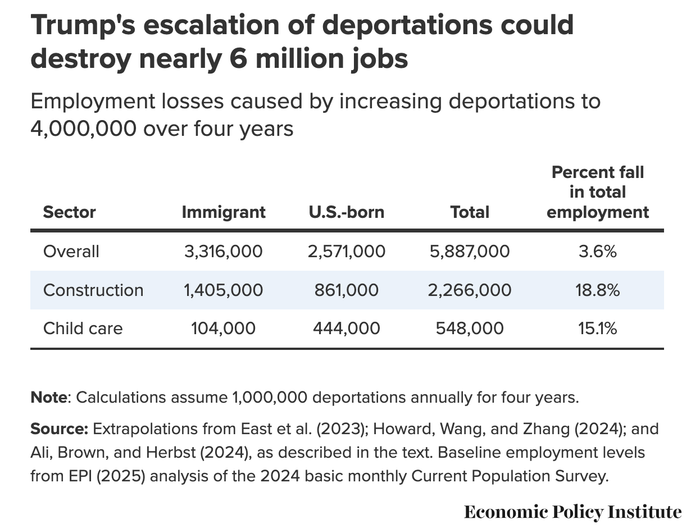
If President Donald Trump succeeds at deporting millions of people over the next four years, his administration will be responsible for destroying millions of jobs and inflicting "immense pain" on both U.S.-born and immigrant workers.
That's according to a report published Thursday by the Economic Policy Institute (EPI), which bases its analysis on the Trump administration's privately stated goal of deporting at least 1 million immigrants during the Republican president's first year back in the White House.
Should the administration achieve that deportation objective each year for the remainder of Trump's term, "there will be 3.3 million fewer employed immigrants and 2.6 million fewer employed U.S.-born workers at the end of that period," wrote EPI senior economist Ben Zipperer.
"Employment in the construction sector will drop sharply: U.S.-born construction employment will fall by 861,000, and immigrant employment will fall by 1.4 million," Zipperer wrote. In late May, Immigration and Customs Enforcement (ICE) publicly touted its arrest of more than 100 construction workers in Tallahassee, Florida.
The millions of deportations desired by Trump and his deputies would also "eliminate half a million childcare jobs," EPI estimated.
Every state in the U.S. would be impacted by the president's attack on immigrants, according to Zipperer's analysis, but California, Florida, New York, and Texas would be most heavily impacted.
"The Trump administration's deportation goals will cause a major blow to the U.S. labor market," Zipperer wrote, "squandering the full employment that the Trump administration inherited from the Biden administration and also causing immense pain to the millions of U.S.-born and immigrant workers who may lose their jobs."
The EPI analysis comes days after Trump signed into law a sprawling budget measure that includes $75 billion in additional funding over the next four years for ICE, an agency whose current annual budget is around $10 billion. The $75 billion figure includes nearly $30 million for enforcement and deportation.
Immigrant rights groups and analysts warned following the Republican legislation's passage that the massive boost in ICE funding would supercharge Trump's mass deportation machine.
"There is a question of how quickly ICE can build up its infrastructure and personnel using its newfound resources," Vox's Nicole Narea wrote Thursday. "But just days after the bill passed, the administration made a show of force at Los Angeles' MacArthur Park on Monday, with heavily armed immigration agents in tactical gear and military-style trucks showing up to arrest undocumented immigrants."
Trump's mass deportation efforts are already having an impact on the U.S. economy, according to top officials and recent employment data.
During congressional testimony last month, Federal Reserve Chair Jerome Powell—against whom Trump frequently rails despite initially picking him for the job during his first White House term—said the president's draconian crackdown on immigration was "one of the reasons" for slowing U.S. economic growth.
Earlier this month, following the release of the June jobs report, labor economist Mark Regets told Forbes that "the data for the last five months indicate a serious fall in the number of immigrant workers."
"Despite growth in the unadjusted numbers, the U.S.-born labor force participation rate and the overall seasonally adjusted labor force total suggest that the loss of immigrant labor is not bringing more U.S.-born workers into the labor force," said Regets.
In a tacit admission that its mass deportation agenda is damaging employment in certain industries, the Trump administration reportedly instructed ICE officials last month to mostly pause raids on agricultural, hotel, and restaurant work sites.
"The U.S. government is laundering repression through a private blacklist," said one pro-Palestinian news outlet.
By Julia Conley
Confirming what students detained by the Trump administration have suspected for months, a senior homeland security official on Wednesday admitted for the first time that his agency had used a website run by a secretive pro-Israel group that compiles "blacklists" of pro-Palestinian students as it worked to carry out President Donald Trump's policy of arresting international students for their protest activities earlier this year.
In a courtroom in Massachusetts during a hearing on a Harvard University faculty group's lawsuit over Trump's attempts to deport pro-Palestinian students, Immigration and Customs Enforcement (ICE) official Peter Hatch testified under oath that a task force he formed in March scoured a list compiled by Canary Mission, an operation linked to Israel's intelligence agencies, to compile reports on the students on the list.
Hatch, the assistant director of ICE's homeland security investigations department, said the team was ordered to rush an analysis of roughly 5,000 students listed on Canary Mission's website, which includes photos and names of students who have taken part in "anti-Israel events." One student listed participated in a student walkout at Harvard University in support of boycotting Israel, and another attended a rally organized by Jews for Cease-fire.
Such allegations were evidently enough to warrant Hatch's team compiling reports on 100-200 of the non-citizen students listed on Canary Mission's website. Hatch said the team relied on Canary Mission's list as well as a list compiled by another pro-Israel group, Betar Worldwide.
Hatch told lawyers for the plaintiffs in the American Association of University Professors' (AAUP) lawsuit and Judge William G. Young of the Federal District Court in Massachusetts that his team's reports detailed the students' employment and travel history, criminal activity, and alleged support for terrorist groups such as Hamas. He said the students' use of phrases including "Free Palestine" were included in the reports as well.
The Trump administration has claimed students have shown "support for terrorist groups" simply by participating in protests against Israel's U.S.-backed assault on Gaza, where at least 57,762 Palestinians have been killed by Israeli forces since October 2023. Nearly 70% of those killed in Gaza were verified by the United Nations to be women and children as of November 2024, even as both Democratic and Republican U.S. lawmakers have claimed Israel is targeting Hamas.
Hatch's team sent the reports on students to the U.S. State Department, where Secretary of State Marco Rubio later said Columbia University student organizer Mahmoud Khalil's participation in protests was detrimental to U.S. foreign policy interests, after Khalil was arrested by ICE. Khalil was ultimately detained in Louisiana for three months.
Hatch testified that the ICE office used the lists compiled by Canary Mission and Betar "without a firm understanding of the methodology through which individuals came to be included on either record," according to The New York Times.
Five of the students included in the reports sent to the State Department have been named in the AAUP's lawsuit as non-citizen students who were targeted by ICE for their pro-Palestinian speech.
The AAUP and other plaintiffs in the case argue the Trump administration has imposed an "ideological deportation policy" by detaining and trying to remove Khalil, Tufts University student Rümeysa Öztürk, Columbia University student Mohsen Mahdawi, and others.
Students have posited for months that Canary Mission's blacklists were likely involved in the administration's rounding up of pro-Palestinian organizers, with Sophie Hurwitz reporting at Mother Jones this week that Öztürk was detained only "after being smeared on Canary Mission's website, being falsely labeled as being antisemitic."
A judge who ordered the release of another student activist, Efe Ercelik of the University of Massachusetts, Amherst, said Ercelik had been jailed "almost exclusively" because he was included in blacklists compiled by Canary Mission and Betar.
Khalil's lawyers filed a Freedom of Information Act request after his arrest, seeking information about Canary Mission's role in his targeting by ICE. The group's anonymously run website includes an extensive report on Khalil's expressions of support for Palestinians and his protest activities.
But Hatch's testimony marks the first time Canary Mission's involvement in the targeting of students has been acknowledged by the administration.
Young ordered the Trump administration to provide partially redacted reports that Hatch's team compiled on students to the plaintiffs' lawyers on Wednesday evening.
As James Bamford wrote at The Nation in December 2023, Canary Mission is "a key intelligence asset for the Ministry of Strategic Affairs, a highly secretive intelligence organization that is largely focused on the United States." A profile of Palestinian American student Lara Alqasem was compiled by Canary Mission and used to prevent her from entering Israel in 2018; Alqasem was planning to study at the Hebrew University of Jerusalem, but Israel attempted to bar her from doing so because she was the chapter president of Students for Justice in Palestine at the University of Florida.
The pro-Palestinian news outlet Mondoweiss said the information disclosed by Hatch on Wednesday "is bigger than one trial."
"The U.S. government is laundering repression through a private blacklist," said Mondoweiss. "It's criminalizing dissent, undermining free speech, and exporting Israel's surveillance playbook into U.S. policy."
"It's a ticking time bomb," said the executive director of UNAIDS.
By Brad Reed
UNAIDS, the United Nations agency dedicated to combating the spread of HIV around the globe, has issued a dire warning about the impact of the United States slashing its funding for foreign aid.
In a newly released report, the agency contends that the Trump administration's drastic reduction of foreign aid funding to the United States President's Emergency Plan For AIDS Relief (PEPFAR) has been a "systemic shock" to organizations trying to stop the spread of HIV.
"HIV programs across the world are struggling from the sudden, drastic reductions in funding for the global HIV response announced by the United States Government in early 2025," the report states. "PEPFAR had committed USD 4.3 billion in bilateral support in 2025. Those services were stopped overnight when the United States Government shifted its foreign assistance strategies. Disruptions are being felt across the HIV response and pose a huge risk of increased mortality, a surge of new HIV infections, and the development of resistance to the most commonly used treatment regimens. Urgent action and revived solidarity are needed to sustain the progress made and prevent a resurgence of HIV."
The report estimates that if American funding for HIV prevention collapses entirely, it would result in 6 million additional infections and 4 million additional deaths over the next four years alone.
"This is not just a funding gap—it's a ticking time bomb," said Winnie Byanyima, executive director of UNAIDS. "We have seen services vanish overnight. Health workers have been sent home. And people—especially children and key populations—are being pushed out of care."
The report notes that countries that have traditionally benefited from American PEPFAR funding cannot possibly hope to make up the difference with domestic revenue and it calls on other nations to step up where the U.S. has stepped away.
"Low- and lower-middle-income countries... remain highly vulnerable," the report warns. "HIV programs in many of them are highly dependent on external financing and they are unlikely to withstand unplanned or rapid reductions in donor funding. This could lead to disruptions in essential services and weaken the overall HIV response."
Five countries in particular—Haiti, Mozambique, Nigeria, the United Republic of Tanzania, and Zambia—are highlighted as particularly vulnerable given that they received more than 60% of their funding for HIV-related programs through PEPFAR.
Regardless, the report said that the world is still closer than it ever has been to ending the threat of AIDS. But it stressed that low- and middle-income countries would nonetheless need annual funding of $21.9 billion USD to make that goal a reality by 2030.
Congressional Democrats want investigations "at every level of government of what went wrong" and to "stop the dismantling of federal agencies."
By Stephen Prager
U.S. Secretary of Homeland Security DOG KILLER Kristi Noem renewed her call Wednesday to "eliminate" the Federal Emergency Management Agency calling it "slow to respond" to the deadly floods that have killed more than 120 people in Texas over the past week.
But that "slow" response was the direct result of a policy put in place by Noem herself, according to four FEMA officials who spoke to CNN.
Last month, the network reported on a new policy introduced by Noem that required any contract or grant above $100,000 to cross her desk for approval.
The administration billed the move as a way of "rooting out waste, fraud, [and] abuse." But multiple anonymous officials, including ones from FEMA, warned at the time that it could cause "massive delays" in cases of emergency, especially as hurricane season began to ramp up.
That appears to be what happened in Texas. According to the four officials who spoke to CNN, "FEMA ran into bureaucratic obstacles" as a result of this requirement. Compared to the billions that are typically required to respond to disasters, officials said $100,000 is essentially "pennies."
FEMA officials said they were left to ask for Noem's direct approval on virtually every action they took in response to the catastrophic flood, which created massive delays in deploying Urban Search and Rescue Teams.
The sources told CNN that "in the past, FEMA would have swiftly staged these teams, which are specifically trained for situations including catastrophic floods, closer to a disaster zone in anticipation of urgent requests."
Multiple sources said Noem waited until Monday to authorize the deployment of these search and rescue teams, more than 72 hours after the flooding began. Aerial imagery to aid in the search was also delayed waiting for Noem's approval.
On Wednesday, Noem used these very delays to justify her calls to disband FEMA entirely.
"Federal emergency management should be state and locally led, rather than how it has operated for decades," she said. "It has been slow to respond at the federal level. It's even been slower to get the resources to Americans in crisis, and that is why this entire agency needs to be eliminated as it exists today, and remade into a responsive agency."
President Donald Trump said last month he is in the process of beginning to "phase out" FEMA and that it would begin to "give out less money" to states and be directed out of the White House.
He first took a hatchet to FEMA back in February using the Department of Government Efficiency (DOGE), which eliminated 2,000 permanent employees, one-third of its total staff.
Noem has also boasted about using FEMA funds to carry out Trump's mass deportation crusade, including allocating hundreds of millions from the agency to build the so-called "Alligator Alcatraz" immigrant internment camp in Florida, as well as other detention facilities.
Before a House panel last month, former FEMA Administrator Deanne Criswell noted that the administration's cuts have made it harder for FEMA to respond in disaster areas.
"It just slows down the entire response and delays the recovery process from starting," Criswell said. "If the state director asks for a resource, then FEMA needs to be able to quickly respond and mobilize that resource to come support whatever that is. They still need the staff that are going in there. And so when you have less people, you're going to have less ability to actually fill those senior roles."
The revelation that Noem's policy may have contributed to the slowdown has only amplified calls by congressional Democrats to investigate how Trump administration cuts to FEMA and other services like the National Weather Service may have contributed to the devastation.
"During disasters, every second matters," said Rep. Joaquin Castro (D-Texas). "Noem must answer for this delay."
Congressman Greg Casar (D-Texas) said this disaster in his home state highlighted the need for federal agencies like FEMA.
"Year after year, Texans face deadlier fires, freezes, and floods." Casar said. "As we continue to support first responders and grieving families after the terrible flooding, we will need investigations at every level of government of what went wrong and what could save lives in future."
"We must stop the dismantling of federal agencies that are supposed to keep us safe from the next disaster," he added.




No comments:
Post a Comment
Note: Only a member of this blog may post a comment.