Wednesday, December 17, 2025
■ Today's Top News
Discussing the post-2008 financial rules, Trump's Treasury chief told a Fox host that "we have to take the financial system out of this straitjacket."
By Jessica Corbett
President Donald Trump’s administration “wants to turn the clock back to 2008 and let Wall Street run wild.”
That’s how US Sen. Elizabeth Warren (D-Mass.) responded on Wednesday to Treasury Secretary Scott Bessent’s comments to Fox Business Network host Maria Bartiromo about the administration’s deregulatory push.
Without naming it, Bessent took aim at the Dodd-Frank Wall Street Reform and Consumer Protection Act, a 2010 law that Warren, then a longtime Harvard University professor, fought for in the wake of the 2008 financial crisis.
Recalling that era, Warren said: “We all know how that ended—with taxpayers bailing out Wall Street while millions lost their homes and got fired from their jobs. Donald Trump could be setting the stage for the next crash.”
Warren was far from alone in calling out Bessent after journalist Aaron Rupar noted that during the Fox interview, the ex-hedge fund manager said: “I chair something called FSOC, the Financial Stability Oversight Council, and these 2008, 2009, 2010 financial rules were too tight. They have hamstrung the American financial system. It was time for a change. We’re gonna be safe, smart, and sound in terms of our deregulation. But we have to take the financial system out of this straitjacket.”
University of Michigan business law professor Jeremy Kress said: “Fact check: The decade following the Dodd-Frank Act marked the longest period of economic growth in US history. The main problem with the post-2008 reforms is that they did not do nearly enough to limit the nonbank risk-taking that Bessent and his allies have enabled.”
Progressive political commentator and YouTuber Kyle Kulinski declared, “These people are hell-bent on creating a new Great Depression.”
Dean Baker, senior economist at the Center for Economic and Policy Research, said, “Remember BLEAT: Bessent Lies about Everything All the Time.”
The Fox appearance on Tuesday came after Bessent earlier this month announced an overhaul to the structure of FSOC—which was established by Dodd-Frank—and wrote in the introduction letter to the council’s annual report that it “would shift its focus from ‘prophylactic’ regulatory and supervisory policies to an approach aimed at removing red tape in areas like artificial intelligence, in a bid to spur economic growth,” as Politico summarized at the time.
As Politico also reported:
Markets groups and members of Congress expressed their concern over the changes. In a letter to Bessent... Sen. Elizabeth Warren (D-Mass.) expressed concern that the FSOC has met fewer times this year than in any past year of its existence and that the council is “sabotaging its own authorities.” Dennis Kelleher, CEO of Better Markets, an advocacy group focused on regulation, stated that “undermining the FSOC is undermining the economy and the financial system.”
Sharing the Politico report on social media earlier this month, Kress said that “this is a dereliction of duty by the Financial Stability Oversight Council. But if there is a silver lining, it is that the Trump administration now unequivocally owns whatever crisis lies ahead.”
Sen. Ron Wyden said the bill "increases military spending by tens of billions of dollars and fails to include guardrails against Donald Trump and Hegseth’s authoritarian abuses."
By Stephen Prager
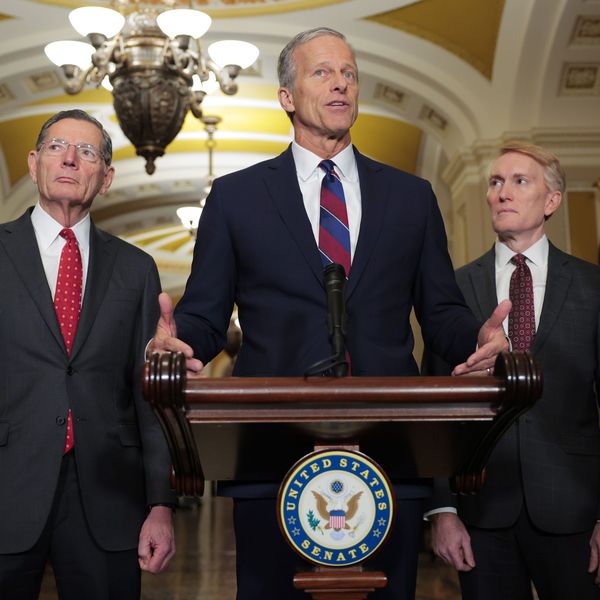
A majority of Democratic senators joined Republicans on Wednesday to pass the largest military spending bill in US history, handing President Donald Trump the bulk of his demands, even as he enacts steep cuts across nearly every other sector of the federal budget.
The more than $900 billion National Defense Authorization Act (NDAA) passed by a vote of 77-20, with 27 Democrats, as well as the independent Sen. Angus King (Maine), in support. Just three members of the Republican majority voted against the bill, along with 16 Democrats and independent Sen. Bernie Sanders (Vt.).
Among many other items on Trump’s wish list, the bill provides funds for weapons meant to counter China, full funding for Trump’s National Guard deployments to support the US immigration agents, and more funds for what are described as “counternarcotics operations.”
It also removes a measure that would have restored collective bargaining rights that Trump stripped earlier this year from Pentagon employees, permanently ends Defense Department initiatives to curb climate change, and excludes a measure that would mandate healthcare coverage for in vitro fertilization.
Combined with $156 billion in the GOP’s One Big Beautiful Bill Act this July, the package passed by the Senate pushes military spending for fiscal year 2026 into the trillions—a new record in absolute terms and a relative level unseen since World War II.
The bill will head to Trump’s desk just a day after he announced a “total and complete blockade” on Venezuelan oil tankers, a major escalation described by Rep. Joaquin Castro (D-Texas) as “unquestionably an act of war.”
The bill contains a measure demanding that the Pentagon release the unedited video of a September 2 “double-tap” strike on a boat in the Caribbean that members of both parties have suggested may violate international law.
On Tuesday, Defense Secretary Pete Hegseth and Secretary of State Marco Rubio declined another congressional request to release the video. The defense bill ramps up the pressure for transparency, mandating a 25% cut to Hegseth’s travel budget if the administration does not comply.
Senate Democrats have previously voted in support of war powers resolutions to require congressional approval for Trump’s boat strikes and for further military action against Venezuela. These measures have repeatedly fallen just short in the Republican-controlled Senate.
But Stephen Semmler, a co-founder of the Security Policy Reform Institute, argued that “if the Senate truly cared about Trump seeking congressional approval before starting a war with Venezuela, it wouldn’t have passed a bill authorizing $901 billion in military spending.”
Sen. Ron Wyden (D-Ore.), who voted no on the defense spending bill, said, “I cannot support a bill that increases military spending by tens of billions of dollars and fails to include guardrails against Donald Trump and Hegseth’s authoritarian abuses.”
“Donald Trump has repeatedly used the military to occupy major US cities, including Portland—endangering our service members, disrupting our economy, and eroding trust in our communities,” Wyden continued. “He has also shown that he will use the Department of Defense to conduct deadly military operations without congressional authorization to intimidate political opponents and immigrants through the military, to purge senior military leaders without cause, to funnel billions of dollars in contracts to his personal supporters, and to waste billions of taxpayer dollars.”
The defense spending bill passed the US House last week, with support from 115 Democrats. This was despite opposition from the Congressional Progressive Caucus, whose deputy chair, Rep. Ilhan Omar (D-Minn.), said it was “enabling unchecked executive war powers.”
The House is expected to vote Wednesday evening on a pair of war powers resolutions. One, introduced by Rep. Gregory Meeks (D-NY), would block Trump’s extrajudicial airstrikes on boats in the Caribbean. Another bipartisan resolution would require Trump to receive congressional approval before taking direct military action, including land strikes, against Venezuela.
"Trump explicitly promised voters he would slash utility bills by half within the first year, yet in the first nine months of his term, they surged," said the author of Public Citizen's new report.
By Jessica Corbett
Underscoring expert warnings that exporting liquefied natural gas not only worsens the climate emergency but also drives up energy prices for Americans, Public Citizen revealed Tuesday that as LNG exports surged under the Trump administration, US households paid $12 billion more in utility bills from January through September than they did last year.
In other words, “the costs borne by residential consumers in the first nine months of 2025 are up 22%,” or an average of $124 per family, according to an analysis of federal data by Tyson Slocum, director of the consumer advocacy group’s Energy Program and author of the new report. “LNG exports are also up 22% over that same time.”
His report highlights President Donald Trump’s 2024 campaign pledges, pointing to a Newsweek op-ed and various speeches across the country. Slocum said in a statement that “Trump explicitly promised voters he would slash utility bills by half within the first year, yet in the first nine months of his term, they surged, squeezing some of the country’s most vulnerable households.”
Now, “1 in 6 Americans—21 million households—are behind on their energy bills,” which “are rising at twice the rate of inflation,” the report states. “Even registered Republican voters are increasingly blaming President Trump for the affordability crisis.”
“Limiting or prohibiting LNG exports would provide immediate relief for households across the country, but it would require action from the White House.”
It’s not just “higher domestic natural gas prices, driven primarily by record LNG exports,” affecting US utility prices, the report acknowledges. Other factors include “electric transmission and distribution costs, which include extreme weather and wildfire liabilities. These costs are administered by state or federal regulators and have been exacerbated by climate change.”
“Electricity demand load growth, driven by the rise of artificial intelligence data centers, along with transportation electrification,” is also having an impact, the document details. Additionally, “Trump’s unprecedented cancellation and revocation of billions of dollars of permitted renewable energy projects, combined with his unlawful abuse of emergency authorities to impose punitive tariffs, have injected chaos into domestic supply chains, stifling domestic investment in energy infrastructure.”
As the report explains:
Of these four factors, record natural gas exports not only represent the largest impact on natural gas prices, but feature clear statutory solutions to help protect consumers. The Natural Gas Act—passed by Congress during the Great Depression—asserts in Section 1 that “the business of transporting and selling natural gas for ultimate distribution to the public is affected with a public interest,” with the US Supreme Court affirming that the “primary aim” of this 87-year-old law is “to protect consumers against exploitation at the hands of natural gas companies.” Section 3 of the law forbids exports of natural gas unless the Department of Energy determines the exports to non-Free Trade Agreement countries are “consistent with the public interest.”
Rather than living up to those obligations, Slocum said, “Energy Secretary Chris Wright and Interior Secretary Doug Burgum have acted as global gas salesmen, traveling to Europe to push exports and gut European methane regulations while attacking mainstream climate science. Meanwhile, Trump has done nothing to keep prices down at home.”
“Limiting or prohibiting LNG exports would provide immediate relief for households across the country, but it would require action from the White House,” he added. “Trump would need to stand up to some of his fossil fuel donors to make our energy more affordable.”
It’s not just Public Citizen pushing for action by the president. US Sen. Edward Markey (D–Mass.)—the upper chamber’s leading champion of the Green New Deal—joined a press event for the group’s new report. He stressed that “record-breaking levels of natural gas exports are breaking the bank on your monthly energy bill.”
Public Citizen released the report just a day after Bloomberg also noted what the export boom means for US energy prices.
“We have been talking about, in apocalyptic terms, for a decade now when the world would start taking away America’s cheap gas,” Peter Gardett, CEO of Noreva, an energy trading platform specializing in power, told Bloomberg. “Well, we’re here.”
"This is self-sabotage by a wildly ignorant and malicious administration cutting off their nose to spite their face," said one hurricane researcher.
By Julia Conley
One US House Democrat pledged Tuesday night that Colorado officials will fight the Trump administration’s latest attack on science “with every legal tool that we have” after top White House budget adviser Russell Vought announced a decision to break up a crucial climate research center in Boulder.
Rep. Joe Neguse (D-Colo.) called the decision to dismantle the National Center for Atmospheric Research (NCAR) “a deeply dangerous” action.
“NCAR is one of the most renowned scientific facilities in the WORLD—where scientists perform cutting-edge research every day,” said Neguse. “We will fight this reckless directive.”
Vought, the director of the Office of Management and Budget (OMB) said the National Science Foundation (NSF), which contracts the University Corporation for Atmospheric Research (UCAR) to run NCAR, “will be breaking up” the center and has begun a “comprehensive review,” with “vital activities such as weather research” being moved to another entity.
He added that NCAR is “one of the largest sources of climate alarmism in the country.”
But scientists pointed to the center’s 65-year history of making major advances in climate research and developing systems that scientists use regularly.
NCAR developed GPS dropsondes, which are dropped from the center’s aircraft into the eye of hurricanes to gather crucial data and improve forecasts, as well as severe weather warnings and analyses of the economic impacts that weather can bring, Daniel Swain, a climate scientist at the University of California, told USA Today, which first reported on the plan to dismantle the facility.
Neguse also called the decision to shutter NCAR “blatantly retaliatory.” The breakup of the center was announced days after President Donald Trump announced his plan to pardon Tina Peters, despite uncertainty over his authority to do so. The former county clerk was convicted in Colorado court on felony charges of allowing someone to access secure voting system data—part of an effort to prove the baseless conspiracy theory pushed by Trump that the 2020 election had been stolen from him.
Trump attacked Colorado’s Democratic governor, Jared Polis, over the Peters case last week, calling him “incompetent” and “pathetic.”
Also on Tuesday, the administration announced it was canceling $109 million in environmental transportation grants for Colorado that were aimed at boosting investment in electric vehicles, rail improvements, and other research.
Writer Benjamin Kunkel said the dismantling of NCAR is evidently “what happens to a state whose leading officials do accept climate science... and don’t accept that Trump won the 2020 election.”
Polis said Tuesday that his government had not received any communication from the White House about the NCAR review and dismantling, but “if true, public safety is at risk and science is being attacked.”
“Climate change is real, but the work of NCAR goes far beyond climate science,” he said. “NCAR delivers data around severe weather events like fires and floods that help our country save lives and property, and prevent devastation for families.”
The White House Tuesday said it objected to UCAR’s “woke direction,” including its efforts to “make the sciences more welcoming, inclusive, and justice-centered” via the Rising Voices Center for Indigenous and Earth Sciences and wind turbine research that aims to “better understand and predict the impact of weather conditions and changing climate on offshore wind production.”
The administration also said the review of NCAR will eliminate “green new scam research activities”—green energy research completed by many of the center’s 830 employees.
Climate scientist Katherine Hayhoe warned that the dismantling of NCAR was an attack on “quite literally our global mothership.”
“NCAR supports the scientists who fly into hurricanes, the meteorologists who develop new radar technology, the physicists who envision and code new weather models, and yes—the largest community climate model in the world,” said Hayhoe. “Dismantling NCAR is like taking a sledgehammer to the keystone holding up our scientific understanding of the planet.”
Hurricane specialist Michael Lowry said the center is “crucial to cutting-edge meteorology and improvements in weather forecasting.”
“It’s far, far bigger than a ‘climate’ research lab,” he said. “This is self-sabotage by a wildly ignorant and malicious administration cutting off their nose to spite their face.”
The president this year has also pushed massive cuts to the National Oceanic and Atmospheric Administration, where major climate and weather research takes place. The cuts have come as 2024 has been named the hottest year on record and scientists have warned that planetary heating has contributed to recent weather disasters.
“Any plans to dismantle NSF NCAR,” UCAR president Antonio Busalacchi told the Washington Post, “would set back our nation’s ability to predict, prepare for, and respond to severe weather and other natural disasters.”
"It’s a raw deal for working people: higher costs and less coverage, or no coverage at all," said Democratic Rep. Brendan Boyle.
By Jake Johnson
The Republican bill that’s set for a vote in the US House on Wednesday would leave around 100,000 more Americans uninsured per year over the next decade, according to a new analysis by the nonpartisan Congressional Budget Office.
The analysis published late Tuesday examines each major section of the legislation, which experts have characterized as an assortment of GOP healthcare ideas that—in combination—would do little to achieve its stated goal of “lower healthcare premiums for all.”
The CBO estimates that the Republican bill, which stands no chance of passing the Senate even if it clears the House on Wednesday, would lower gross benchmark premiums by 11% on average between 2027 and 2035.
But the legislation does not extend enhanced Affordable Care Act (ACA) subsidies that expire at the end of the year, meaning premiums overall are poised to more than double on average in the coming year. Many Americans are expected to forgo insurance coverage entirely in the face of unaffordable premium increases.
Rep. Brendan Boyle (D-Pa.), the top Democrat on the House Budget Committee, said Tuesday that the CBO analysis “makes clear that the bill Republican leadership wants to pass tomorrow would make a bad situation even worse,” compounding the widespread damage caused by the Medicaid cuts the party approved over the summer.
“It’s a raw deal for working people: higher costs and less coverage, or no coverage at all,” said Boyle. “If Republicans were serious about fixing the healthcare crisis they created, they’d work with Democrats to extend the Affordable Care Act tax credits and prevent costs from rising for tens of millions of Americans.”
“While Congress heads home for the holidays, it’s leaving millions of families behind to wonder how they will make ends meet in the new year.”
The CBO analysis came hours after House Speaker Mike Johnson (R-La.) shot down a bipartisan push for a vote to extend the expiring ACA tax credits, which more than 20 million Americans relied on to afford health coverage.
But on Wednesday, four swing-district House Republicans—Brian Fitzpatrick, Rob Bresnahan, and Ryan Mackenzie of Pennsylvania and Mike Lawler of New York—revolted against the GOP leadership and signed onto a Democratic discharge petition aimed at forcing a floor vote on a proposed three-year extension of the enhanced ACA subsidies.
“The only policy that is worse than a clean three-year extension without any reforms, is a policy of complete expiration without any bridge,” Fitzpatrick said in a statement. “Unfortunately, it is House leadership themselves that have forced this outcome.”
It’s unclear when the House will vote on the extension, as lawmakers are leaving town for a two-week holiday recess on Friday. The House is set to return to session on January 6, 2026—after the official expiration of the ACA subsidies.
“While Congress heads home for the holidays, it’s leaving millions of families behind to wonder how they will make ends meet in the new year,” Ailen Arreaza, executive director of the advocacy group ParentsTogether, said in a statement Wednesday. “By refusing to fix this healthcare crisis, Republicans are choosing political games over families’ health and financial security.”
“These subsidies have been a lifeline for millions, and letting them expire will force millions to make impossible choices or even go without coverage altogether,” said Arreaza. “Make no mistake: Families around the country will pay the price for Congress’ inaction.”
"Alfred Nobel's endowment for peace cannot be spent on the promotion of war."
By Brad Reed
WikiLeaks founder Julian Assange on Wednesday filed a complaint against the Nobel Foundation to stop its planned payouts to Venezuelan opposition leader and 2025 Nobel Peace Prize winner María Corina Machado, who has backed US President Donald Trump’s campaign of military aggression against her own country.
According to a press release that WikiLeaks posted to X, Assange’s lawsuit seeks to block Machado from obtaining over USD $1 million she’s due to receive from the Nobel Foundation as winner of this year’s Peace Prize.
The complaint notes that Alfred Nobel’s will states that the Peace Prize named after him should only be awarded to those who have “conferred the greatest benefit to humankind” by doing “the most or the best work for fraternity between nations, for the abolition or reduction of standing armies, and for the holding and promotion of peace congresses.”
In an interview that aired on Sunday on CBS News’ “Face the Nation,” Machado praised Trump’s policies of tightening economic sanctions and seizing Venezuelan oil tankers, acts of aggression that appear to go against Nobel’s stated declaration that the Peace Prize winner must promote “fraternity between nations.”
“Look, I absolutely support President Trump’s strategy, and we, the Venezuelan people, are very grateful to him and to his administration, because I believe he is a champion of freedom in this hemisphere,” Machado told CBS News.
Trump’s campaign against Venezuela has not only included sanctions and the seizing of an oil tanker, but a series of bombings of purported drug trafficking vessels that many legal experts consider to be acts of murder.
In his complaint, Assange claims that Machado’s gushing praise of Trump in the wake of his illegal boat-bombing campaign is enough to justify the Nobel Foundation freezing its disbursements to the Venezuelan politician.
“Alfred Nobel’s endowment for peace cannot be spent on the promotion of war,” Assange states, adding that “Machado has continued to incite the Trump Administration to pursue its escalatory path” against her own country.
The complaint also argues that there’s a risk that funds awarded to Machado will be “diverted from their charitable purpose to facilitate aggression, crimes against humanity, and war crimes.”
Were this to happen, the complaint alleges, it would violate Sweden’s obligations under Article 25(3)(c) of the Rome Statute, which states that anyone who “aids, abets, or otherwise assists” in the commission of a war crime shall be subject to prosecution under the International Criminal Court.
Trump in recent days has ramped up his aggressive actions against Venezuela, and on Tuesday night he announced a “total and complete blockade” of all “sanctioned oil tankers” seeking to enter and leave the country.
“Venezuela is completely surrounded by the largest Armada ever assembled in the History of South America,” Trump wrote in a Truth Social post. “It will only get bigger, and the shock to them will be like nothing they have ever seen before.”