
04 September 25

In a shocking revolt, HHS employees wrote a letter calling for their boss to step down.
The signatories, who released the letter on Wednesday, include representatives from a number of health-related agencies, such as the Administration for Children and Families, the Centers for Disease Control and Prevention, the National Institutes of Health, the Centers for Medicare and Medicaid, and more.
After a reportedly anti-vax shooter attacked the CDC on August 8, a number of federal health employees sent a letter to Kennedy, urging him to stop spreading false information about Covid-19. But now, as Kennedy “continues to endanger the nation’s health,” these horrified federal workers, scientists, and physicians are leveling up their demands.
Last week, Kennedy fired CDC Director Susan Monarez, which spurred the resignations of multiple other high-ranking officials. Demetre Daskalakis, the director of the National Center for Immunization and Respiratory Diseases, was one of those who stepped down. He shared his resignation letter on X, writing: “I am unable to serve in an environment that treats the CDC as a tool to generate policies and materials that do not reflect scientific reality and are designed to hurt rather than to improve the public’s health.”
Current and former employees cited these examples, along with Kennedy’s appointment of “political ideologues who pose as scientific experts,” his refusal to be briefed by CDC experts, and his rescinding of the FDA’s emergency use authorization for the Covid vaccine, as reasons they were demanding Kennedy’s resignation.
“We swore an oath to support and defend the United States Constitution and to serve the American people. Our oath requires us to speak out when the Constitution is violated and the American people are put at risk,” employees wrote.
The letter is also addressed to Congress. If Kennedy refuses to step down, the signatories requested that Congress and the president appoint someone new to take his place.
But for the sake of these federal employees, and the health of all Americans, let’s hope it doesn’t get to the point where relying on the sanity and compassion of congressional Republicans is our only option.
Tourists Detained at US Airports Prompt Travel Warning Updates Across Europe
 US Customs and Border Protection agent. (photo: Reuters)
U.S. immigration enforcement policies cause uncertainty for international travelers
These actions reflect growing concern over the consequences of U.S. immigration enforcement policies and highlight increasing uncertainty for international travelers—even those with valid documents.
The detentions have sparked concern among the affected nations, human rights advocates, and immigration attorneys, who note that the discretionary power of Customs and Border Protection officers at ports of entry can lead to unpredictable outcomes.
Multiple German Citizens Detained
Germany was among the first to revise its travel advisory after at least three German citizens were denied entry and detained upon arrival in the U.S. despite holding what they believed were appropriate travel documents.
One German tourist was held in a U.S. immigration detention center for 16 days after reentering the U.S. from Mexico. Another German citizen spent over six weeks in detention.
The German Foreign Office clarified that having a valid visa or an approved Electronic System for Travel Authorization (ESTA) does not guarantee entry. “The final decision on whether a person can enter the U.S. lies with the U.S. border authorities,” the advisory stated.
Travelers are now urged to be prepared for possible secondary screening and to ensure that their travel plans, financial support, and intended activities align with their visa or ESTA conditions.
UK’s Strengthened Travel Warning
The United Kingdom updated its travel advisory after several British citizens were reportedly detained under similar circumstances.
In one case, a British woman was held for more than ten days over concerns she may have breached visa conditions. UK officials emphasized that U.S. immigration laws are “strictly enforced,” and even minor perceived violations can lead to detention or removal.
The Foreign, Commonwealth … Development Office is now advising UK travelers to double-check their visa conditions and ensure they are not engaging in activities—such as unpaid work or extended stays—that could be interpreted as outside the bounds of their visa or ESTA.
Nordic Countries Warn Transgender Travelers'
Denmark and Finland issued targeted warnings for transgender individuals planning to travel to the U.S., citing specific risks tied to documentation and identity recognition.
Travelers whose passports include a gender marker of "X" or who have recently changed gender markers are advised to contact the U.S. embassy before traveling to clarify how border officials will interpret their documents.
Denmark’s advisory highlighted the possibility of entry denial or distressing experiences at airports for transgender travelers. These nations recommend proactive communication with U.S. authorities before travel to avoid unexpected detention or refusal of entry.
New Risks for Travelers at U.S. Borders
Tourists from friendly nations with traditionally uncomplicated entry procedures are now being advised to prepare for increased scrutiny. These updates caution that even routine visits can result in detainment if border authorities suspect a violation—intended or not—of visa terms.
International travelers should now factor immigration risks into their travel planning more than in years past, particularly as U.S. enforcement practices tighten and the threshold for entry denial appears to have lowered.
Israeli Military Database Indicates Only a Quarter of Gaza Detainees Are Fighters
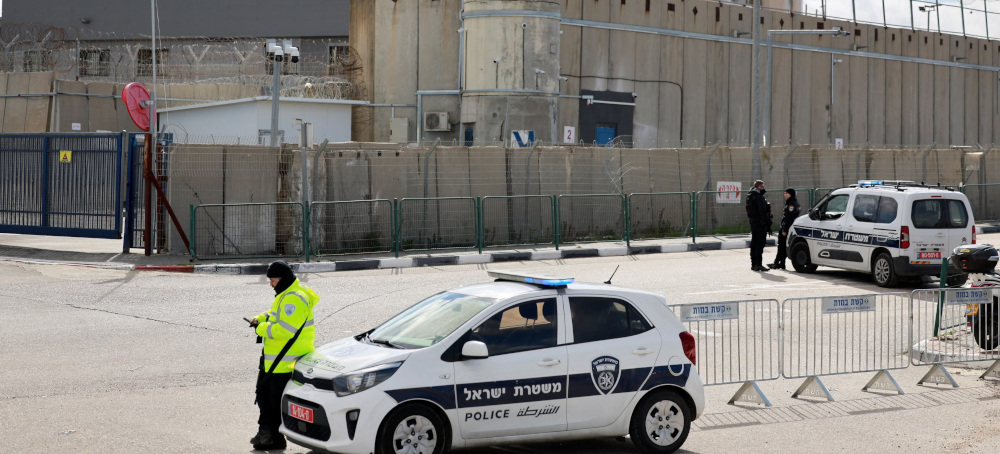 Israeli forces personnel outside Ofer military prison on the day Israel was expected to release Palestinian prisoners on 8 February this year. (photo: Ammar Awad/Reuters)
Elderly woman with Alzheimer’s, medical workers and children among 6,000 Palestinians held
Those jailed for long periods without charge or trial include medical workers, teachers, civil servants, media workers, writers, sick and disabled people and children.
Among the most egregious cases are those of an 82-year-old woman with Alzheimer’s jailed for six weeks and of a single mother separated from her young children. When the mother was released after 53 days she found the children begging on the streets.
The Sde Teiman military base at one point held so many sick, disabled and elderly Palestinians that they had their own hangar, dubbed “the geriatric pen”, a soldier serving there said.
The scale of civilian detention indicated by Israel’s own data has been revealed in an investigation by the Guardian, the Israeli-Palestinian publication +972 Magazine and the Hebrew-language outlet Local Call.
Israeli military intelligence keeps a database of more than 47,000 named individuals whom it classifies as Hamas and Palestinian Islamic Jihad fighters.
Commanders consider it the most accurate information Israel has on enemy forces, according to multiple intelligence sources. It is based on information including files captured from Hamas, updated regularly and includes names of new recruits.
In May this year the database listed 1,450 individuals in detention, whose files were marked “arrested”. That is equivalent to just one in four of all Palestinians from Gaza held in Israeli jails on suspicion of militant links since 7 October 2023.
At that point in May Israel had detained 6,000 people under its “unlawful combatants” legislation, which allows indefinite imprisonment without charge or trial, official data released after legal appeals showed.
Israel is also holding up to 300 Palestinians from Gaza suspected of taking part in the 7 October attacks. They are in criminal detention because Israel says it has sufficient evidence to prosecute them, although no trials have been held.
Both rights groups and Israeli soldiers have described an even smaller ratio of fighters to civilians. When photos of Palestinians stripped and shackled caused international outrage in late 2023, senior officers told Haaretz newspaper that “85 to 90 per cent” were not Hamas members.
The Gaza-based Al Mezan Center for Human Rights has represented hundreds of civilians held in Israeli jails. “We believe the proportion of civilians among those detained is even higher than Israel’s own figures suggest,” said Samir Zaqout, Mezan’s deputy director.
“At most, perhaps one in six or seven might have any link to Hamas or other militant factions, and even then, not necessarily through their military wings.”
Israel’s military said it had returned more than 2,000 civilian detainees to Gaza after finding no connection to militant activity. Israel was fighting enemies who “disguise themselves as civilians”, but those releases demonstrated “a thorough review process” for detentions, the military said in a statement.
It did not dispute the existence of the database or the figures for May, but claimed that “most” detainees were “involved in terrorist activities”.
In May 2,750 Palestinians were permanently interned as unlawful combatants, and another 1,050 had been released under ceasefire deals, the military said.
Israeli politicians, the military and the media often refer to all detainees as “terrorists”.
That includes Fahamiya al-Khalidi, an 82-year-old with Alzheimer’s who was abducted with her female carer in Gaza City in December 2023, and held in Israel for six weeks under the unlawful combatant law, prison documentation shows.
She was disoriented, could not remember her age and thought she was still in Gaza, according to a military medic who treated her in Anatot detention centre after she injured herself on a fence.
“I remember her limping badly toward the clinic. And she’s classified as an unlawful combatant. The way that label is used is insane,” the medic said. Photographs confirm his presence at Anatot at the time.
The Israeli military said Khalidi was targeted “based on specific intelligence concerning her personally”, but the arrest should not have gone ahead.
“The detention was not appropriate and was the result of a local, isolated error in judgment,” the military said, adding that “individuals with medical conditions or even disabilities can still be involved in terrorism”, citing Hamas’s former military chief Mohammed Deif.
Israel’s unlawful combatants legislation allows indefinite detention without producing evidence in open court.
The state can hold someone for 75 days before allowing access to a lawyer and 45 days before bringing them in front of a judge to authorise the detention. At the start of the war, those periods were extended to 180 and 75 days respectively. There have been no known trials of anyone captured in Gaza since 7 October 2023.
Tal Steiner, the director of the Public Committee Against Torture, said: “As soon as the wave of mass arrests began in Gaza in October 2023, there was serious concern that many uninvolved people were being detained without cause.
“This concern was confirmed when we learned that half of those arrested at the beginning of the war were eventually released, demonstrating that there had been no basis for their detention in the first place.”
State figures on the number of unlawful combatants were given to the group after it launched a lawsuit. One soldier who served at Sde Teiman military prison, which became notorious for abuse, described mass detentions of elderly and severely ill people.
“They brought men in wheelchairs, people without legs,” he said, adding these detainees were sent to a “geriatric pen”. “I always assumed the supposed excuse for arresting patients was that maybe they had seen the hostages or something.”
Hassan Jabareen, the director of the Palestinian legal rights group Adalah said Israel’s unlawful combatants legislation was “designed to facilitate the mass detention of civilians and enforced disappearances”.
“It strips detainees of protections guaranteed under international law, including safeguards specifically intended for civilians, using the ‘unlawful combatant’ label to justify the systematic denial of their rights.”
The military medic who treated Khalidi said he also treated a woman bleeding heavily after a miscarriage and a breastfeeding mother who had been separated from her baby and asked him for a pump to stop her breast milk from drying up.
Abeer Ghaban, 40, who was held with Khalidi inside Israel, was separated from her daughter aged 10, and two boys aged nine and seven, when she was detained at an Israeli checkpoint in December 2023.
Although officially still married, she was raising them alone, so when she was taken away the children were on their own.
She realised in interrogation that officers had confused her husband, a farmer, with a Hamas member of the same name. One conceded his error after comparing photographs, she said, but she was kept in jail for six more weeks.
Israeli troops deployed to guard Palestinians often opposed releasing civilians cleared of any Hamas links, an Israeli stationed at a military facility said. They wanted to hold them indefinitely as leverage in hostage negotiations.
“We kept releasing people ‘for free’, and it made [soldiers] angry,” the source said. “[The soldiers] would say: ‘They’re not returning hostages, so why should we let them go?’”
Israeli politicians have expressed similar sentiments.
When Mohammed Abu Salmiya, the director of Gaza’s Shifa hospital, was released last year, Simcha Rothman, chair of the Knesset’s constitution, law and justice committee, complained that he was freed “not in exchange for hostages”.
Rights groups suspect this approach has unofficially been a driver of mass detentions throughout the war. “Even before 7 October, Israel withheld the bodies of hundreds of Palestinians, using them as bargaining chips instead of returning them to their families for burial,” said a spokesperson for Al Mezan.
“We believe the thousands of civilians from Gaza now in detention are likewise intended to be used as bargaining chips.”
The majority of people held as unlawful combatants are also effectively kept incommunicado, deepening anguish for both those in jail and their loved ones in Gaza.
When Ghaban was released, she found her children begging in the street. “They were alive, but seeing the state they had been in for 53 days without me broke me,” she said. “I wished I had remained in prison rather than seeing them like that.”
The unlawful combatants legislation has been used to facilitate the “forced disappearance of hundreds and even thousands of people”, said Jessica Montell, the director of the legal rights organisation HaMoked.
Nesreen Deifallah spent months searching for her 16-year-old son, Moatasem, who went to look for food on 3 December 2024 and never came home, even checking decomposed corpses in hospital morgues in case she recognised his clothes.
In August a recently freed detainee told Deifallah he had been held with Moatasem. “I fainted when I learned that my son was still alive,” she said. Still she cannot confirm where he is, or contact Moatasem, who was sick, according to the man.
By August Israel’s prison service held a record 2,662 unlawful combatants, data obtained by HaMoked showed. An unknown number more are in military detention facilities.
One Israeli officer who led mass arrest operations in Khan Younis said soldiers saw no difference “between a terrorist who entered Israel on 7 October and someone working for the water authority in Khan Younis”.
Environmental Activists Decry Trump Border Wall’s Impact on Wildlife
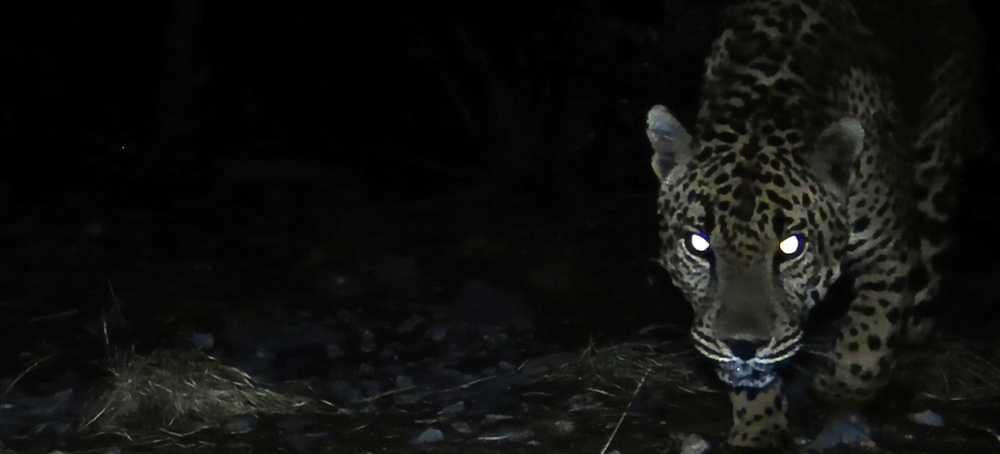 A field camera captures an endangered jaguar roaming in southern Arizona on Aug. 6. (photo: University of Arizona Wild Cat Research and Conservation Center)
Construction in Arizona’s San Rafael Valley grasslands will prevent cross-border movement of endangered jaguars and other animals.
The first of the steel bollards are expected to go up in late summer across a 24.7-mile stretch of the San Rafael Valley grasslands, halting cross-border movement of animals in an area of extreme biodiversity.
The wildlife includes bobcats, speedy pronghorn, pig-like javelina, gregarious Gambel’s quail and endangered jaguars such as the one that was detected on wildlife cameras six times in August at four different locations in southern Arizona.
“It’s super concerning that with the technology we have available today we are using a type of border security that is so detrimental to wildlife,” said Susan Malusa, a Catholic biogeographer who heads the University of Arizona’s nonprofit Wild Cat Research and Conservation Center that detected the jaguar earlier this month.
“We have deep social responsibilities not to use and lose our Earth,” said Malusa, who also holds a master’s degree in theology. “This is not only a Catholic idea. We do not get to judge what can be expendable as a species.”
American bishops along the U.S.-Mexico border spoke out in February 2019 against President Donald Trump’s declaration of a national emergency so he could order construction of a barrier in the remaining gaps along the border.
They called the additional barrier “a symbol of division and animosity between two friendly countries” and said they would “destroy parts of the environment, disrupt the livelihoods of ranchers and farmers, weaken cooperation and commerce between border communities.”
The statement echoed an urgent call to care for the Earth expressed by Pope Francis a decade ago in his encyclical “Laudato Si’, on Care for Our Common Home.”
“In assessing the environmental impact of any project, concern is usually shown for its effects on soil, water and air, yet few careful studies are made of its impact on biodiversity, as if the loss of species or animals and plant groups were of little importance,” says the encyclical’s section on biodiversity.
It adds: “Highways, new plantations, the fencing-off of certain areas, the damming of water sources, and similar developments, crowd out natural habitats and, at times, break them up in such a way that animal populations can no longer migrate or roam freely. As a result, some species face extinction.”
Franciscan Sr. Joan Brown, who is deeply familiar with environmental issues in the U.S. Southwest, said that the wall construction project in southern Arizona “is so immoral,” especially in the face of climate change.
“We do not have a right to continue to act as God creating walls and borders that lead to death on migration routes that have existed for millennia,” said Brown, the former and founding director of New Mexico and El Paso Interfaith Power and Light.
The somewhat rare discovery Aug. 6 of an endangered jaguar roaming in southern Arizona shows the importance of open corridors for wildlife to roam freely to hunt and mate, said Malusa. A century ago, jaguars traveled as far north as the Grand Canyon, but most are now found in Mexico except for an occasional wandering male.
Malusa said that Jaguar No. 4 was detected on a camera by one of some 40 volunteer citizen-scientists who are critical to the research effort, which operates with grants and small donations. The field camera’s exact location has not been disclosed to protect the animal’s safety.
The nonprofit Sky Island Alliance says that its extensive wildlife camera monitoring in the valley has detected fewer than one person per camera every 10 months for the last five years. More than half of them were law enforcement agents, ranchers and people legally on federal lands for recreation.
Department of Homeland Security Secretary Kristi Noem in June announced the waiver of laws, including the National Environmental Policy Act, to expedite several wall construction projects along about 36 miles in New Mexico and Arizona, with the largest stretch in the San Rafael Valley.
The agency said then that the construction projects “are critical steps to secure the southern border and reinforce our commitment to border security” and would “ensure the expeditious construction of physical barriers and roads, by minimizing the risk of administrative delays.”
In response to a request by the National Catholic Reporter for further comment, U.S. Customs and Border Protection said in an Aug. 12 statement that it could not offer more specifics about what it refers to as the Tucson Sonoita Wall Project because of ongoing litigation.
The environmental groups Center for Biological Diversity and Conservation CATalyst have sued the administration to halt construction, saying that the government violated the constitution by waiving environmental laws without consulting Congress.
“The border wall will have irreparable impacts on the ecosystem that will be felt for generations,” said biologist Eamon Harrity, wildlife program manager for Sky Island Alliance, which strives to protect “sky islands,” which are isolated mountain ranges that rise out of the desert in Arizona and Mexico.
Far to the east near Arizona’s border with New Mexico, Sky Island Alliance is monitoring the long-term effects of one section of the wall erected during Trump’s first administration on the wildlife inside the San Bernardino National Wildlife Refuge. Fauna in the sensitive wetland include white-tailed deer, black bears, skunks, bats and badgers. There are also more than 300 bird species including various sandpipers, egrets, hawks, bald eagles, elf owls and yellow-billed cuckoos.
The potential effects of the construction on area water are also of concern.
Ross Humphreys, who raises award-winning Angus cattle on his sprawling San Rafael Ranch near the border worries that the millions of gallons of water needed for cement to affix the bollards into deep ditches will further draw down aquifers in a drought-plagued area.
“They’ll be drilling ungodly amounts of water,” said Humphreys. “But I’ve had my head down. I’m just a rancher trying to raise my cattle and take it to market.”
Biologist Myles Traphagen, borderlands coordinator for the nonprofit Wildlands Network, calls the valley “an ecological gem” and notes that it has been an important migration corridor for animals and humans going back millennia.
From nearby Montezuma Peak at the Coronado National Memorial, visitors can see the expansive valley where Spanish conquistador Francisco Vázquez de Coronado led an expedition of Europeans into what later became the United States.
Traphagen hopes federal officials will consider his group’s recommendation to create openings of 8 x 11 inches in the wall to allow smaller wildlife to pass and include flood gates that can be kept open for larger mammals.
“We can only make recommendations,” said Traphagen. “It will fall to what they decide to do during construction, and the sector chiefs.”
PO Box 2043 / Citrus Heights, CA 95611


No comments:
Post a Comment
Note: Only a member of this blog may post a comment.