"If Donald Trump won’t dig us out of this hole, Congress must step into the breach and exercise its constitutional authority over matters of war and peace," the minority leader said. |
|
For the fifth time since President Donald Trump launched the Iran War in February, US senators on Wednesday voted down a resolution that would have blocked Trump from continuing his joint assault with Israel on the Mideast nation.
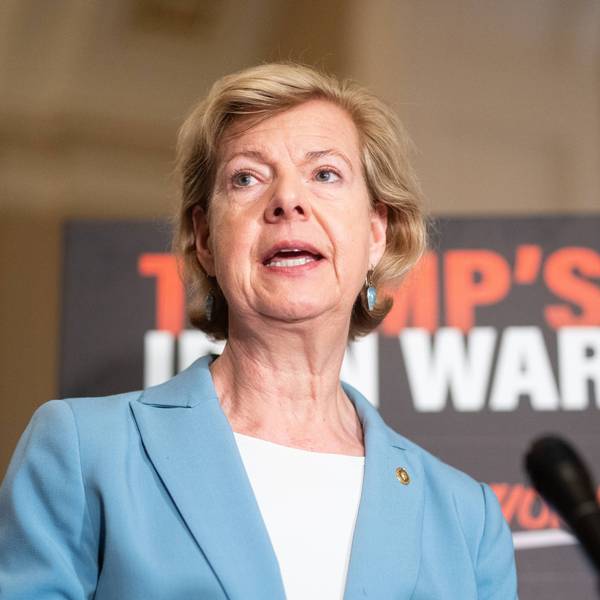
Upper chamber lawmakers voted 51-46 against SJ Res. 114, Sen. Tammy Baldwin’s (D-Wis.) war powers resolution. Kentucky Republican Rand Paul joined Democrats in voting for the resolution, while John Fetterman of Pennsylvania was the only Democrat to oppose it. Three senators—Chuck Grassley (R-Neb.), Dave McCormick (R-Pa.), and Mark Warner (D-Va.)—did not vote.
Wednesday’s vote marked the fifth time that an Iran war powers resolution has failed to pass the Senate this year. On March 4, Fetterman helped upper chamber Republicans sink one such measure introduced by Paul and Sen. Tim Kaine (D-Va.). Two weeks later, senators came within three votes of passing a similar resolution introduced by Sen. Cory Booker (D-NJ), a rejection repeated days later in a follow-up vote. Last week, Fetterman again crossed the aisle to help defeat a fourth resolution introduced by disabled combat veteran Tammy Duckworth (D-Ill.).
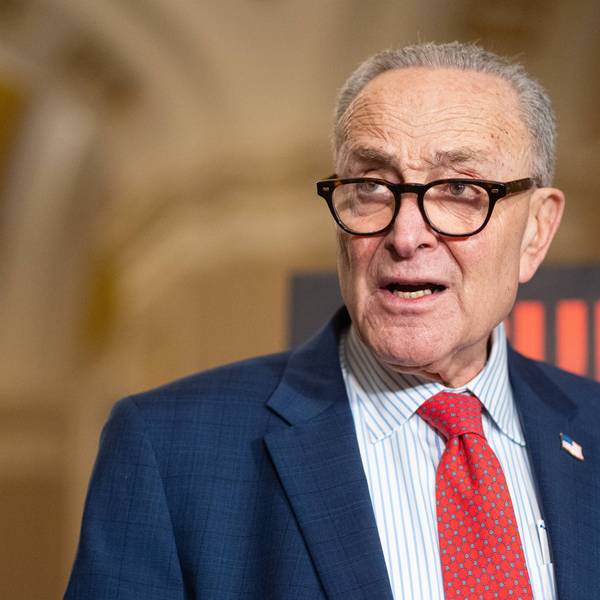
In remarks delivered on the Senate floor before Wednesday’s vote, Minority Leader Chuck Schumer (D-NY) said: “Every day, we hear new promises from the Trump administration that victory has been achieved, that peace is at hand, that costs are starting to come down. And every day, we see the opposite. Trump can talk all he wants, but nothing will change until he realizes that this war needs to end.”
“And if Donald Trump won’t dig us out of this hole, Congress must step into the breach and exercise its constitutional authority over matters of war and peace,” Schumer added. “Democrats will continue to force votes on our resolutions every week until Senate Republicans see reason.”
On Tuesday, Rep. Ro Khanna (D-Calif.) introduced a fresh Iran war powers resolution, reportedly in coordination with the Congressional Progressive Caucus. Khanna and Rep. Thomas Massie (R-Ky.) previously introduced the first of three failed Iran war powers resolutions in the lower chamber.
Responding to Wednesday’s vote, Fetterman told Fox News host Sean Hannity that “Iran must be so excited by the American media and the Democratic Party,” adding that Iranian leaders must be thinking, “as long as we can hang on... more and more people [will] continue to vote against the Trump administration.”
As US and Israeli attacks on Iran—which have left more than 30,000 people dead or wounded, according to Iranian and international officials—are paused for a truce extension pending the outcome of negotiations, the Trump administration announced Wednesday that US Navy Secretary John Phelan is resigning “effective immediately.” The administration gave no reason for the move.
PLEASE KEEP SPEAKING OUT AND INFORMING YOUR ELECTED OFFICIALS
OF YOUR OPPOSITION! THEY NEED TO HEAR YOUR OPPOSITION TO THIS
OUTRAGEOOUS PROPOSAL!
"At a time when we should be strengthening protections for species," said one advocate, "not weakening them, it’s clear there is growing opposition to efforts that put special interests ahead of science and conservation." |
|
Republican leadership in the US House of Representatives planned to mark Earth Day with a “catastrophic” attack on the Endangered Species Act, but ultimately canceled Wednesday’s vote at the last minute, a development celebrated by conservationists nationwide.
After reports of “problems” getting some Republicans to back the ESA Amendments Act and a procedural vote that “showed shaky support from party members,” as The New York Times put it, the House adjourned without a final vote on the bill—which the newspaper called “an embarrassing setback” for Speaker Mike Johnson (R-La.).
While the lead sponsor, House Committee on Natural Resources Chair Bruce Westerman (R-Ark.), claimed that “we just have a few provisions we’ve got to work through on it, and hopefully in the next couple of weeks, we’ll be able to vote on it,” Stephanie Kurose, deputy director of government affairs at the Center for Biological Diversity, said that “this should be a wake-up call to Rep. Westerman that not even his own colleagues support his extreme attacks on wildlife.”
“It’s time for him to drop this failed crusade,” Kurose declared. “Good riddance.”
Other wildlife defenders joined Kurose in enthusiastically welcoming the blow to what Bradley Williams, the Sierra Club’s deputy legislative director for wildlife and lands protection, called “extremely harmful legislation.”
“We are encouraged to see that the House of Representatives has pulled this bill after outcry from Republicans and Democrats,” Williams said in a statement. “By rejecting a bill that would have gutted protections for endangered and threatened species across the country, Congress is sending a clear message that protecting wildlife is a shared American value, not a partisan issue.”
Jewel Tomasula, policy director for the Endangered Species Coalition, which has hundreds of member organizations, said that “given the more than 58,000 emails sent to elected officials, along with hundreds—if not thousands—of calls made in just the past few days, it is clear that the American people support the Endangered Species Act, understand its value, and want its protections for threatened and endangered wildlife to remain in place.”
“This is a welcome sign that efforts to gut protections for imperiled species are not moving forward on Earth Day,” Tomasula continued. “We’re glad Congress is hearing their constituents’ concerns about Westerman’s harmful bill and taking pause to listen. For now, the important work to protect endangered species can continue. This Congress should leave the ESA alone.”
Sara Amundson, president of Humane World for Animals Action Fund, similarly said that “on Earth Day, pulling the House vote on the deeply flawed Endangered Species Act bill is a clarion call that legislators need to stop heeding their own leadership and start doing the will of their constituents.”
“At a time when we should be strengthening protections for species like grizzly bears and sea turtles, not weakening them, it’s clear there is growing opposition to efforts that put special interests ahead of science and conservation,” Amundson said. “We urge Congress to abandon this harmful proposal altogether and instead focus on upholding and strengthening the Endangered Species Act for future generations.”
“The decision to not advance the vote keeps current safeguards in place, which have protected 99% of species from extinction,” Beetham added. “While there is still much more work to secure lasting protections for wildlife, today’s outcome is a meaningful victory for conservation.”
"You can't just redefine how you calculate percentages," said one mathematician in response to Kennedy's claims.
US Health and Human Services Secretary Robert F. Kennedy Jr. on Wednesday tried to defend President Donald Trump’s mathematically absurd claims about prescription drug prices by saying the president has his own unique method of calculating percentages. During a Senate Finance Committee hearing, Sen. Elizabeth Warren (D-Mass.) grilled Kennedy about the president’s repeated false claims that he has slashed the prices of prescription drugs by as much as 600%, which would mean that pharmaceutical companies are paying consumers to take their medications.
“President Trump has his own way of calculating,” Kennedy replied. “There’s two ways of calculating percentages. If you have a $600 drug, and you reduce it to $10, that’s a 600% reduction.” In fact, such a drop in price would represent a 98.3% reduction, less than one-sixth the size of the president’s claims. A 600% reduction in the price of a $600 drug would mean that drug manufacturer paid consumers $3,000 every time they picked up their prescription. Kit Yates, a mathematician at the University of Bath, marveled at Kennedy’s attempts to create an alternate version of arithmetic. “We’ve known for a while that the USA’s current regime have been out for science, but I never thought they would try to mess with math!” Yates wrote in a social media post. “You can’t just redefine how you calculate percentages.” In addition to exposing Kennedy’s apparent ignorance of elementary mathematics, Warren shined a light on how the TrumpRx website misleads consumers into thinking they’re being offered bargains on prescription drugs that are available elsewhere in generic varieties. In once instance, Warren noted that TrumpRx is selling a brand-name heartburn medication for $200, whereas a generic version of the same drug is available at Costco for $16. Warren also highlighted a heart arrhythmia drug for sale on TrumpRx for $336, even though a generic version of the drug is available at Costco for $12. Warren added that, in exchange for making select brand-name drugs available on the TrumpRx website, pharmaceutical companies have gotten exemptions from the president’s 100% tariffs on imported patented medicines. “Think about that: Big Pharma makes billions of dollars in tariff relief by listing their drugs on TrumpRx, and then they don’t even lower the costs on many of these drugs,” she said. “That is a great deal for Big Pharma.” Warren’s analysis of TrumpRx’s pricing scheme echoes a March report from the Center for American Progress (CAP), which found that the president’s prescription drug website offered genuinely lower prices on “exactly one” of the 54 medications listed. CAP also found that nearly one-third of the drugs available on the TrumpRx website have generic alternatives that were cheaper than what was being offered, and that the website made no mention of this. Reuters reported in December that at least 350 branded medications are set for price hikes in 2026, including “vaccines against Covid, RSV, and shingles,” as well as the “blockbuster cancer treatment Ibrance.” Later in the Senate Finance Committee hearing, Sen. Bernie Sanders (I-Vt.) ridiculed Kennedy for claiming that, under Trump’s leadership, “the American people are now paying the lowest costs in the world rather than the highest for prescription drugs.” “That is an absurd statement,” Sanders said. “Nobody in the world believes that.” |
|
The head of the American Lung Association said President Donald Trump's Environmental Protection Agency has "rolled back rules that would have protected kids from power plant and vehicle pollution." |
|
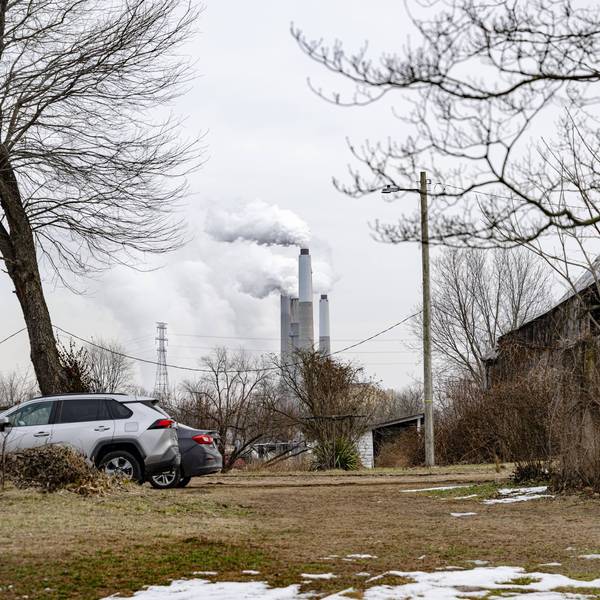
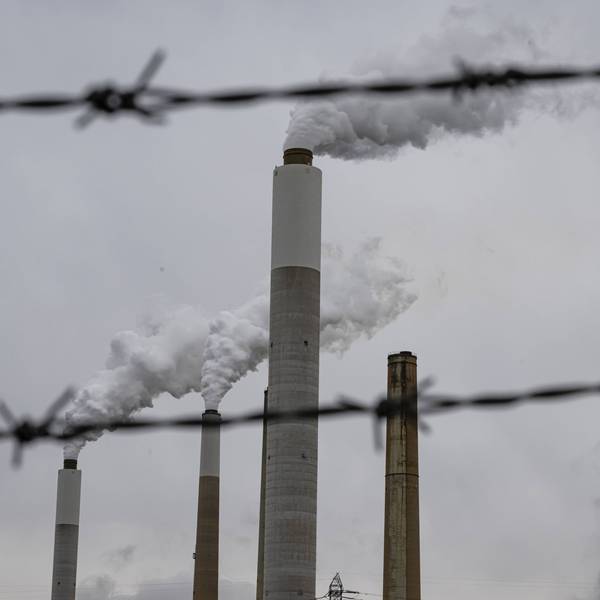
Close to half of the children in the United States—more than 33 million kids—live in counties with dangerously high levels of toxic air pollution, according to the American Lung Association’s annual air quality report out Wednesday.
The 27th iteration of the ALA’s report examines “two of the most widespread and dangerous air pollutants”—fine particles and ground-level ozone, commonly known as smog—and assigns grades to counties and cities based on pollution levels, both daily and annually. In what the report describes as a “grim indication of the deterioration of air quality nationwide,” just one city—Bangor, Maine—was “ranked on all three cleanest-cities lists by earning an ‘A’ for ozone and short-term particle pollution and being listed among the 25 cities with the lowest year-round particle levels.”
“Last year, there were two (the other metro area being San Juan-Bayamón, Puerto Rico),” the report notes. “Past reports have been graced by as many as half a dozen metro areas meeting these criteria.”
The report, which uses air quality data collected between 2022 and 2024, estimated that 46% of all children in the US live in counties that received a failing grade on at least one measure of air pollution analyzed by the ALA. More than 7 million children—10% of all kids in the country—live in an area with failing grades for all three of the ALA’s measures.
Harold Wimmer, president and CEO of the ALA, said at a time when the federal government should be strengthening air quality standards, President Donald Trump’s Environmental Protection Agency (EPA) “is doing the opposite,” despite Trump’s campaign promise to deliver “the cleanest air.”
“In the last year, EPA has weakened enforcement and rolled back rules that would have protected kids from power plant and vehicle pollution,” said Wimmer. “Children need clean air to grow and play, and communities need clean air to thrive. Leaders at every level must act to improve and protect America’s air quality.”
For the seventh consecutive year, Bakersfield, California ranked as the US metropolitan area with the worse year-round particle pollution. Fairbanks, Alaska ranked as the city with the worse short-term particle pollution, while Los Angeles topped the list of cities with the worst ozone pollution.
The Trump administration has gleefully taken an ax to climate regulations—including air pollution standards—and the legal finding underpinning environmental rules while aggressively promoting the oil, gas, and coal industries, threatening decades of progress toward cleaner air and water.
The Guardian noted Wednesday that “since returning to office last year, the Trump administration has initiated at least 70 actions to roll back environmental and climate protections. Among them is the loosening of regulations on power plants that limit mercury and other hazardous air toxins.”
“Other rollbacks include overturning limits on major air pollution sources, disbanding EPA advisory committees on air quality, and ending the practice of estimating the monetary value of lives saved by limiting fine particulate matter and ozone while still calculating costs to companies,” the outlet added.
Trump's Iran War has caused "a massive disruption in the supply chain of fertilizers," and "clearly we are seeing a crisis emerging" in the agricultural industry, said one UN expert. |
|

















No comments:
Post a Comment
Note: Only a member of this blog may post a comment.