
02 October 25

ALSO SEE: The Hartmann Report, Substack
When lies become policy and propaganda becomes identity, democracy itself is put at risk…
Although his position against the Civil Rights Act was reprehensible, I took Goldwater at his word that it was based on his concern about federal overreach and the 10th Amendment; having read both his books, I came to deeply respect his principled stands, even though I also deeply disagreed with most of them.
As most historians will confirm, Barry Goldwater believed what he said, and never, so far as I can find, knowingly lied to the American people.
That was my dad’s Republican Party. They’d spin or shade the truth, but rarely told what they knew were naked lies. And many among them deeply believed in the principles they espoused.
That party is dead.
Today’s Republican politician quite literally lies for a living, as you can see on any of the Sunday political shows or whenever a Republican is interviewed on CNN or Morning Joe. Consider just a handful of the pre- and post-Trump versions of the GOP.
Before Trump, Republicans largely only shaded the truth:
- Ronald Reagan repeatedly claimed his tax cuts “paid for themselves,” a misleading but not entirely fabricated notion since some revenue returned via economic growth, though far less than claimed.
- George W. Bush’s administration asserted “we know” Iraq has WMDs. The statements danced on ambiguous intelligence, carefully presenting suspicions as certainties.
- Their “War on coal” job-loss talking points made blanket claims that EPA rules would “kill jobs” even though labor data and research consistently showed EPA regulations were a minor layoff driver relative to collapsing demand for coal in the face of a gas fracking boom.
- Reagan’s “Welfare queen” rhetoric was based on one egregious fraud case (Linda Taylor) but was then generalized to stigmatize all welfare recipients and wielded as a racialized caricature.
- Republican pitches for the Keystone XL pipeline claimed it would create “42,000 jobs,” but those were just short-term construction and support jobs; the long-run permanent jobs were only in the dozens.
- The Bush administration defined “torture” in legal terms that excluded waterboarding, technically denying “torture” while knowingly permitting harsh practices.
- Paul Ryan’s claims about Obama “raiding Medicare” to fund the ACA gracefully omitted that Obamacare’s cuts were to overpayments, not to benefits.
- Sarah Palin’s “death panels” warning about Obamacare referenced end-of-life planning provisions, not anything like “death panels,” but skirted the border of outright fabrication.
- GOP messaging around the Clinton tax hikes of the 1990s predicted economic downturns, assertions based on selective economic forecasting, not contrary evidence.
- Republican officials regularly portrayed the estate tax as a “death tax hitting family farms.” Cases of family farms being lost were extremely rare, but not fabricated entirely.
- President Bush’s “Mission Accomplished” banner described the end of major combat in Iraq, failing to clarify that significant fighting remained; it was misleading but not untrue.
- Claims that the Affordable Care Act was a “government takeover of healthcare” overstated federal involvement but weren’t outright invented; private insurance remained intact.
But then Trump came into office and started lying on his very first day as president.
On January 20th and 21st of 2017, he claimed as many as 1.5 million people attended his inauguration, far above all official estimates; lied that it never rained during his speech, though weather reports and visual evidence proved otherwise; accused journalists of deliberately misreporting on crowd size “to sow discord,” suggested a rift with the intelligence community that was not supported by evidence; and, most disgustingly, at the CIA HQ lied about disagreements with the intelligence agencies and the number of times he had appeared on magazine covers.
As The Washington Post documented, during his first four years in office Donald Trump told 30,573 verified lies, a record he’ll probably easily beat in his second term. And Republicans in Congress clearly got the memo: lying was to be the GOP’s new political strategy.
Consider their record with these Post-2016 direct, easily disprovable lies:
- Trump and top Republicans lied that millions of illegal immigrants voted in the 2016 election even though there’s not a shred of evidence to supports the claim.
- Lies that Democrats want to “open borders” and “abolish ICE” are utterly false but have become standard Republican Party rhetoric.
- Lying that Biden had hired 87,000 “new IRS agents to harass you.” (This lie was often told using the phrase “jackbooted thugs,” compounding the damage to the agency.)
- Trump repeatedly lied that he “created the greatest economy ever,” contradicting all metrics.
- To this day they lie that the 2020 election was “stolen” from Trump, a story invented out of thin air and repeatedly disproven.
- Repeated lies — now being used to push back against the government shutdown — that Democrats want to “give a trillion dollars to illegal aliens for healthcare” was invented without referencing a single actual legislative proposal or law.
- Lies of “total exoneration” by Mueller’s probe of Trump’s many connections to Russia are easily contradicted by simply reading the actual contents of the report.
- Stating that windmills cause cancer and kill birds, coal is “clean,” and climate change is a “hoax” are all baseless lies presented as facts during speeches including Trump’s at the UN.
- Lying that COVID-19 was “totally under control” at the start of 2020, leading to the unnecessary deaths of a half-million Americans, despite internal warnings and contrary facts.
- Lying that they “passed the Veterans Choice” law when it was enacted under Obama, not Trump.
- Insisting Mexico would pay for the border wall when they knew full well that Mexico never agreed nor would pay a single penny.
- Trump, Republicans, and Fox “News” personalities repeatedly lied that “Dominion voting machines switched votes,” knowing there was no evidence; Fox hosts internally acknowledged the lies and it cost the company hundreds of millions.
- They repeatedly lied that “China pays the tariffs” when anybody paying attention knew import tariffs are always paid by Americans and American companies.
For reasons unknown, our mainstream media is allergic to using the words “lie,” “lies,” and “lied.”
They overlook the fact that telling lies is a classic fascist strategy to so confound the public that it becomes impossible to know what’s real and what’s not, causing people to check out of following politics or challenging them.
They also overlook the fact that the last time Democrats engaged in systematic lying was when LBJ got us into the Vietnam War. That burned the party badly, and they’ve largely kept to the truth ever since.
That’s not to say Democrats are perfect, blameless, or the solution to all our nations problems. But at the moment, they’re what we have. We need to push them hard.
Nonetheless, like the media, Democratic politicians until recently have kept talking about how their “friends on the other side of the aisle” are engaging in “falsehoods,” “deceptions,” or “misinformation.”
Yesterday, Senate Minority Leader Chuck Schumer broke with that tradition, telling Joe Scarborough that Trump, Vance, Johnson, and other Republican politicians were “telling an effing lie” when they said Democrats were filibustering the Continuing Resolution to keep the government open because Dems were demanding “trillions for healthcare for illegal aliens.”
Bravo, Chuck. Hopefully it’s the beginning of a trend.
Not only that, Republicans could pass their continuing resolution through the Senate and reopen the government today without a single Democratic vote; all they need to break the Democratic filibuster is 50 votes to change the Senate rules, which they have, and they’ve used that process to break filibusters and install judges (both Supreme Court and lower) and executive branch appointments in the recent past.
They’re pretending to be helpless because they think this shutdown theater will help them and gives them a great excuse to eviscerate our government.
It’s way past time that Democrats, our news media, and the rest of us start telling the truth about the nearly-continuous firehose of modern Republican lies.
Hundreds of Celebrities Relaunch a McCarthy-Era Committee to Defend Free Speech
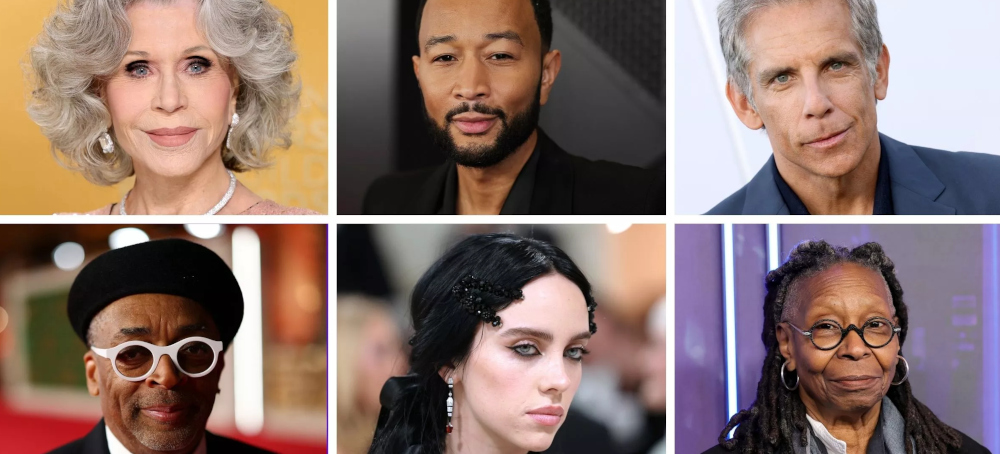 Clockwise from top left: Jane Fonda, John Legend, Ben Stiller, Whoopi Goldberg, Billie Eilish, and Spike Lee. Led by Fonda, hundreds of celebrities have signed on to a letter in defense of free speech and free expression, re-launching a McCarthy-era committee. (photo: Getty)
The current group is headlined by actor and activist Jane Fonda — whose father, actor Henry Fonda, was one of the early members of the first Committee for the First Amendment, which was founded in the 1940s to oppose the infamous House Un-American Activities Committee, through which the federal government accused many top entertainers of being communists or communist sympathizers and derailed their careers.
Other members of the newly re-formed committee include filmmakers Spike Lee, Barry Jenkins, J.J. Abrams, Patty Jenkins, Aaron Sorkin and Judd Apatow; TV show creator Quinta Brunson; musicians Barbra Streisand, John Legend, Janelle Monáe, Gracie Abrams and Billie Eilish; comedians Tiffany Haddish and Nikki Glaser; as well as actors Mark Ruffalo, Anne Hathaway, Kerry Washington, Pedro Pascal, Natalie Portman, Viola Davis and Ben Stiller. Another signatory is actor Fran Drescher, who last month ended a term as the president of the SAG-AFTRA union, whose membership includes NPR's journalists.
In the letter, the authors write: "This Committee was initially created during the McCarthy Era, a dark time when the federal government repressed and persecuted American citizens for their political beliefs. They targeted elected officials, government employees, academics, and artists. They were blacklisted, harassed, silenced, and even imprisoned. The McCarthy Era ended when Americans from across the political spectrum finally came together and stood up for the principles in the Constitution against the forces of repression."
"Those forces have returned. And it is our turn to stand together in defense of our constitutional rights," the letter continues. The group says that defending free speech and free expression is not a partisan issue.
In a letter inviting her peers to join the re-established group, Fonda writes: "I'm 87 years old. I've seen war, repression, protest, and backlash. I've been celebrated, and I've been branded an enemy of the state. But I can tell you this: this is the most frightening moment of my life. When I feel scared, I look to history. I wish there were a secret playbook with all the answers — but there never has been. The only thing that has ever worked — time and time again — is solidarity: binding together, finding bravery in numbers too big to ignore, and standing up for one another."
In Iowa, a Sleepy City Is Moved to Protest for a Beloved Superintendent Detained by ICE
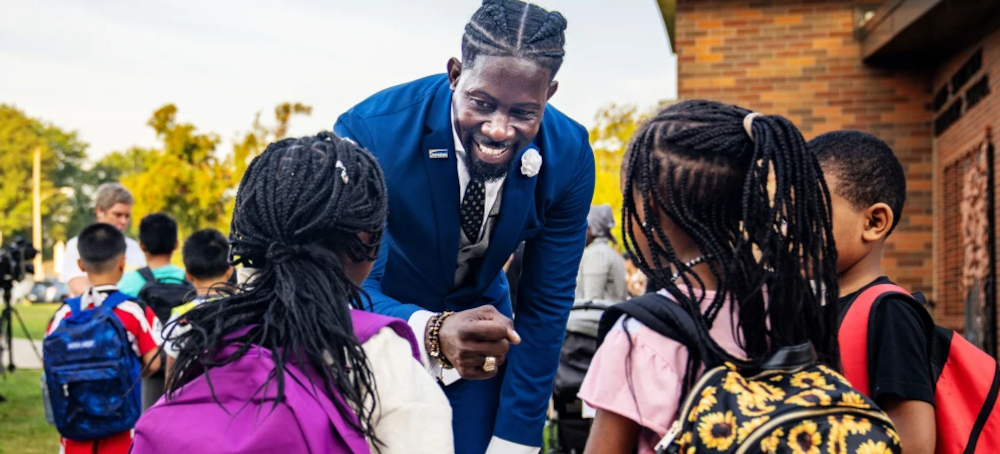 Former Des Moines Public Schools Superintendent Ian Roberts was deeply enmeshed in the community. (photo: USA Today Network)
Despite questions swirling around Ian Roberts, the demonstrations on his behalf continue.
In the afternoon, several dozen students gathered at the State Capitol, calling for Roberts’ release from the Sioux City jail where he’s being held, and holding signs reading “Radical Empathy,” a tagline he frequently used.
“I don’t think anyone really cares about the fact he’s illegal,” said Gabriel Doyle Scar, 17, who helped organize the protest. “We’re just sad about the fact that an extremely nice man that supported us heavily and really strongly is now taken away from us.”
During rush hour that night, roughly 20 people displayed a banner from a bridge over the interstate that cuts across the center of the city reading “Free Dr. Roberts,” as dozens of cars and large trucks honked in support as they passed underneath.
Roberts had been the superintendent of Des Moines Public Schools when ICE arrested him early Friday, accusing him of being in the country without authorization. ICE has said he tried to evade arrest and was found with a loaded gun in his district-issued car, a hunting knife and $3,000 in cash. At a news conference earlier this week, his lawyer, Alfredo Parrish, didn’t discuss those allegations. Through Parrish, Roberts submitted a letter of resignation Tuesday, writing that he didn’t want to be a distraction while he tried to stop his deportation.
But neither his resignation nor the unanswered questions about his case have quelled the protests in Des Moines, the left-leaning capital of a Republican-led state. Instead, Roberts’ arrest has sparked a moment of mass mobilization in a sleepy city where protests are relatively rare.
“It’s very unusual,” Dave Peterson, a political science professor at Iowa State University, said of the daily protests, adding that for many, Roberts’ detainment was the first major moment in which the recent wave of ICE arrests truly hit home.
“This is a moment where people can express support for somebody who they value, somebody who’s an important part of the community, and be protesting against what ICE is doing more broadly,” he said.
Makhani Scearcy, 20, a college student standing with classmates outside the capitol Tuesday, made a similar point. “Definitely people truly love Dr. Roberts,” she said, “but he’s just one puzzle piece of just how insane things have been.”
Republicans in Iowa have called for investigations of the district’s hiring practices. U.S. Rep. Zach Nunn, a Republican whose district includes Des Moines, said he is seeking further information from the Department of Homeland Security about the case, and he released a redacted excerpt of the May 2024 removal order for Roberts signed by a judge.
“Many of us in the community knew Dr. Roberts and trusted him, which makes it hurt even more that he spent so long providing us false information,” Nunn said this week on KCCI-TV of Des Moines.
Yet, in interviews with two dozen parents, colleagues and students this week, many expressed strong support for him, even as new questions about his background have trickled out.
“We were told by the current administration that they were going to get rid of people that didn’t belong here; that’s not what they’re doing,” said Justin Peters, a high school baseball coach in the district. “They’re getting rid of high-class people that are part of our community.”
Roberts, a former Olympian from Guyana, worked his way up in leadership for school districts across the country, from Washington, D.C., to California. After Des Moines hired him in 2023, he became a fixture at community events, nearly always dressed in flashy suits with sneakers, and the first person of color to lead the state’s most diverse district. He was arrested hours before he was scheduled to participate in a “fun run” with second graders in his district.
School district staff members at the protests recalled Roberts’ coming to read to children for hours, visiting classrooms, helping students with scavenger hunts and marching in parades with them.
“My kindergartner knows his superintendent,” said Amber Graeber, a Des Moines parent and teacher. “I don’t think very many kids can say that.”
On Friday evening, more than 400 people packed into Corinthians Baptist Church on the edge of downtown Des Moines, spilling into the hallway and the kitchen.
On Sunday, the Rev. Jonathan Whitfield, the church’s senior pastor, addressed the situation during his service, defending Roberts as someone who “left a legacy of goodness” in every education job he had.
Roughly 100 protesters held another demonstration outside the federal building Monday afternoon. It was the day the Iowa Board of Educational Examiners revoked his license and legal authority to serve as superintendent.
ICE said in a statement that Roberts arrived on a student visa in 1999, but according to Coppin State University in Baltimore, he graduated from there in 1998 and competed in NCAA track competitions even earlier. Roberts “was a standout scholar and athlete during his undergraduate studies,” Coppin State President Anthony L. Jenkins said in a statement.
Roberts has said he attended six other universities in some capacity: the Massachusetts Institute of Technology, Georgetown University, Morgan State University, St. John’s University, Harvard’s Graduate School of Education and Trident University International, an online school. St. John’s confirmed he earned a master’s degree in social studies from the institution in 2000. Morgan State said he attended as a graduate student for five years but didn’t earn a degree from it. And MIT said it had no record of Roberts’ having attended. The others didn’t respond to requests for comment.
According to the school district, Roberts had provided a résumé to the search firm that recruited him falsely stating that he had earned a doctorate from Morgan State, but the firm had him correct it before it submitted it to the Des Moines School Board. The district said it was aware he didn’t finish his doctorate at Morgan State.
"The Des Moines School Board is also a victim of deception by Dr. Roberts, one on a growing list that includes our students and teachers, our parents and community, our elected officials and Iowa’s Board of Educational Examiners, and others,” Jackie Norris, the school board chair, said in a statement Wednesday.
Roberts had indicated on his I-9 form that he was a citizen when he was hired two years ago, and he provided a driver’s license and a Social Security card as proof, district officials said. The district has said it was unaware that Roberts received a final order of removal last year, and it said DHS provided a copy Monday afternoon.
Parrish, Roberts’ attorney, declined to say Tuesday when Roberts first came to the United States and under what status or what his legal clearance to work in the country was when he was hired by Des Moines Public Schools. He couldn’t be reached for further comment.
Parrish provided reporters with a copy of a letter to Roberts from Jackeline Gonzalez, a Texas-based immigration attorney, dated March 27, 2025, that stated his immigration case had “reached a successful resolution.” In response to an email, Gonzalez said she was unable to provide information.
Whatever happens next, Roberts’ arrest has shaken up the city, said Mike Draper, founder and owner of Raygun, a popular local clothing chain known for political and Midwest-themed apparel. He began selling shirts reading “Free Dr Roberts” and “ICE Abducted Our School’s Superintendent,” and he plans to donate proceeds toward Roberts’ legal defense.
“It takes a lot to get a protest going in Des Moines,” Draper said. “So when I saw how many people were down there and how loud everything was and how fired up people were, it kind of blew my mind.”
Stephen King Is the Most Banned Author in US Schools, According to Report
 During the 2024-2025 school year, there were more then 6,800 instances of books being pulled, led by the horror author. (photo: AP)
During the 2024-2025 school year, there were more then 6,800 instances of books being pulled, led by the horror author
PEN America’s Banned in the USA, released on Wednesday, tracks more than 6,800 instances of books being temporarily or permanently pulled for the 2024-2025 school year. The new number is down from more than 10,000 in 2023-24, but still far above the levels of a few years ago, when PEN didn’t even see the need to compile a report.
Some 80% of those bans originated in just three states that have enacted or attempted to enact laws calling for removal of books deemed objectionable: Florida, Texas and Tennessee. Meanwhile, PEN found little or no instances of removals in several other states, with Illinois, Maryland and New Jersey among those with laws that limit the authority of school and public libraries to pull books.
“It is increasingly a story of two countries,” says Kasey Meehan, director of PEN’s Freedom to Read program and an author of Wednesday’s report. “And it’s not just a story of red states and blue states. In Florida, not all of the school districts responded to the calls for banning books. You can find differences from county to county.”
King’s books were censored 206 times, according to PEN, with Carrie and The Stand among the 87 works of his affected. The most banned work of any author was Anthony Burgess’s dystopian classic from the 1960s, A Clockwork Orange, for which PEN found 23 removals. Other books and authors facing extensive restrictions included Patricia McCormick’s Sold, Judy Blume’s Forever and Jennifer Niven’s Breathless, and numerous works by Sarah J Maas and Jodi Picoult.
Reasons often cited for pulling a book include LGBTQ+ themes, depictions of race, and passages with violence and sexual violence. An ongoing trend that PEN finds has only intensified: thousands of books were taken off shelves in anticipation of community, political or legal pressure rather than in response to a direct threat.
“This functions as a form of ‘obeying in advance’,” the report reads, “rooted in fear or simply a desire to avoid topics that might be deemed controversial.”
The PEN report comes amid ongoing censorship efforts not just from states and conservative activists, but from the federal government. The Department of Education ended an initiative by the Biden administration to investigate the legality of bans and has called the whole issue a “hoax”. PEN’s numbers include the Department of Defense’s removal of hundreds of books from K-12 school libraries for military families as part of an overall campaign against DEI initiatives and “un-American” thinking.
In Florida, where more than 2,000 books were banned or restricted, a handful of counties were responsible for many of the King removals: dozens were pulled last year as a part of a review of whether they were in compliance with state laws.
“His books are often removed from shelves when ‘adult’ titles or books with ‘sex content’ are targeted for removal – these prohibitions overwhelmingly ban LGBTQ+ content and books on race, racism and people of color – but also affect titles like Stephen King’s books,” Meehan says. “Some districts – in being overly cautious or fearful of punishment – will sweep so wide they end up removing Stephen King from access, too.”
PEN’s methodology differs from that of the American Library Association (ALA), which also issues annual reports on bans and challenges. PEN’s numbers are much higher in part because the free-expression organization counts any books removed or restricted for any length of time, while the ALA only counts permanent removals or restrictions.
Both organizations have acknowledged that because they largely rely on media reports and information that they receive directly, their numbers are far from comprehensive. Stephana Ferrell, director of research and insight at the Florida Freedom to Read Project, wrote in an email this week that total bans are “likely much higher” than in PEN’s snapshot analysis, based on the project’s ongoing public records requests.
The PEN report includes no banning data from Ohio, Oklahoma, Arkansas and other red states because researchers could not find adequate documentation. Meehan adds that PEN also doesn’t know the full impact of statewide laws.
“It’s become harder and harder to quantify the scope of the book banning crisis,” Meehan says. “In a state where a banning law is passed, we don’t have the data to know whether every school in that state had the books affected. Our data is a snapshot. It’s what we were able to collect through what’s publicly reported or on websites or what journalists have uncovered.”
 An encampment of pro-Palestinian protesters on the campus of the University of California at Berkeley in 2024. (photo: The Washington Post)
A Tufts University graduate student was among those targeted after the Trump administration created a “tiger team” to investigate pro-Palestinian activists.
A federal trial that ended Tuesday revealed for the first time the story behind the images, showing how the government assigned a special team to target Ozturk and other pro-Palestinian activists, laying the groundwork for their highly unusual arrests.
Ozturk had committed no crime, yet her detention was a priority for the new Trump administration.
U.S. officials used the immigration system in unprecedented ways to covertly research and detain noncitizen students, relying on an investigative arm of the Department of Homeland Security whose work traditionally has focused on crimes such as drug smuggling and human trafficking.
On Tuesday, U.S. District Judge William Young in Boston ruled that the push to target Ozturk and other students was blatantly unconstitutional. The White House vowed to appeal the decision.
The bench trial — decided by a judge rather than a jury — generated thousands of pages of depositions, court transcripts and filings that provided a detailed picture of the machinery that led to the arrests.
Among the findings: White House Deputy Chief of Staff Stephen Miller, a top ally of President Donald Trump and architect of his mass deportation campaign, spoke with senior officials at the State Department and DHS more than a dozen times in March to discuss student visa revocations.
Homeland Security Investigations, an arm of U.S. Immigration and Customs Enforcement that investigates transnational crime, took the lead. HSI researched the protesters and referred dozens of cases to the State Department, sometimes citing an obscure statute for revoking visas. Then it carried out the arrests.
HSI analysts compiled more than 100 reports on protesters, a first, according to the official who oversaw the process. In at least two cases, including Ozturk’s, the HSI supervisory agents involved in the arrests sought additional legal guidance because they had never detained students whose immigration status had changed.
The effort to deport pro-Palestinian student activists represented the Trump administration’s first major challenge to free-speech norms in the United States, said Sen. Chris Van Hollen (D-Maryland), who has been one of the most outspoken critics of the detentions in Congress.
“This has been a wave that’s been building, and it really started with these students,” Van Hollen said in an interview. “Locking them up for speech was an early warning sign.”
Liz Huston, a White House spokeswoman, said in a statement Tuesday that Trump is “a staunch supporter and defender of First Amendment rights, but violent riots and student harassment are not protected speech.”
While Trump administration officials have repeatedly accused the students of being “terrorist sympathizers” and “Hamas supporters,” no evidence of any connection to violence or terrorism was presented at trial.
HSI arrested Ozturk because she co-wrote an op-ed with three other people in the Tufts University student newspaper more than a year earlier. The piece criticized the university’s unwillingness to divest from companies with ties to Israel.
While the Trump administration publicly accused Ozturk of engaging in activities “in support of Hamas,” an internal State Department memo noted that there was no evidence that Ozturk had engaged in any antisemitic activity or indicated any support for terrorism.
Ozturk was one of at least nine people the Trump administration sought to detain and deport in connection with their pro-Palestinian activism, nearly all of them students. She was held in an ICE detention center in Louisiana for about six weeks before a federal judge ordered her release on bail in May. The government is still trying to remove her from the country.
State Department spokesperson Tommy Pigott said the United States is "under no obligation to allow foreign aliens to come to our country, commit acts of anti-American, pro-terrorist, and antisemitic hate, or incite violence. We will continue to revoke the visas of those who put the safety of our citizens at risk.” DHS did not respond to a request for comment.
The reports
Earlier this year, Peter Hatch’s bosses came to him with an urgent new assignment. Hatch heads the intelligence unit at Homeland Security Investigations, overseeing hundreds of analysts who support DHS investigations into crimes such as drug smuggling, money laundering and terrorism.
Hatch testified in the federal trial that senior leadership at HSI directed him to develop reports on student protesters, looking for potential criminal activity and violations of immigration law and paying special attention to anything that could be considered “pro-Hamas.”
About 10 HSI analysts were diverted to a so-called “tiger team” devoted to the effort, including from units that normally focus on counterterrorism, counterintelligence and cybersecurity, Hatch said (tiger team is a common term referring to the speed and intensity of the project, he said, and was not intended to intimidate or be made public).
Before this year, Hatch had never been asked to prepare reports on protesters, he testified.
For this unusual assignment, one source above all was key: The team relied heavily on the website of Canary Mission, an opaque, anonymous pro-Israel group that says it documents individuals who “promote hatred of the USA, Israel and Jews,” focusing primarily on college campuses.
The website included profiles of people who allegedly participated in a wide range of protest activity against Israel, from organizing encampments to signing letters to writing op-eds, as in Ozturk’s case. The website contained more than 5,000 names, Hatch said.
Canary Mission did not respond to a request for comment.
The HSI tiger team ultimately generated between 100 to 200 reports on protesters, Hatch said, with many of the names coming from Canary Mission. Some came from Betar US, a militant Zionist organization that the Anti-Defamation League considers an extremist group. Several names also came directly from DHS leadership, Hatch said, as well as the office of White House border czar Tom Homan.
The White House showed keen interest in the process. John Armstrong, the senior consular official at the State Department, testified that he spoke with Miller more than a dozen times on conference calls that discussed student visa revocations.
The memo
In February, Ozturk called up a dear friend, full of fear and worry. Ozturk’s name had just appeared on the Canary Mission website. The profile pointed to the March 2024 op-ed she co-wrote and listed classes she was scheduled to teach on children and the media at Tufts.
In March, unbeknownst to Ozturk, an HSI analyst generated a report on her. It included the op-ed she co-wrote and the full Canary Mission profile, Hatch testified.
The report also included a November article about the Tufts chapter of Students for Justice in Palestine — a separate student group that had supported the positions of the op-ed — noting it had been suspended for calling for ‘student intifada’ and using images of weapons to promote a protest rally.
DHS sent a letter to the State Department concluding that Ozturk had been involved in associations “that may undermine U.S. foreign policy by creating a hostile environment for Jewish students and indicating support for a designated terrorist organization.”
However, an internal State Department memo contradicted that finding. DHS has not “provided any evidence showing that Ozturk has engaged in any antisemitic activity or made any public statements indicating support for a terrorist organization,” the memo said.
The memo went on to say DHS “implies a connection” between Ozturk and Tufts Students for Justice in Palestine. But it failed to show any link beyond the op-ed that was endorsed by several student groups, or that Ozturk was in any way involved in activities that led to the group’s suspension.
To deport Ozturk, the State Department could use an authority that allows it to revoke visas at its discretion, the memo concluded (in the cases of several other protesters it instead employed a little-known provision to remove them on foreign-policy grounds).
Armstrong, the senior consular official at the State Department, testified at trial in July that he revoked Ozturk’s visa because she was “against Tufts’ relationship with Israel” and “associated” with Tufts Students for Justice in Palestine.
Alexandra Conlon, a lawyer for the plaintiffs, drew Armstrong’s attention to the sentence in the memo saying there was no evidence Ozturk was involved in any of the activities of the suspended group. “I really don’t think she deserves to be besmirched further,” Conlon said.
The arrest
In March, Patrick Cunningham, the assistant special agent in charge of HSI’s Boston field office, received an instruction that he considered unusual, Cunningham told the court in July.
Cunningham had spent most of his career investigating drug smuggling and money laundering. Now he was being asked to oversee Ozturk’s arrest, which he understood to be a high priority. HSI headquarters in Washington “was inquiring about it,” Cunningham testified.
The arrest was abnormal on several levels. It was almost unheard of for students whose visas had been revoked to be arrested and sent to ICE detention, particularly in the absence of any criminal charges. What’s more, a different arm of ICE – Enforcement and Removal Operations, or ERO – has long had primary responsibility for detaining people who are in the country illegally.
Cunningham said that in his 17 years at HSI, he couldn’t recall another time when he had received a “top-down” instruction to surveil and arrest someone solely due to a visa revocation. So he reached out separately to an HSI lawyer “to ensure that we were on solid legal ground.”
Cunningham oversaw a team of agents that arrived in unmarked vehicles outside Ozturk’s apartment in Somerville, Massachusetts, on the afternoon of March 25.
The way the arrest unfolded startled even HSI veterans. “I’ve just never seen, on a student visa revocation, that level of force,” said Eric Balliet, who worked at the agency for 25 years before retiring in 2024. He said he had taken violent drug traffickers into custody with less overt intimidation and haste.
Cunningham testified that agents drove Ozturk to an ICE facility in Vermont. Early the following morning, Ozturk was flown to Louisiana, where she remained in an ICE detention center in Louisiana until May 9, when a federal judge ordered her released on bail.
In July, Ozturk published a lengthy first-person account of her time in ICE detention. She never imagined she would find herself a prominent prisoner, she said.
“I want to preserve this story in a time capsule,” Ozturk wrote. “… It could very well be your story too.”
11 Inspiring Jane Goodall Quotes About Our Planet’s Future
 Jane Goodall speaks at the Annual Meeting 2019 of the World Economic Forum in Davos, January 22, 2019. (photo: World Economic Forum)
—
Renowned zoologist and primatologist Jane Goodall, has died on Wednesday at the age of 91 of natural causes.
Dr. Goodall was world-renowned for her 65-year study of wild chimpanzees in Gombe, Tanzania. Later in life, however, she broadened her focus, becoming a global advocate for a range of crucial issues, including human rights, animal welfare, species and environmental protection.
“Jane was passionate about empowering young people to become involved in conservation and humanitarian projects and she led many educational initiatives focused on both wild and captive chimpanzees. She was always guided by her fascination with the mysteries of evolution, and her staunch belief in the fundamental need to respect all forms of life on Earth,” read a statement on the Jane Goodall Institute website.
Throughout her career, Goodall has published books, attended international conferences and talked to global leaders on this subject. Most importantly, she has inspired millions of people worldwide to take action and make our planet a better place.
Here are 10 powerful and inspiring Jane Goodall quotes.
On Destroying our Planet
1. “Someday we shall look back on this dark era of agriculture and shake our heads. How could we have ever believed that it was a good idea to grow our food with poisons?” – From the book Harvest for Hope: A Guide to Mindful Eating (2005)
2. “I’m 300 days a year on the road. I’m talking about what we’re doing to our planet, how we’re destroying the forests, we’re polluting the ocean and the air and the rivers, we are spraying poisonous chemicals on our food, with our pesticides and herbicides. I have to work with young people today so that we try and raise new generations to look after this poor old planet better than we have, before it’s too late.” – Dr. Goodall reflects on the documentary Jane (2017)
On Endangered Animal Species
3. “The least I can do is speak out for the hundreds of chimpanzees who, right now, sit hunched, miserable and without hope, staring out with dead eyes from their metal prisons. They cannot speak for themselves.” – From the book Jane Goodall: 40 Years at Gombe (1999)
4. “If we do not do something to help these creatures, we make a mockery of the whole concept of justice.”
5. “Surely we do not want to live in a world without the great apes, our closest living relatives in the animal kingdom? A world where we can no longer marvel at the magnificent flight of bald eagles or hear the howl of wolves under the moon? A world not enhanced by the sight of a grizzly bear and her cubs hunting for berries in the wilderness? What would our grandchildren think if these magical images were only to be found in books?” – Dr. Goodall’s statement in defense of the Endangered Species Act
6. “I’ve spent my life speaking out on behalf of animals. And there is one issue that stands out uniquely as one of the worst threats to their survival. The illegal wildlife trade… Without doing something today, we could face a world in which thousands and thousands of species go silent. Never to return. But there is something we can do today, and it will take all of us working together to make it possible.” – Jane Goodall introduces #4EverWild wildlife trafficking campaign
If you like these Jane Goodall quotes, you might also like: 7 Best Books by Jane Goodall on Nature and Primatology
On Changing the World
7. “You cannot get through a single day without having an impact on the world around you. What you do makes a difference, and you have to decide what kind of difference you want to make.”
8. “Change happens by listening and then starting a dialogue with the people who are doing something you don’t believe is right.”
9. “Only if we understand, can we care. Only if we care, we will help. Only if we help, we shall be saved”
10. “We can have a world of peace. We can move toward a world where we live in harmony with nature. Where we live in harmony with each other. No matter what nation we come from. No matter what our religion. No matter what our culture. This is where we’re moving towards.” – Dr. Goodall’s Message for Peace Day 2018
11. “I do believe there is a window of time when we can at least slow down climate change and loss of biodiversity. But only if we get together and take action now. And without hope we will fall into apathy and do nothing. Then we are doomed.” – Dr.Goodall’s 2025 Earth Day Message.
PO Box 2043 / Citrus Heights, CA 95611


No comments:
Post a Comment
Note: Only a member of this blog may post a comment.