Friday, August 29, 2025
■ Today's Top News
One critic said Texas Republicans' "reckless, partisan power grab will harm our democracy for years to come."
By Jessica Corbett
Democracy defenders on Friday blasted elected Texas Republicans, including Gov. Greg Abbott, after he signed a new congressional map gerrymandered for the GOP at the request of US President Donald Trump—and Missouri Gov. Mike Kehoe, for launching a copycat effort.
"Gov. Abbott would rather do Trump's dirty work than help the people of Texas," said Brett Edkins, managing director of policy and political affairs at the progressive advocacy group Stand Up America, in a statement.
"For months, he has ignored the real issues affecting Texans, including flood relief, and instead pandered to Trump's demand that he redraw Texas' political maps to rig the 2026 elections and silence communities of color," he continued. "Texas Republicans have started a nationwide redistricting arms race with no end in sight. Their reckless, partisan power grab will harm our democracy for years to come."
Abbott and state lawmakers have been open about aiming to help the GOP retain control of Congress during next year's midterm elections by passing their so-called "One Big Beautiful Map." The governor—who called two special legislative sessions to force through the bill—posted a video of himself signing it on social media and declared that "Texas will be more RED in Congress."
During the first legislative session, dozens of Democrats in the Texas House fled to blue states in a bid to block the map, but they ultimately returned to Austin. After GOP legislators passed the bill, the NAACP and the Lawyers Committee for Civil Rights Under Law filed a lawsuit over the map.
After the governor signed the bill on Friday, Texas Democratic Party Chair Kendall Scudder said in a statement that "with a stroke of the pen, Greg Abbott and the Republicans have effectively surrendered Texas to Washington, DC."
"They love to boast about how 'Texas Tough' they are, but when Donald Trump made one call, they bent over backwards to prioritize his politics over Texans. Honestly, it's pathetic," he said. "I am proud of the Texas Democrats in the House and Senate who chose to fight, whether by a constitutionally protected quorum break, questioning these mapmakers, trying to pass amendments, or even attempting to filibuster."
"This isn't over—we'll see these clowns in court," he pledged. "We aren't done fighting against these racially discriminatory maps, and fully expect the letter of the law to prevail over these sycophantic Republican politicians who think the rules don't apply to them."
The contested map makes five Texas districts for the US House of Representatives that are currently held by Democrats more favorable to Republicans.
While elected Democrats in states such as California have threatened to fight fire with fire and draw Republican congressional districts out of existence, GOP governors—under pressure from the president—have also moved to follow Texas' lead. For example, Missouri Gov. Mike Kehoe on Friday announced a special legislative session to pass his proposed "Missouri First Map."
Responding in a statement, Democratic National Committee (DNC) Chair Ken Martin said that "another Republican governor just caved to the demands of Donald Trump at the expense of Missouri families and American democracy. Time and time again, Missouri Gov. Mike Kehoe has undermined the voice of Missouri voters."
"Now he is attempting to dilute their power altogether by removing the ability of Missourians to stand up against this power grab," Martin continued. "Make no mistake: This all started because Trump and Republicans passed a historically unpopular budget bill that wrecks the working class to reward billionaires. Now, instead of facing the consequences of their votes, Republicans think they can just choose their voters—that's not how this works."
"As California has shown, Democrats are rising up to protect voters' sacred rights, and we're not pulling our punches," he added. "The DNC will stand with Democrats protecting the rights of all Americans as Donald Trump and spineless Republicans try to rig the game against the will of the people."
John Bisognano, president of the National Democratic Redistricting Committee, said that "over the past month, Missourians of all stripes, from proud union members to business leaders, have expressed their opposition to a mid-decade gerrymander, yet Missouri Republicans are choosing to take orders from Washington instead of their constituents."
"Republicans enacted the current congressional map in response to public pressure from Missouri voters," he said. "Their sudden reversal shows that their pursuit of a mid-decade gerrymander is nothing more than a power grab at the expense of the people. Heading into this special session, Missouri Republicans have a choice: They can listen to Missourians, who oppose a mid-decade gerrymander, or they can fold to Donald Trump's demands and face the same level of fierce resistance displayed in Texas."
"This is about workers showing up and demanding what workers deserve all across the country," said Randi Weingarten, president of the American Federation of Teachers.
By Stephen Prager
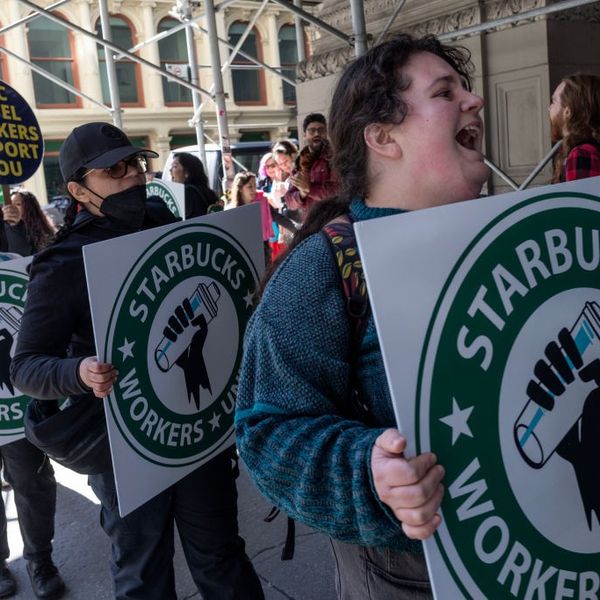
Unions and progressive organizations are planning nearly 1,000 "Workers Over Billionaires" demonstrations across the United States this Labor Day to protest President Donald Trump's assault on workers' rights.
The day of national action has been organized by the May Day Strong coalition, which includes labor organizations like the AFL-CIO, American Federation of Teachers, and National Union of Healthcare Workers, as well as advocacy groups like Americans for Tax Fairness, Indivisible, Our Revolution, and Public Citizen.
"Labor and community are planning more than a barbecue on Labor Day this year because we have to stop the billionaire takeover," the coalition says. "Billionaires are stealing from working families, destroying our democracy, and building private armies to attack our towns and cities."
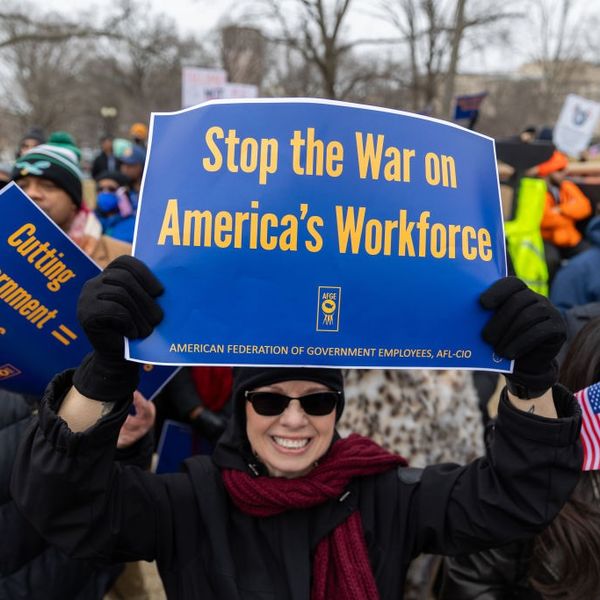
Since coming into office, the Trump administration has waged war on workers' rights. Among many other actions, his administration has stripped over a million federal workers of their right to collectively bargain in what has been called the largest act of union busting in American history and dramatically cut their wages.
He has also weakened workplace safety enforcement, eliminated rules that protected workers against wage theft, and proposed eliminating the federal minimum wage for more than 3.7 million childcare and home workers.
Despite Trump's efforts, Americans still believe in the power of collective action. According to a Gallup poll published Thursday, 68% of Americans say they approve of labor unions, the highest level of support since the mid-1960s.
"Just like any bad boss, the way we stop the takeover is with collective action," the coalition says on its website.
The May Day Strong coalition previously organized hundreds of thousands of workers to take to the streets for International Workers Day, more commonly known as "May Day." On Monday, rallies are once again expected across all 50 states.
Four months later, their list of grievances has grown even longer, with Republicans having since passed a tax cut expected to facilitate perhaps the largest upward transfer of wealth in US history, featuring massive tax breaks for the wealthy paid for with historic cuts to the social safety net.
"There are nearly 1,000 billionaires in the country with a whopping $6 trillion, and that is still not enough for them," said Saqib Bhattie, executive director of the Action Center on Race and the Economy, another group participating in the protests. "They are pushing elected officials to slash Medicaid, [Supplemental Nutrition Assistance Program] benefits, and special education funding for schools in order to fund their tax breaks. We need to claw back money from the billionaire. We need to push legislation to tax billionaires at the state and local levels. We need to organize to build the people power necessary to overcome their money."
The group also plans to respond to Trump's lawless attacks on immigrants and his militarized takeovers of American cities.
"This Labor Day," said Lisa Gilbert, co-president of Public Citizen, "we continue the fight for our democracy, the fight for the soul of our nation, the fight against the vindictive authoritarian moves Trump and the billionaire class aimed at stealing from working people and concentrating power."
"This is about workers showing up and demanding what workers deserve all across the country," said Randi Weingarten, president of the American Federation of Teachers. "This Labor Day is really different, because it's not just labor unions, as important as we may be to the workers we represent. It has to be all workers and all working families saying enough. Workers and working families deserve the bounty of the country."
May Day Strong will host a national "mass call" online on Saturday. The locations of the hundreds of protests on Monday can be found using the map on May Day Strong's website.
Social Security Administration chief data officer Charles Borges described "fear and anxiety over potential illegal actions resulting in the loss of citizen data" in his resignation letter.
By Brad Reed
A federal worker who filed a shock whistleblower report alleging that employees of the Department of Government Efficiency had potentially compromised Americans' Social Security data abruptly resigned on Friday.
In a letter obtained by independent journalist Melissa Kabas, Social Security Administration (SSA) chief data officer Charles Borges said that he was "involuntarily" stepping down from his position at the agency due to "serious... mental, physical, and emotional distress" caused in the wake of his whistleblower report.
Borges said that after filing his report with the help of the Government Accountability Project, he was subjected to "exclusion, isolation, internal strife, and a culture of fear" that created a hostile work environment and made "work conditions intolerable."
Borges then recounted that he filed the whistleblower report because he was concerned that Department of Government Efficiency (DOGE) employees had uploaded Americans' Social Security information onto a cloud server that he believed was vulnerable to external hackers.
"As these events unfolded, newly installed leadership in IT and executive offices created a culture of panic and dread, with minimal information sharing, frequent discussions on employee termination, and general organizational dysfunction," Borges claimed. "Executives and employees were afraid to share information or concerns on questionable activities for fear of retribution and termination."
Borges concluded by saying that the total lack of visibility into the actions of DOGE employees who were handling Americans' most sensitive data created a sense of "fear and anxiety over potential illegal actions resulting in the loss of citizen data."
The report, whose existence was made public earlier this week, contends that Borges has evidence of a wide array of wrongdoing by DOGE employees, including "apparent systemic data security violations, uninhibited administrative access to highly sensitive production environments, and potential violations of internal SSA security protocols and federal privacy laws by DOGE personnel."
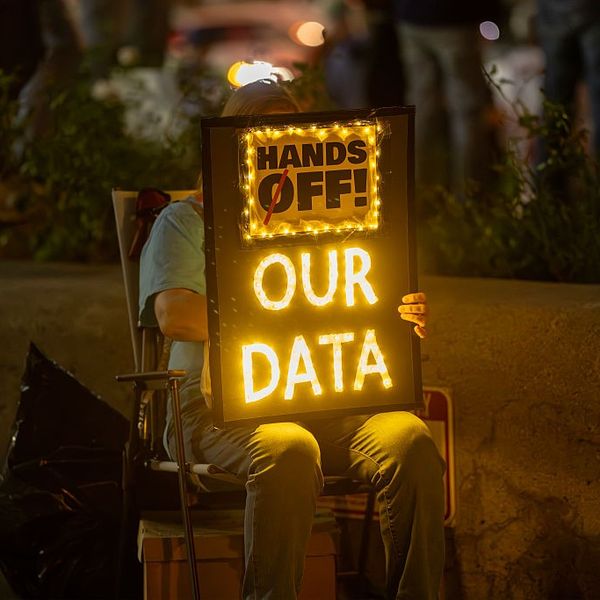
At the heart of Borges' complaint is an effort by DOGE employees to make "a live copy of the country's Social Security information in a cloud environment" that "apparently lacks any security oversight from SSA or tracking to determine who is accessing or has accessed the copy of this data."
Should hackers gain access to this copy of Social Security data, the report warns, it could result in identity theft on an unprecedented scale and lead to the loss of crucial food and healthcare benefits for millions of Americans. The report states that the government may also have to give every American a new Social Security number "at great cost."
"Confidence that the Fed will respond wisely to future periods of macroeconomic stress... will evaporate," warned one economist.
By Brad Reed
Economists are warning that US President Donald Trump's efforts to meddle with the Federal Reserve are going to wind up raising prices even further on working families.
Michael Madowitz, principal economist at the Roosevelt Institute, said on Wednesday that the president's efforts to strong-arm the US central bank into lowering interest rates by firing Federal Reserve Gov. Lisa Cook would backfire by accelerating inflation.
"The administration's efforts to politicize interest rates—an authoritarian tactic—will ultimately hurt American families by driving up costs," he said. "That helps explain why Fed independence has helped keep inflation under 3%, while, after years of political interference in their central bank, Turkey's inflation rate is over 33%."
Heidi Shierholz, the president of the Economic Policy Institute, said that the president's move to fire Cook "radically undermines what Trump says his own goal is: lowering U.S. interest rates to spur faster economic growth."
She then gave a detailed explanation for why Trump imposing his will on the Federal Reserve would likely bring economic pain.
"Presidential capture of the Fed would signal to decision-makers throughout the economy that interest rates will no longer be set on the basis of sound data or economic conditions—but instead on the whims of the president," she argued. "Confidence that the Fed will respond wisely to future periods of macroeconomic stress—either excess inflation or unemployment—will evaporate."
This lack of confidence, she continued, would manifest in investors in US Treasury bonds demanding higher premiums due to the higher risks they will feel they are taking when buying US debt, which would only further drive up the nation's borrowing costs.
"These higher long-term rates will ripple through the economy—making mortgages, auto loans, and credit card payments higher for working people—and require that rates be held higher for longer to tamp down any future outbreak of inflation," she said. "In the first hours after Trump's announcement, all of these worries seemed to be coming to pass."
Economist Paul Krugman, a former columnist for The New York Times, wrote on his personal Substack page Thursday that Trump's moves to take control of the Federal Reserve were "shocking and terrifying."
"Trump's campaign to take over monetary policy has shifted from a public pressure to personal intimidation of Fed officials: the attack on Cook signals that Trump and his people will try to ruin the life of anyone who stands in his way," he argued. "There is now a substantial chance that the Fed's independence, its ability to manage the nation's monetary policy on an objective, technocratic basis rather than as an instrument of the president's political interests and personal whims, will soon be gone."
The economists' warnings come as economic data released on Friday revealed that core inflation rose to 2.9% in August, which is the highest annual rate recorded since this past February. Earlier this month, the Producer Price Index, which is considered a leading indicator of future inflation, came in at 3.3%, which was significantly higher than economists' consensus estimate of 2.5%.
Data aggregated by polling analyst G. Elliott Morris shows that inflation is far and away Trump's biggest vulnerability, as American voters give him a net approval of -23% on that issue.
The administration, warned two union leaders, "is inserting private AI companies, which have a giant financial stake in the denial of care, into the doctor-patient relationship."
By Brad Reed
Creating what critics are equating to "AI death panels" elderly Americans in need of care, the Trump administration is launching a pilot program in six states that will use artificial intelligence to determine whether Medicare recipients should qualify for certain procedures.
As reported by The New York Times on Thursday, the pilot program will hire private firms to deploy AI to make what are known as "prior authorization" decisions regarding whether Medicare should pay for certain procedures, including spinal surgeries and steroid injections. The program is set to run first in Arizona, New Jersey, Ohio, Oklahoma, Texas, and Washington.
According to the paper, the program will rely on algorithms similar to those "used by insurers have been the subject of several high-profile lawsuits, which have asserted that the technology allowed the companies to swiftly deny large batches of claims and cut patients off from care in rehabilitation facilities."
The way the program is being structured will also give AI firms big incentives to maximize the denial of claims for Medicare recipients, as the Times reported that "Medicare plans to pay them a share of the savings generated from rejections."
Abe Sutton, the director of the Center for Medicare and Medicaid Innovation, emphasized in an interview with the Times that this program would not be used to review emergency services or hospital stays.
Even so, some experts and advocates have warned that this program risks bringing the same problems experienced by people who use private insurance to Medicare.
"It's basically the same set of financial incentives that has created issues in Medicare Advantage and drawn so much scrutiny," Ohio-based surgeon Dr. Vinay Rathi, who is also an expert in Medicare payment policies, explained to the Times. "It directly puts them at odds with the clinicians."
Jathan Sadowski, a senior lecturer and research fellow in the Emerging Technologies Research Lab at Monash University, also warned about private insurance practices creeping into traditional Medicare.
"The government is hiring companies using AI to make those determinations about healthcare," he wrote on X. "This is exactly the same tactic that private insurers like UnitedHealth use to delay and deny treatment."
The reported pilot program also drew harsh reviews from the American Federation of Teachers (AFT), as president Randi Weingarten and the union's Retirees Program and Policy Council co-chair Tom Murphy issued a joint statement accusing the Trump administration of "attempting to transform Medicare into the very worst of private insurance."
"Instead of making life easier and better for older Americans, this administration is introducing extra hurdles that are burdensome to patients and often get in the way of their desperately needed treatments," they said. "And the administration is inserting private AI companies, which have a giant financial stake in the denial of care, into the doctor-patient relationship."
"Working people want unions and the numbers prove it," says one labor leader. "While billionaires and their yes-men in Congress try to slash wages, gut health care, and silence working people, we are fighting back—organizing, mobilizing, and demanding a voice."
By Jon Queally
A new poll reveals that Americans continue to support organized labor at historic levels, even as the Trump administration and its Republican allies in Congress take a battering ram to union rights and the nation's working class.
Gallup's annual survey, released Thursday, shows more than two-thirds of people in the US (68%) approve of labor unions and the economic security and prosperity they provide working families. The popular support matches record-high numbers of recent years after a long decline from the 1960s through the early 2000s.
As Gallup notes:
When Gallup first measured Americans’ ratings of labor unions in 1936, 72% approved. Approval reached the record high, 75%, in 1953 and 1957 and ranged between 63% and 73% from 1958 through 1967. Then, from 1972 through 2016, approval was lower, with few readings over 60%, including the 48% all-time low recorded in 2009. This was the only time approval fell below the majority level. Since 2017, approval has been above 60%, the longest period at this level since the 1960s.
"Working people want unions and the numbers prove it," said Lee Saunders, president of the American Federation of State, County and Municipal Employees (AFSCME), in response to the latest polling.
The survey shows sharp partisan divides despite the overall approval of organized labor. While 90% of Democrats surveyed and 69% of independents voiced support, only 41% of Republicans expressed the same level of support for organized workers and their unions. "All party groups show increased support for unions compared with 2016," said Gallup, "though Republican support has declined since peaking at 56% in 2022. That was the only time Republicans’ approval has risen above 50% in the past 25 years."
"Instead of getting the respect they've earned, [working families are] getting squeezed by CEOs and anti-worker politicians who want to hand out tax breaks to the billionaire class at the expense of Medicaid, food assistance, worker protections and our communities."
Saunders, like other members of the labor movement, has been a steady voice in rebuking President Donald Trump and his Republican Party as they run roughshod over labor rights and wage a relentless war against the working class by attacking Medicaid, food assistance, public education, better wages, collective bargaining, and workplace safety—all while slashing regulatory safeguards designed to protect America's working families from industry greed and handing out massive tax breaks for billionaires and corporations.
"Gallup polling once again shows historically strong support, because workers understand that they have the power to win fair pay, safer working conditions, and dignity on the job when they organize a union. Today, that power matters more than ever," said Saunders. "While billionaires and their yes-men in Congress try to slash wages, gut health care, and silence working people, we are fighting back—organizing, mobilizing, and demanding a voice."
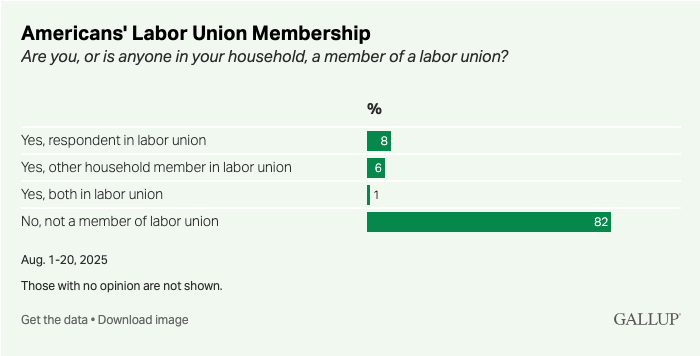
Despite the support of a large majority of Americans across the political spectrum, union density remains at historic lows, which makes sense given the hostility from both major parties to the needs of the working class and their fealty to represent the interests of big business over those of working families over the last five decades.
In his latest attack on the working class—and just ahead of the Labor Day weekend—Trump on Thursday issued a new executive order expanding his assault on the government agencies where federal employees would lose their collective bargaining rights.
Union members and labor experts immediately called the order unlawful—just like the original March order upon which it was based—and vowed to fight it tooth and nail in court.
"This is how President Trump is commemorating Labor Day: continuing his administration's all-out attack on workers and unions," said Liz Schuler, president of the AFL-CIO. "This new executive order once again distorts the law by ripping away the collective bargaining rights of federal workers in an attempt to silence their voices on the job."
"Issuing these executive orders just days before the holiday that honors everything working people have fought and died for—including our right to come together with our co-workers in a union and bargain for what we deserve—shows us that this administration's callous disregard for workers' rights knows no bounds," added Schuler. "No matter what it throws our way, the labor movement will never stop organizing and fighting for each other—and we'll see him in court."
AFSCME's Saunders, suggested the polling should serve to invigorate the labor movement, even at a time when corporate power's hold on the levers of power seems near complete.
"We know that working families are the backbone of our economy. But instead of getting the respect they've earned, they're getting squeezed by CEOs and anti-worker politicians who want to hand out tax breaks to the billionaire class at the expense of Medicaid, food assistance, worker protections and our communities," he said. "It is easy to see why trust in Congress and big corporations is hitting new lows, while support for unions remains strong."
Saunders added that his union's 1.4 million members are "proud to stand with every worker who is fighting back to demand dignity, fairness, and a voice on the job. Because when we stand together, we can defend our freedoms from billionaires who want to rob us of them."
Bemoaning how Republicans have been able to coopt the mantle of being the party of the working class, all while undermining wages, workplace safety, and the right to collectively bargain, Les Leopold, executive director of the Labor Institute, has been among those warning the Democratic Party that it must change direction, or die trying, if it wants to win back the working class.
As he wrote following Trump's 2024 reelection, "It's time to end this sad chapter in U.S. history when the Democratic Party leaders refuse to be genuine allies for workers and the Republican Party is rewarded for pretending to be."














No comments:
Post a Comment
Note: Only a member of this blog may post a comment.